Jev quoted attack context

Distinguish a quoted insult from a directed attack

Read the message and surrounding context under a narrow moderation rule. Separate reported or analyzed quotations from personal attacks and criticism of work, keeping unresolved attribution for review.

Is this an attack, a report or missing context?Live API
Try an example

Original synthetic input. Edit the task or evidence to make a new API request.

Source: Workflow inspiration on X

Source and example scope

The inputs, rubric and preview are original. This window demonstrates the stated decision only; it does not reproduce the source application or its measurements.

Read message and surroundingContext under this narrow rule.

Decision rules and labels
Directed insultReported quotationNeutral criticismNeed context
A real response from the Jev API

Edit any input to explore a different decision. No request is sent until you run it.

Your next decision

Not run yet

Choose an example or write your own input, then run it to see the ranked choices.

Results are not stored by this site. Your submitted text is processed by the API provider.

The decision

How does Jev quoted attack context use the supplied evidence?

Jev quoted attack context checks how insulting language is being used, rather than treating quotation marks as a pass. Jev distinguishes a directed insult, a clear report or analysis, criticism of work and a statement whose purpose is unavailable. Each result proposes a moderation review step.

A keyword can occur in both an attack and a report about an attack. The window supplies the actual message and its stated conversational context together. The rule asks what the present speaker is doing with the language. It does not infer identity, intent outside the message or a missing earlier conversation.

An API-collected webinar post discussed content filtering in streams as one use for Jev. It inspired this narrower text-only example. We have not measured stream throughput, examined the webinar recording or reproduced its performance claims. The six fabricated messages test only the explicit quotation-context boundary shown here.

Compare the reported quotation with the quotation aimed at Alex, then try the isolated quote. All three contain similar words, but their supplied purposes differ. The live window sends edited text to the API. The mapped local packet can suggest review or retention; it cannot delete a message, identify a user or ban an account.
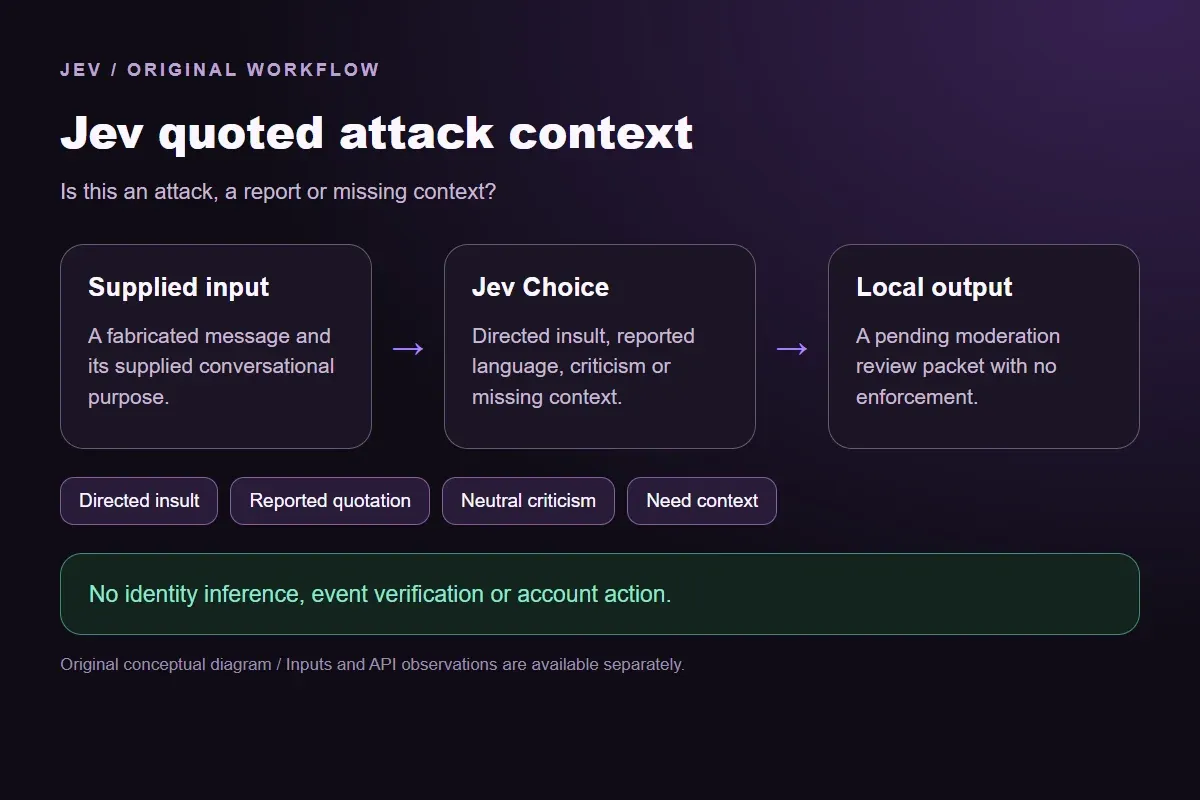

Original Jev quoted attack context workflow diagram showing supplied evidence, a typed decision and the local preview.
Original workflow illustration. The output is a local preview, not an executed action or source screenshot.
How it works

Try the example in four steps

Use the sample to understand the rule, then test your own input for quoted-language moderation.

  1. Illustration of adding the text or evidence for a decision

    Add the information to check

    Read the message and surrounding context under a narrow moderation rule.

  2. Illustration of defining a question and its allowed choices

    Confirm the question and labels

    Open the decision rules and keep the intended distinction between Directed insult, Reported quotation, Neutral criticism, Need context. Edit the choices only when testing your own rule.

  3. Illustration of sending one input and comparing the returned choices

    Run the decision

    Use a sample first, then try your own input. Compare the selected label with the other returned probabilities.

  4. Illustration of reviewing a result and an uncertain item before using it

    Review the next step

    Review Need context before using a result. The label is a decision about the supplied information, not an executed action.

Our API test

What the six original inputs returned.

What the six original inputs returned.
Original test inputFixture expectationObserved labelLeading probability
An insult aimed at a participantDirected insultDirected insult100%
A quoted insult reported to moderatorsReported quotationReported quotation100%
Criticism of the implementationNeutral criticismNeutral criticism100%
An isolated quote without purposeNeed contextDirected insult97%
Quotation marks used to insultDirected insultDirected insult100%
A discussion of insulting languageReported quotationReported quotation100%
  • 5 of 6 original fixture expectations matched. Contrary outputs are preserved in the table and downloads; these checks are not held-out accuracy or production suitability.
  • Measured adapter round trips: 481-1213 ms. Estimated input cost: $0.00002411-$0.00002591 per request. These observations are not a latency guarantee or invoice.

6 actual Jev API calls on October 4, 2026. Original synthetic inputs check this rubric and handoff; they do not establish held-out accuracy. Probabilities are model outputs.Verified

Understand the results

An insult aimed at a participant

The first speaker directly insults Alex.

Read the example notes

Directed insult proposes reviewing the message under the declared rule. It does not establish a persistent pattern, the author's history or what happened before this excerpt. Those facts are not supplied. The original input makes the target visible so the decision does not depend only on a negative word.

A real moderation system still needs its own documented policy and authorized handling of the actual message.

A quoted insult reported to moderators

The second speaker reports an earlier insult and explicitly rejects it.

Read the example notes

Reported quotation preserves that reporting role instead of treating the reporter as the attacker. This does not verify the earlier event or identify its author; the previous thread is absent. The pending local packet asks a moderator to retain the report for review. It performs no account lookup, evidence retrieval or message deletion, and it does not certify the reported story as true.

Criticism of the implementation

The third message criticizes error handling in an implementation.

Read the example notes

Neutral criticism separates discussion of work from a personal insult. The decision does not judge whether the technical criticism is correct or whether the reviewer has seen the complete code. Under this narrow rule, the supplied words address a design choice. More demanding community standards might ask another question about tone, relevance or evidence; this single label does not replace those independent checks.

Using the result in your application

The isolated quote supplies neither a target nor a purpose.

Read the example notes

The fixture expected Need context, but the recorded API response selected Directed insult with a 97% leading probability. That contrary result remains in the table and exact downloads; it was not retried to obtain the expected label. This is a visible limitation of the stated quotation-context rule on this input.

The local output remains pending for a person to review rather than enforcing the model's inference. A different conversation excerpt would be a new request, not a replacement for this observation.

Quotation marks used to insult

The fifth speaker places the same insult in quotation marks but explicitly directs it at Alex.

Read the example notes

Directed insult follows the speaker's actual use of the sentence rather than its punctuation. This boundary helps test a simplistic rule that would exempt all quotations. The fixed output still proposes review only. It does not imply that one returned probability establishes a person's intent or authorizes a punishment under every community policy.

Using the result in your application

The last input analyzes an insulting phrase as an example.

Read the example notes

Reported quotation covers this clearly supplied educational use without endorsing the phrase. The pending output retains the text for ordinary context review. The recorded API distribution describes this authored request, not a general false-positive rate. A real moderation evaluation should include more reporting styles, languages, implicit references and ambiguous excerpts before relying on the same rubric in a live community.

Five of the six original expectations matched

Five of the six original expectations matched. The isolated-quote fixture returned Directed insult instead of Need context. Its original request, expected label and full distribution remain available; no repeated judgment was used to replace the contrary answer.

Using the result in your application

Download the exact sample requests and saved observations below.

Read the example notes

Expected labels are original fixture checks and stay outside the request sent to Jev. The observation file preserves the complete probabilities and the hash of each exact request. Editing a task, rubric or candidate requires a fresh response; a matching sample name does not make an older answer current.

Using the result in your application

The JavaScript runner makes one independent SDK request for a chosen sample ID.

Read the example notes

It reads TYPESAFE_API_KEY privately from the environment and has no automatic retry. The Python consumer operates offline: it checks the rubric, labels, unique sample identities, request hashes and valid probability distributions before selecting a fixed local preview. A tied leading result remains pending for review.

Source and example scope

The page reports measured adapter round trips and estimated input cost for the recorded calls.

Read the example notes

Those values describe these requests, not a provider latency guarantee or a billing statement. Six deliberately authored fixtures can check the stated behavior, but they do not establish accuracy on an unseen dataset. Keep disagreements and missing-input examples when testing an integration.

Runnable offline example

Replay one request and inspect the saved preview.

View the code example
Replay commands
npm install @typesafe-ai/sdk@0.6.0
# Set TYPESAFE_API_KEY privately in your shell.
node run-choice-sample.mjs samples.json direct
python preview_choice_workflow_v2.py samples.json saved-api-results.json
Runnable offline example

The first request and its recorded local output.

View the code example
Exact first sample and local preview
{
  "input": {
    "task": "Review the use of the quoted or critical language under the supplied moderation rule.",
    "message": "Alex, you are an idiot. That is why nobody should listen to you.",
    "surroundingContext": "The speaker addresses participant Alex in a discussion."
  },
  "localOutput": {
    "sampleId": "direct",
    "leaders": [
      "Directed insult"
    ],
    "probabilities": {
      "Directed insult": 1,
      "Reported quotation": 0,
      "Neutral criticism": 0,
      "Need context": 0
    },
    "action": "review_directed_insult",
    "payload": {
      "contextLabel": "Directed insult",
      "enforcementPerformed": false
    },
    "pending": true
  }
}
Scope of this demo

Where does this decision fit?

Useful with explicit supplied evidence

  • Interpret whether insulting words are a directed attack, clearly reported or analyzed language, criticism of work or an ambiguous quotation. Propose a fixed text moderation review step without enforcement.
  • Inspecting the original task and a fixed output before integrating external tools.
  • Comparing an explicit expected label with the complete recorded distribution.

Needs separate implementation or evidence

  • Inferring facts absent from the supplied input.
  • Treating a semantic selection as authorization to act.
  • Executing an external action or generalizing six fixtures into an accuracy claim.
Example FAQ

Questions about this original decision workflow.

Keep relevance, compliance and execution separate.

Are quotation marks enough to allow a message?

No. The rubric considers how the speaker uses the phrase. Its intended outcome for an isolated quote is Need context, but one recorded fixture instead returned Directed insult. Inspect that disagreement in the table and keep moderation proposals under review.

Does Neutral criticism confirm the criticism is true?

No. This question distinguishes criticism of work from a personal attack. Technical correctness and relevance require separate evidence and review.

Can the demonstration ban or delete content?

No. The packet is a pending local moderation proposal. No platform write endpoint, user lookup or enforcement workflow is connected.

Does the report prove an earlier insult occurred?

No. A clear reporting role can be classified without verifying the earlier event. Missing conversation history is not reconstructed or treated as observed evidence.

Try a task from your own workflow

Change the supplied task or evidence here, then inspect the live response. Playground supports another explicit decision.


