Jev code snippet selection

Find the code fragment that implements a behavior

State the behavior you need and supply candidate fragments. Select visible matching code, keeping an unseen helper or an absent implementation unresolved.

Which visible code fragment answers the question?Live API
Try an example

Original short code fragments. The snippets are evidence to read, not code to execute.

Source: Workflow inspiration on X

Source and example scope

Our snippets, questions and exact-context preview are original. This window does not scan a repository, install the source plugin or reproduce token-saving claims.

Which supplied fragment implements the requested behavior in visible code?

Decision rules and labels
Fragment AFragment BFragment CNo matching fragmentNeed more context
A real response from the Jev API

Edit any input to explore a different decision. No request is sent until you run it.

Your next decision

Not run yet

Choose an example or write your own input, then run it to see the ranked choices.

Results are not stored by this site. Your submitted text is processed by the API provider.

The decision

How does Jev code snippet selection use visible behavior?

Jev code snippet selection asks which supplied fragment shows the behavior a developer wants to inspect. A function name is not always the phrase used in the task. Our account function is called enrol, while the task asks about rejecting an empty signup email. The model reads the visible operation and chooses a fragment ID.

Local code then returns the original path and snippet as reading context.

The fixture contains only three fragments. One checks whether an email is blank before calling createUser. Another calls sendResetLink. The third returns a sign-in form. These small snippets make the decision inspectable: you can see the relevant operation and compare it with the question. They are not a complete application, and the blank-email guard is not a general email-address validator.

An API-collected X post about retrieving useful code before a coding agent reads it inspired this example. We read the maintainer documentation for related Jevgrep implementations to check the workflow boundary. Those tools can search authorized repositories and return source context. This page demonstrates selection from explicitly supplied fragments.

It does not install a CLI, scan your project or reproduce the source author's context and cost measurements.
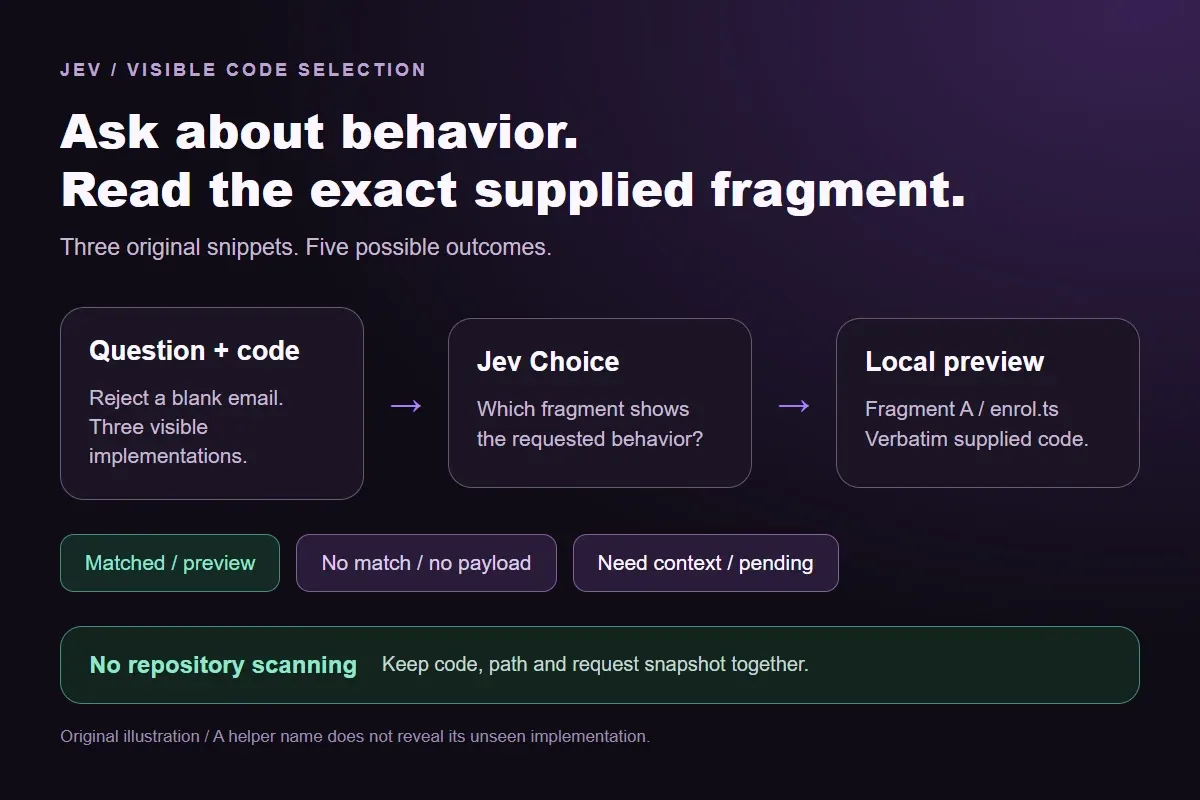

Original Jev code snippet selection diagram from behavior question and supplied fragments to an exact local reading-context preview, with missing-context outcomes.
Original workflow diagram. Reading context is copied from the supplied fixture; no repository is scanned.
How it works

Prepare exact reading context in four steps.

Keep the supplied code and the returned preview tied to the same request.

  1. Illustration of adding the text or evidence for a decision

    Supply the behavior question

    Describe the operation you need to inspect. A question about rejecting a blank signup email can match enrol even when the function name does not contain signup.

  2. Illustration of defining a question and its allowed choices

    Provide bounded code fragments

    Include stable IDs, paths and exact snippet text. The model sees those strings only. A call to createUser does not reveal its body, callers or database implementation.

  3. Illustration of sending one input and comparing the returned choices

    Read the complete distribution

    Compare all five outcomes. No matching fragment means the behavior is absent from the supplied code. Need more context keeps vague questions or unseen helper implementations unresolved.

  4. Illustration of reviewing a result and an uncertain item before using it

    Preview the exact source payload

    The offline consumer checks request identity and binds each payload to the corresponding visible fragment. It prints the original code and path as JSON, without opening that path or executing the snippet.

Our API test

What the six behavior questions returned.

What the six behavior questions returned.
Behavior questionObserved labelLeading probability
Reject an empty signup emailFragment A100%
Send a password reset linkFragment B64%
Render the sign-in formFragment C99%
Missing tax calculationNo matching fragment99%
Unseen helper implementationNeed more context85%
Unspecified code questionNeed more context61%
  • Measured adapter round trips: 477-1273 ms. Estimated input cost: $0.00002978-$0.00003020 per request. These observations are not a latency guarantee or invoice.

6 actual Jev API calls on October 1, 2026. Original synthetic inputs check this rubric and handoff; they do not establish held-out accuracy. Probabilities are model outputs.Verified

Understand the results

Using the result in your application

Download samples.json to inspect the full corpus and request strings.

Read the example notes

Each request contains the same three original fragments, including their stable IDs and paths. Expected labels are fixture checks kept outside the API request. The saved observations include the actual labels, distributions, measured adapter round trips and exact request hashes. A changed question or snippet requires a fresh observation; six favorable examples cannot establish general retrieval accuracy.

Using the result in your application

The JavaScript runner makes one independent SDK request for a selected sample.

Read the example notes

Choose email-guard to test a behavior described differently from its function name. Choose hidden-helper to inspect a question the visible code cannot fully answer. The runner reads a private TYPESAFE_API_KEY from the environment and has no automatic retry. Your snippets travel to the provider, so use synthetic code or code you are allowed to submit.

Render the sign-in form

The Python consumer reads the fixture and saved results offline.

Read the example notes

It first validates the question, choices, sample identities and complete probability distributions. It recomputes the request hash rather than accepting a result with a matching sample name alone. That distinction prevents a recorded answer for an older fragment from appearing to describe edited code. A provider error is not a valid recorded observation.

Using the result in your application

This case also uses contextBindings.

Read the example notes

For each fragment label, the fixture names the nested JSON location containing its payload. The consumer compares that object with the fixed action payload before returning any preview. If Fragment A's visible code changes but its local payload still holds the older snippet, the consumer rejects the mismatch even if a newly captured result has a valid request hash.

The reading context must be the code that was supplied.

Using the result in your application

A matched outcome returns preview_reading_context with fragmentId, path and code.

Read the example notes

The text is copied verbatim from the original local fixture. No matching fragment returns no payload; Need more context remains pending. Tied leading labels also remain pending for review. The consumer never uses the path to read another file, never follows imports and never asks the model to generate a replacement snippet.

Source and example scope

For a larger integration, perform authorized file discovery separately and keep the code snapshot that produced each request.

Read the example notes

The model's fragment choice is a reading lead. A coding agent still needs to inspect relevant dependencies, implement the change and run tests. If you already know an exact symbol or literal, a normal rg search is a useful starting point; this exercise addresses behavior questions over the specific material supplied.

Try changing only the question first

Try changing only the question first.

Read the example notes

Asking where a reset link is sent should favor a different visible operation from asking where a form is rendered. Then change a snippet in a local fixture and observe why the earlier result no longer binds to that request. Keep those experiments separate and retain their raw responses. A selected fragment can be relevant without being sufficient to complete the whole engineering task.

Runnable offline example

Replay one behavior question, then print the exact context.

View the code example
Replay commands
npm install @typesafe-ai/sdk@0.6.0
# Set TYPESAFE_API_KEY privately in your shell.
node run-choice-sample.mjs samples.json email-guard
python preview_choice_workflow_v2.py samples.json saved-api-results.json
Scope of this demo

When does fragment selection help?

Useful for bounded reading leads

  • A behavior question over explicitly supplied original snippets.
  • Unknown function names with visible operations that answer the task.
  • Inspecting an exact-context handoff before adding repository discovery.

Requires additional evidence or tools

  • Finding files absent from the supplied corpus.
  • Inferring helper bodies, hidden dependencies or complete program behavior.
  • Generating fixes, executing snippets or claiming production savings.
Example FAQ

Questions about selecting a visible code fragment.

Keep relevance, compliance and execution separate.

Why can enrol match a signup question?

The visible function checks input.email and calls createUser. That behavior is the evidence, even though its name differs from the task wording. The choice does not establish how createUser stores data. Read the exact snippet returned by the offline preview and keep those two claims separate.

Why is the hidden helper unresolved?

A caller names createUser, but the fixture never supplies that helper's implementation. Its database statements are not visible. Need more context is available for that missing body. A model should not turn a familiar function name into an invented SQL implementation.

Does a high leading probability prove the fragment is sufficient?

No. It describes a choice under the supplied question and candidates. A relevant fragment can still depend on code you have not provided. The example preserves the full distribution and makes no claim about calibrated retrieval accuracy or complete repository coverage.

What happens if code changes after an API call?

The recorded request hash no longer matches an edited request. The consumer rejects it. It also compares the fixed preview payload with the fragment object supplied in that request, so a valid fresh answer cannot silently return an older code string. Keep snapshot identity alongside any production reading lead.

Can I compare this with a complete repository-search plugin?

You can compare the workflow boundaries, but these results do not measure that plugin. This page supplies three short synthetic fragments and makes one closed Choice. A complete search tool adds discovery, chunking, repeated relevance judgments, authorized scope and its own failure policy. Test those components separately before making coverage or savings claims.

Ask a different behavior question

Edit the original snippets here, or use Playground for another bounded code-context decision.


