



Jev transcript disagreement

Compare two transcripts for a changed request

Provide both candidate transcripts and speaker context. Check whether action, negation, referent or time changed, preserving both versions instead of deciding which words were actually spoken.

Keep small transcript changes from hiding a different request.Live API
Try an example

Original synthetic input. Edit the task or evidence to make a new API request.

Source: Workflow inspiration on X

Source and example scope

The inputs, rubric and preview are original. This window demonstrates the stated decision only; it does not reproduce the source application or its measurements.

Compare transcriptA and transcriptB with supplied speakerContext.

Decision rules and labels
Meaning preservedMeaning changedNeed context
A real response from the Jev API

Edit any input to explore a different decision. No request is sent until you run it.

Your next decision

Not run yet

Choose an example or write your own input, then run it to see the ranked choices.

Results are not stored by this site. Your submitted text is processed by the API provider.

The decision

How does Jev transcript disagreement use the supplied evidence?

Jev transcript disagreement checks whether two supplied transcript candidates preserve the same request. It separates harmless wording changes from differences in negation, destination or time, while keeping unresolved references pending.

The API-collected source describes comparing several transcriptions in a reconciliation stage. This original text-only example isolates one useful check before a candidate is accepted. It does not transcribe audio, infer what a speaker really said or reproduce the source reconciliation system.

Both candidates remain visible in the input. A meaningful disagreement tells an application what needs review; it does not decide which candidate is correct. The fixed local packet retains the finding without sending a message, moving a file or scheduling an event.

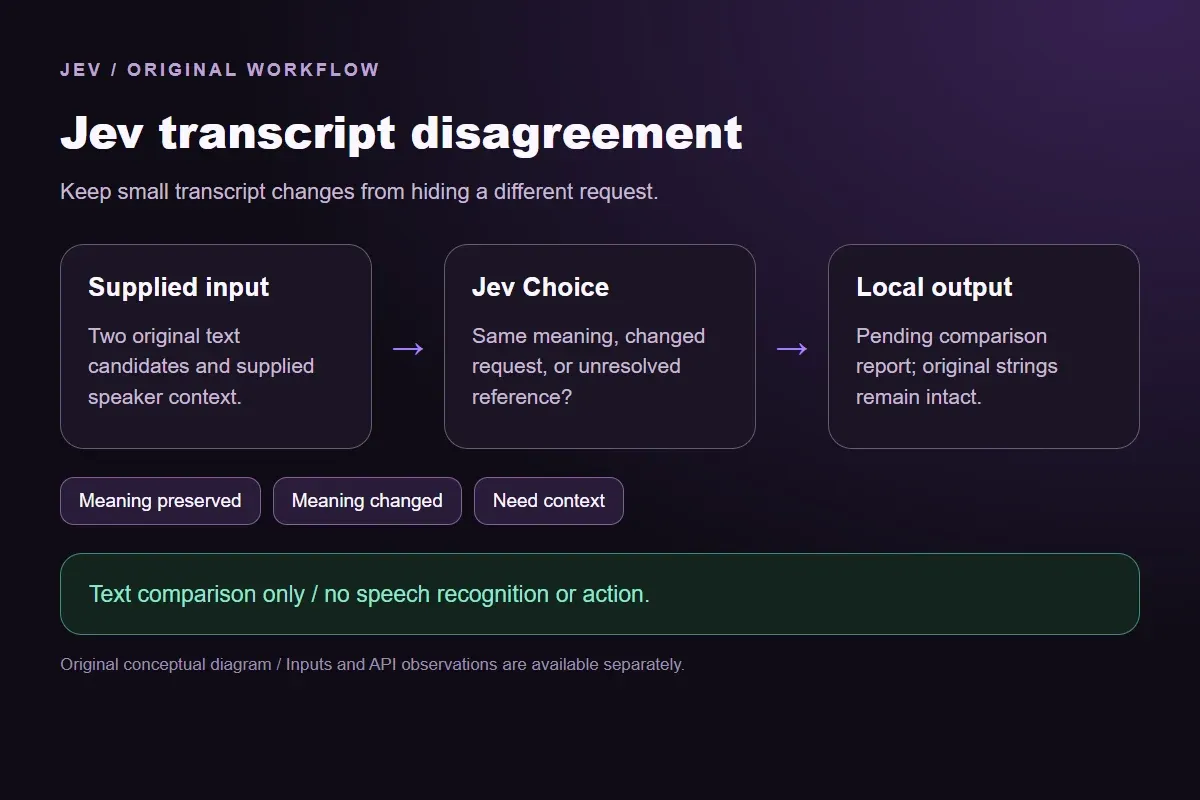
Original Jev transcript disagreement workflow diagram showing supplied evidence, a typed decision and the local preview.
Original workflow illustration. The output is a local preview, not an executed action or source screenshot.
How it works

Try the example in four steps

Use the sample to understand the rule, then test your own input for transcript meaning comparison.

  1. Illustration of adding the text or evidence for a decision

    Add the information to check

    Provide both candidate transcripts and speaker context.

  2. Illustration of defining a question and its allowed choices

    Confirm the question and labels

    Open the decision rules and keep the intended distinction between Meaning preserved, Meaning changed, Need context. Edit the choices only when testing your own rule.

  3. Illustration of sending one input and comparing the returned choices

    Run the decision

    Use a sample first, then try your own input. Compare the selected label with the other returned probabilities.

  4. Illustration of reviewing a result and an uncertain item before using it

    Review the next step

    Review Need context before using a result. The label is a decision about the supplied information, not an executed action.

Our API test

What the six original inputs returned.

What the six original inputs returned.
Original test inputFixture expectationObserved labelLeading probability
Same request with different wordingMeaning preservedMeaning preserved100%
Negation removedMeaning changedMeaning changed100%
Different named destinationMeaning changedMeaning changed99%
Different requested dayMeaning changedMeaning changed99%
Unresolved referentNeed contextMeaning preserved82%
Harmless punctuation differenceMeaning preservedMeaning preserved100%
  • 5 of 6 original fixture expectations matched. Contrary outputs are preserved in the table and downloads; these checks are not held-out accuracy or production suitability.
  • Measured adapter round trips: 475-1234 ms. Estimated input cost: $0.00002344-$0.00002390 per request. These observations are not a latency guarantee or invoice.

6 actual Jev API calls on October 2, 2026. Original synthetic inputs check this rubric and handoff; they do not establish held-out accuracy. Probabilities are model outputs.Verified

Understand the results

Same request with different wording

The first fixture compares Please save the draft with Save the draft, please.

Read the example notes

Their word order changes while the same object and operation remain explicit. Meaning preserved concerns that supplied pair. It does not establish transcription accuracy or authenticate a speaker. If the source audio said something else, both candidates could still be wrong. A production application needs its own transcription and confirmation process before treating either string as an instruction.

The negation fixture removes not from Do not send the draft

The negation fixture removes not from Do not send the draft.

Read the example notes

Meaning changed keeps that small textual difference attached to its operational consequence. A broad similarity score could make the strings look nearly identical even though their requests conflict. This check does not send or block an actual message. The local report can prompt a separate comparison with the recording or a user confirmation, under the application's trusted permission and delivery controls.

Source and example scope

The location fixture changes north gate to south gate while retaining the named person.

Read the example notes

Meaning changed flags a different destination, rather than treating the shared name as enough to establish agreement. No map, itinerary or real meeting is supplied. The original candidates are fictional strings designed to expose the boundary. Copying the report into a scheduling application would not authorize that application to select either destination or act on the proposed meeting.

The day fixture changes Thursday to Tuesday

The day fixture changes Thursday to Tuesday.

Read the example notes

The check concerns the explicit words, not calendar arithmetic. It does not resolve a timezone, infer a year or convert either day into a timestamp. A scheduling workflow would parse and validate an agreed date in code after the actual utterance is confirmed.

Keeping this comparison narrow also avoids claiming that a text-level disagreement check can establish whether two different date expressions refer to the same real event.

Source and example scope

The unresolved-reference fixture compares Move it there with Move that over there without naming an object or destination.

Read the example notes

Its authored expectation was Need context. The actual API response selected Meaning preserved at 82%, with Need context at 11%. That disagreement remains in the table and downloads. The two strings can express similar wording while their real referents remain unknown. Treat this as a limitation of the observed boundary check, not permission to move anything; actual objects and destinations require separate confirmation.

Punctuation changes without changing the mute request

The punctuation fixture compares the same explicit mute request with a comma and a changed sentence boundary.

Read the example notes

Meaning preserved reflects the unchanged operation and object. This is a functional boundary case, not an assertion that punctuation never matters: a pause or attribution can alter meaning in another utterance. Inspect the exact texts and the complete recorded distribution. The downloadable report retains both candidates and the original expectation, including any contrary model observation.

Source and example scope

Fixture expectations are authored before the calls. Any contrary model choice remains visible beside its expectation and complete distribution; no repeated judgment is used to obtain a preferred label.

Using the result in your application

Download the exact sample requests and saved observations below.

Read the example notes

Expected labels are original fixture checks and stay outside the request sent to Jev. The observation file preserves the complete probabilities and the hash of each exact request. Editing a task, rubric or candidate requires a fresh response; a matching sample name does not make an older answer current.

Using the result in your application

The JavaScript runner makes one independent SDK request for a chosen sample ID.

Read the example notes

It reads TYPESAFE_API_KEY privately from the environment and has no automatic retry. The Python consumer operates offline: it checks the rubric, labels, unique sample identities, request hashes and valid probability distributions before selecting a fixed local preview. A tied leading result remains pending for review.

Source and example scope

The page reports measured adapter round trips and estimated input cost for the recorded calls.

Read the example notes

Those values describe these requests, not a provider latency guarantee or a billing statement. Six deliberately authored fixtures can check the stated behavior, but they do not establish accuracy on an unseen dataset. Keep disagreements and missing-input examples when testing an integration.

Runnable offline example

Replay one request and inspect the saved preview.

View the code example
Replay commands
npm install @typesafe-ai/sdk@0.6.0
# Set TYPESAFE_API_KEY privately in your shell.
node run-choice-sample.mjs samples.json politeness
python preview_choice_workflow_v2.py samples.json saved-api-results.json
Scope of this demo

Where does this decision fit?

Useful with explicit supplied evidence

  • Compare two supplied transcript candidates for a meaning-critical difference in requested action, negation, referent or scheduling. Report preserved meaning, changed meaning or missing context, keeping the original candidates intact. No audio transcription, repair or action executes.
  • Inspecting the original task and a fixed output before integrating external tools.
  • Comparing an explicit expected label with the complete recorded distribution.

Needs separate implementation or evidence

  • Inferring facts absent from the supplied input.
  • Treating a semantic selection as authorization to act.
  • Executing an external action or generalizing six fixtures into an accuracy claim.
Example FAQ

Questions about this original decision workflow.

Keep relevance, compliance and execution separate.

Does this identify the correct transcription?

No. It compares the meaning of supplied text candidates. Both could disagree with the source audio, which this example does not receive.

Are the transcript candidates real speech recordings?

No. These six candidates are original fictional text fixtures. The outer Jev requests and their recorded responses are real.

Why keep Need context?

Pronouns and missing candidates may prevent a meaningful comparison. The report preserves that gap instead of guessing a referent or repairing a string.

Does a changed day trigger calendar work?

No. The packet is local and pending. Date parsing, user confirmation, permissions and event creation belong to separate code.

Can this replace a speech-recognition benchmark?

No. The fixtures check a stated comparison rule. They contain no audio corpus, word-error-rate measurement or independently labeled recognition dataset.

Try a task from your own workflow

Change the supplied task or evidence here, then inspect the live response. Playground supports another explicit decision.