Jev fictional trail matching

Match a scenery preference to a fictional trail

Compare a stated scenery preference with supplied fictional river, woodland and city descriptions. Select a semantic match or no match without assessing distance, weather, accessibility or route safety.

Match the scenery preference to the description.Live API
Try an example

Original synthetic input. Edit the task or evidence to make a new API request.

Source: Workflow inspiration on X

Source and example scope

The inputs, rubric and preview are original. This window demonstrates the stated decision only; it does not reproduce the source application or its measurements.

Which fictional route description matches the scenery preference?

Decision rules and labels
River pathWoodland loopCity promenadeNo supplied matchNeed preference
A real response from the Jev API

Edit any input to explore a different decision. No request is sent until you run it.

Your next decision

Not run yet

Choose an example or write your own input, then run it to see the ranked choices.

Results are not stored by this site. Your submitted text is processed by the API provider.

The decision

How does Jev fictional trail matching use the supplied evidence?

Jev fictional trail matching connects a textual scenery preference to a description in a supplied catalog. Our original catalog has a river path, a woodland loop and a city promenade. The model chooses a label; the offline consumer copies the corresponding fictional record. It does not discover or recommend a real route.

An API-collected X post described personalized route selection with TypeSafe Jev and route metadata. That idea inspired this narrower semantic exercise. All route names and descriptions here are fictional. The window has no location feed, map, forecast or current trail conditions, and its result cannot establish whether an outdoor route is safe or suitable.

Numeric constraints belong to deterministic code before this question. In a real catalog, distance, travel time and other exact fields can filter the candidates. This fixture starts after that step and asks only about scenery. A description such as forest setting can match woodland wording without relying on an exact shared keyword.
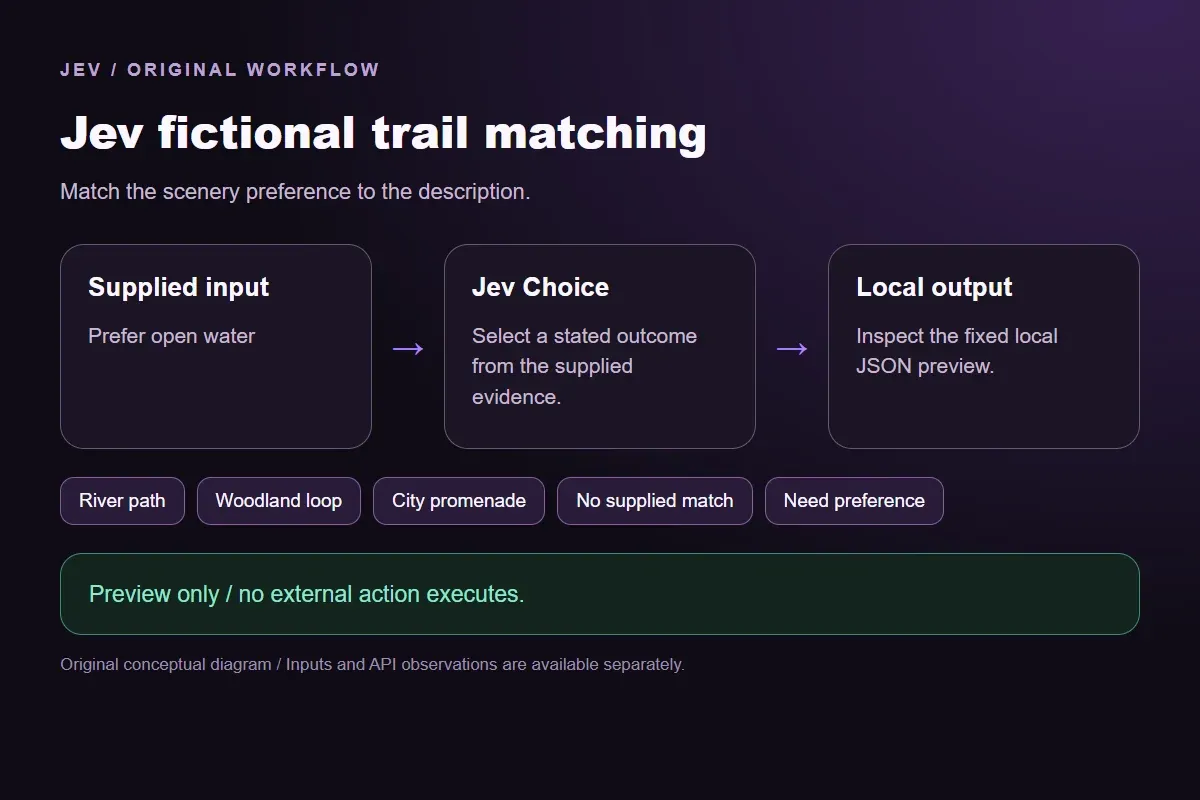

Original Jev fictional trail matching workflow diagram showing supplied evidence, a typed decision and the local preview.
Original workflow illustration. The output is a local preview, not an executed action or source screenshot.
How it works

Try the example in four steps

Use the sample to understand the rule, then test your own input for scenery preference matching.

  1. Illustration of adding the text or evidence for a decision

    Add the information to check

    Compare a stated scenery preference with supplied fictional river, woodland and city descriptions.

  2. Illustration of defining a question and its allowed choices

    Confirm the question and labels

    Open the decision rules and keep the intended distinction between River path, Woodland loop, City promenade, No supplied match, Need preference. Edit the choices only when testing your own rule.

  3. Illustration of sending one input and comparing the returned choices

    Run the decision

    Use a sample first, then try your own input. Compare the selected label with the other returned probabilities.

  4. Illustration of reviewing a result and an uncertain item before using it

    Review the next step

    Review Need preference before using a result. The label is a decision about the supplied information, not an executed action.

Our API test

What the six original inputs returned.

What the six original inputs returned.
Original test inputObserved labelLeading probability
Prefer open waterRiver path85%
Prefer tree sceneryWoodland loop100%
Prefer an urban sceneCity promenade100%
Absent desert sceneryNo supplied match100%
No preference suppliedNeed preference98%
Forest phrasingWoodland loop100%
  • Measured adapter round trips: 470-1218 ms. Estimated input cost: $0.00002869-$0.00002902 per request. These observations are not a latency guarantee or invoice.

6 actual Jev API calls on October 1, 2026. Original synthetic inputs check this rubric and handoff; they do not establish held-out accuracy. Probabilities are model outputs.Verified

Understand the results

Using the result in your application

The river sample states a preference for water scenery and has a directly matching supplied description.

Read the example notes

Its local preview contains the original fiction-river ID and description. Keeping those fields attached to the request distinguishes a catalog selection from generated travel information. The consumer rejects a changed mapped description even if someone obtains a fresh valid request hash for it.

The woodland and forest samples use different phrasing for the same supplied scenery

The woodland and forest samples use different phrasing for the same supplied scenery.

Read the example notes

They test a small semantic match rather than a numeric distance calculation. A production evaluation should include genuinely ambiguous preferences and descriptions that share several features. These clear synthetic cases cannot establish personalization accuracy across a real route database.

The city sample explicitly prefers buildings and street scenery over a natural landscape

The city sample explicitly prefers buildings and street scenery over a natural landscape.

Read the example notes

That information is sufficient for this catalog's City promenade label. It does not establish preferences about crowds, mobility, opening times or facilities because those facts are absent. Do not treat a successful scenery choice as evidence about another preference the question never asked.

Using the result in your application

The desert example is deliberately outside all three candidate descriptions.

Read the example notes

No supplied match keeps that gap visible. A real application might enlarge the catalog or ask whether the user wants an alternative, but this consumer does neither. It does not relabel a woodland path as a desert route simply to produce a recommendation.

Source and example scope

The unspecified-preference sample asks for a usual preference without supplying it.

Read the example notes

Need preference retains that missing state. The model has no personal history beyond the text in this request. A personalization service should retrieve only authorized preferences, record their scope and allow correction before adding them to a later request.

Real trip planning needs current suitability evidence

Actual trip planning needs reliable location records, current restrictions and conditions, and user-specific suitability checks.

Read the example notes

Those requirements are outside this fictional exercise. The diagram shows a semantic selection and a local metadata preview only. The download does not navigate to a map, load an external catalog, perform exact filters or provide real travel guidance.

Using the result in your application

Download the exact sample requests and saved observations below.

Read the example notes

Expected labels are original fixture checks and stay outside the request sent to Jev. The observation file preserves the complete probabilities and the hash of each exact request. Editing a task, rubric or candidate requires a fresh response; a matching sample name does not make an older answer current.

Using the result in your application

The JavaScript runner makes one independent SDK request for a chosen sample ID.

Read the example notes

It reads TYPESAFE_API_KEY privately from the environment and has no automatic retry. The Python consumer operates offline: it checks the rubric, labels, unique sample identities, request hashes and valid probability distributions before selecting a fixed local preview. A tied leading result remains pending for review.

Source and example scope

The page reports measured adapter round trips and estimated input cost for the recorded calls.

Read the example notes

Those values describe these requests, not a provider latency guarantee or a billing statement. Six deliberately authored fixtures can check the stated behavior, but they do not establish accuracy on an unseen dataset. Keep disagreements and missing-input examples when testing an integration.

Runnable offline example

Replay one request and inspect the saved preview.

View the code example
Replay commands
npm install @typesafe-ai/sdk@0.6.0
# Set TYPESAFE_API_KEY privately in your shell.
node run-choice-sample.mjs samples.json river
python preview_choice_workflow_v2.py samples.json saved-api-results.json
Scope of this demo

Where does this decision fit?

Useful with explicit supplied evidence

  • Match a textual leisure preference to three supplied fictional route descriptions. Numeric filtering has already been performed outside Jev. Return exact local catalog metadata without recommending a real trail, using current weather or assessing outdoor safety.
  • Inspecting the original task and a fixed output before integrating external tools.
  • Comparing an explicit expected label with the complete recorded distribution.

Needs separate implementation or evidence

  • Inferring facts absent from the supplied input.
  • Treating a semantic selection as authorization to act.
  • Executing an external action or generalizing six fixtures into an accuracy claim.
Example FAQ

Questions about this original decision workflow.

Keep relevance, compliance and execution separate.

Are these real trails?

No. The catalog contains original fictional descriptions for testing semantic matching. It does not provide real travel or outdoor-safety guidance.

Does Jev calculate distance or travel time?

No. This fixture assumes any exact filtering has happened in application code. The question asks only about the supplied scenery descriptions.

Can the model check current weather?

No. No weather source or location API is connected. The preview cannot establish conditions, restrictions or safety.

What if my preference has no candidate?

The explicit No supplied match outcome preserves that gap. The model cannot create a new catalog record or invent absent scenery.

What does the offline consumer validate?

It checks the exact request and saved distribution, then verifies that the mapped payload equals the supplied candidate record. It returns that original metadata without navigating or fetching a route.

Try a task from your own workflow

Change the supplied task or evidence here, then inspect the live response. Playground supports another explicit decision.


