Jev tool argument source review

Trace the source of a proposed tool argument

Read the provenance notes to distinguish a user-supplied value, external content and mixed origins. Preserve unresolved attribution; knowing where a value came from does not grant execution permission.

What does the recorded lineage establish?Live API
Try an example

Original input for the User supplied outcome. Edit the evidence to send a new request.

Source: Background discussion on X

Source and example scope

The cited X article discusses a tool-call risk gate. This independent exercise examines supplied argument-origin notes before such a gate; it does not reproduce the article, authenticate a provenance record, execute a tool, or verify the source performance and security claims.

Classify the origin established by the provenance notes.

Decision rules and labels
User suppliedExternal contentMixed originOrigin unresolvedNeed evidence
A real response from the Jev API

Edit any input to explore a different decision. No request is sent until you run it.

Your next decision

Not run yet

Choose an example or write your own input, then run it to see the ranked choices.

Results are not stored by this site. Your submitted text is processed by the API provider.

The decision

A routine-looking call can still use external instructions.

The source points out that the proposed call alone can hide where an argument came from. This example therefore supplies provenance notes and asks what origin they establish. It does not guess a missing history from the argument value.

Mixed origin preserves a value assembled from two sources. User supplied describes origin, not permission: a user-provided destination still needs the application’s authorization, validation and security controls.

All destinations are fictional and no executable URL or tool action is transmitted. The model returns a pending lineage-review label, not a safety verdict or approval token.

The cited X article discusses a tool-call risk gate. This independent exercise examines supplied argument-origin notes before such a gate; it does not reproduce the article, authenticate a provenance record, execute a tool, or verify the source performance and security claims.

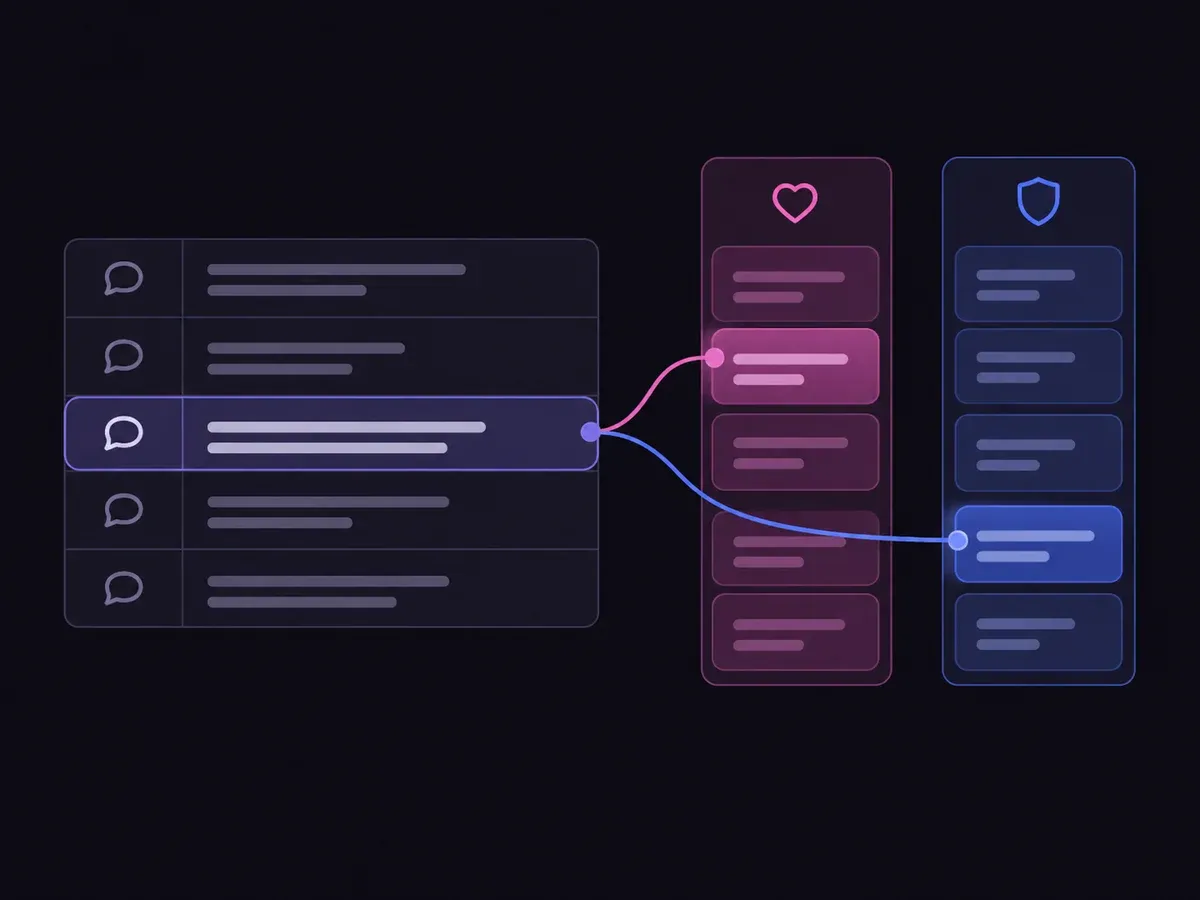
Illustration of one spreadsheet row producing two separate classification results
Illustration of the decision flow.
How it works

Try the example in four steps

Use the sample to understand the rule, then test your own input for tool argument provenance.

  1. Illustration of adding the text or evidence for a decision

    Add the information to check

    Read the provenance notes to distinguish a user-supplied value, external content and mixed origins.

  2. Illustration of defining a question and its allowed choices

    Confirm the question and labels

    Open the decision rules and keep the intended distinction between User supplied, External content, Mixed origin, Origin unresolved, Need evidence. Edit the choices only when testing your own rule.

  3. Illustration of sending one input and comparing the returned choices

    Run the decision

    Use a sample first, then try your own input. Compare the selected label with the other returned probabilities.

  4. Illustration of reviewing a result and an uncertain item before using it

    Review the next step

    Review Need evidence before using a result. The label is a decision about the supplied information, not an executed action.

Our API test

Recorded API observations

Recorded API observations
Original inputObserved labelLeading probability
Direct user valueUser supplied100%
Fetched page instructionExternal content100%
Combined valueMixed origin100%
Unresolved recordOrigin unresolved100%
Routine wording is not lineageExternal content99.0%
Provenance absentNeed evidence66.0%

These six original synthetic requests were each run twice, on 6 and 9 October 2026. This table and saved-api-results.json show the second run, which matched all six authored expectations. The percentage is the leading option probability, not measured accuracy.Verified

Understand the results

The two recorded runs used identical requests

The two recorded runs used identical requests.

Read the example notes

All six winning labels were unchanged on 9 October, but the leading probability changed from 99% to 100% for Unresolved record and from 73% to 66% for Provenance absent. Compare complete runs and retain every response; another call can produce a different distribution.

Using the result in your application

The single-request SDK runner uses your private TYPESAFE_API_KEY. The offline consumer reads saved observations, checks request hashes and prints a pending output. It does not call the model or change any external system.

Runnable offline example

Run one sample, then inspect the local packet

View the code example
Single-request replay
npm install @typesafe-ai/sdk@0.6.0
# Set TYPESAFE_API_KEY privately in your shell.
node run-choice-sample.mjs samples.json case-1
python preview_choice_workflow.py samples.json saved-api-results.json
Scope of this demo

Where this decision fits

Useful scope

  • Reviewing supplied argument lineage
  • Keeping untrusted external contributions visible
  • Replaying fictional provenance records without tool execution

Outside this demonstration

  • Inferring a missing origin from a routine call name
  • Treating user-supplied as authorized or safe
  • Executing an argument based on this label
Example FAQ

Questions about tool argument source review.

The rubric explains the decision; the application owns the next step.

Does User supplied mean the call is allowed?

No. It only describes the supplied origin evidence. Permission, destination validation and the action’s effects require independent checks.

Can the model reconstruct the provenance ledger?

No. The ledger must be captured by the application. Origin unresolved and Need evidence preserve incomplete records instead of inventing lineage.

Does the leading probability measure production accuracy?

No. It is the model distribution for this one request. The six examples are functional checks with authored expectations, not a representative benchmark. Inspect disagreements and evaluate your own examples before using the label.

What happens when the API fails?

The window shows an error and supplies no fresh judgment. The downloadable runner sends one request without retries. Need evidence is a valid outcome about incomplete input; it does not stand in for a network or provider failure.

Try your own tool argument source review input

Edit the evidence above or use the Playground to test another bounded question.

