Jev canonical label mapping

Map a legacy product label to a supplied taxonomy

Compare a legacy label by meaning with fictional home storage, pet care and outdoor gear categories. Keep new concepts and unclear labels separate rather than forcing every item into the taxonomy.

Map an old label to a defined concept.Live API
Try an example

Original synthetic input. Edit the task or evidence to make a new API request.

Source: Workflow inspiration on X

Source and example scope

The inputs, rubric and preview are original. This window demonstrates the stated decision only; it does not reproduce the source application or its measurements.

Map the legacy label by meaning to this fictional taxonomy: Home storage means household organization products; Pet care means supplies for companion animals; Outdoor gear means equipment for camping or hiking.

Decision rules and labels
Home storagePet careOutdoor gearNew conceptClarify label
A real response from the Jev API

Edit any input to explore a different decision. No request is sent until you run it.

Your next decision

Not run yet

Choose an example or write your own input, then run it to see the ranked choices.

Results are not stored by this site. Your submitted text is processed by the API provider.

The decision

How does Jev canonical label mapping preserve concept IDs?

Jev canonical label mapping maps an old product label to a concept with a stable ID. Try closet organizers, pet grooming brushes or backpacking tents in the window. The supplied dictionary defines what each concept means. The returned label selects its exact local JSON record, including the demo taxonomy version.

An API-collected X post described tagging, deduplication and taxonomy normalization in an advertising workflow. This page implements the normalization decision independently. Its six labels and three concepts are original fixtures. The post's advertising volume, spending and expected product tiers are outside these tests.

A useful mapping preserves meaning across vocabulary changes. Two labels can sound different and still refer to the same product purpose. Conversely, a familiar word can name different things: a carrier for a pet belongs to Pet care in this dictionary, while an unexplained carrier needs clarification. The description travels with the label so the model has the evidence needed to distinguish those cases.
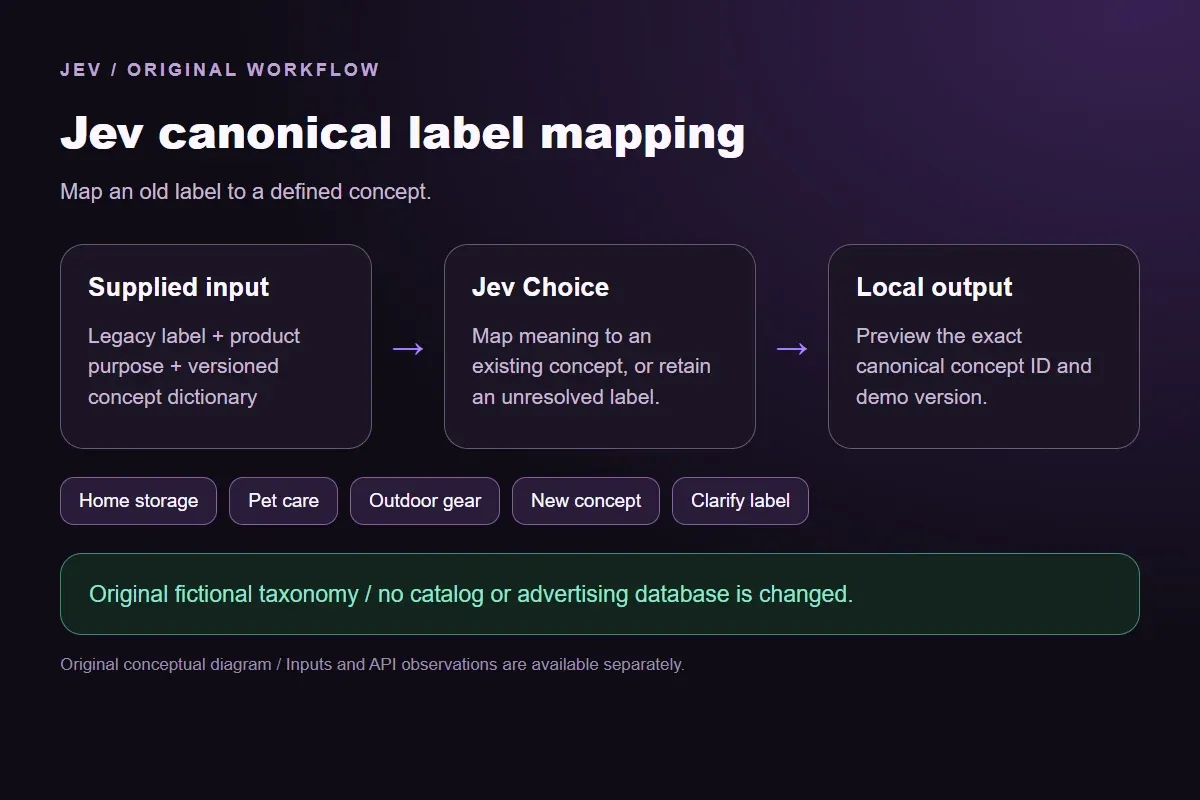

Original Jev canonical label mapping workflow diagram showing supplied evidence, a typed decision and the local preview.
Original workflow illustration. The output is a local preview, not an executed action or source screenshot.
How it works

Try the example in four steps

Use the sample to understand the rule, then test your own input for legacy category mapping.

  1. Illustration of adding the text or evidence for a decision

    Add the information to check

    Compare a legacy label by meaning with fictional home storage, pet care and outdoor gear categories.

  2. Illustration of defining a question and its allowed choices

    Confirm the question and labels

    Open the decision rules and keep the intended distinction between Home storage, Pet care, Outdoor gear, New concept, Clarify label. Edit the choices only when testing your own rule.

  3. Illustration of sending one input and comparing the returned choices

    Run the decision

    Use a sample first, then try your own input. Compare the selected label with the other returned probabilities.

  4. Illustration of reviewing a result and an uncertain item before using it

    Review the next step

    Review uncertain or unexpected results before using a result. The label is a decision about the supplied information, not an executed action.

Our API test

What the six original inputs returned.

What the six original inputs returned.
Original test inputFixture expectationObserved labelLeading probability
A household aliasHome storageHome storage100%
A companion-animal aliasPet carePet care100%
A specific outdoor labelOutdoor gearOutdoor gear100%
A new conceptNew conceptClarify label86%
An unclear shorthandClarify labelClarify label99%
Purpose resolves an ambiguous nounPet carePet care99%
  • 5 of 6 original fixture expectations matched. Contrary outputs are preserved in the table and downloads; these checks are not held-out accuracy or production suitability.
  • Measured adapter round trips: 486-1273 ms. Estimated input cost: $0.00002524-$0.00002554 per request. These observations are not a latency guarantee or invoice.

6 actual Jev API calls on October 1, 2026. Original synthetic inputs check this rubric and handoff; they do not establish held-out accuracy. Probabilities are model outputs.Verified

Understand the results

Using the result in your application

The closet-organizer fixture maps a descriptive legacy phrase to Home storage.

Read the example notes

Its output carries conceptId home-storage and version demo-1. A migration consumer can use that record to propose a mapping, but the preview does not update a database. A later change to the definition or version creates a different input and invalidates this recorded observation.

The pet-brush fixture describes both the item and its intended animals

The pet-brush fixture describes both the item and its intended animals.

Read the example notes

Pet care covers supplies for companion animals in this fictional dictionary. This test does not establish a complete pet-product taxonomy: farm supplies, veterinary services and wildlife equipment would need explicit definitions before a production mapper could distinguish them. The limited vocabulary stays visible beside the request.

The backpacking-tent fixture supplies a concrete outdoor purpose

The backpacking-tent fixture supplies a concrete outdoor purpose.

Read the example notes

Outdoor gear is the available concept for camping or hiking equipment. The decision is about an existing concept ID, rather than generating a new classification tree. The stored response includes every offered probability, so the leader can be inspected without reducing the observation to an unexplained check mark.

Accounting software is an explicit concept outside this dictionary

Accounting software is an explicit concept outside this dictionary.

Read the example notes

The fixture expects New concept, but the recorded leader was Clarify label at 86%. That mismatch exposes the distinction this mapper still needs to improve. Neither outcome creates a canonical ID; adding a software category belongs to a separate vocabulary review. The unchanged observation remains available in the table and downloads.

The label essentials gives no product meaning or audience

The label essentials gives no product meaning or audience.

Read the example notes

Clarify label keeps that information gap separate from a known new concept. A follow-up description could support a mapping, but it needs a fresh API request. The demo cannot recover an advertiser's unstated meaning from a short label or silently substitute a guess for missing catalog data.

Source and example scope

The carrier fixture provides a pet-cat travel-crate description.

Read the example notes

That context resolves an otherwise ambiguous noun. In a real migration, retain the original label, proposed ID, taxonomy version and decision provenance for human adjudication. Exact identifiers and schema validation remain code responsibilities; a semantic choice does not authorize overwriting a category in a live system.

Five of the six recorded leaders matched the original fixture expectations

Five of the six recorded leaders matched the original fixture expectations.

Read the example notes

The accounting-software input returned Clarify label at 86%, although its expected outcome was New concept. The saved distribution and result table retain that mismatch. This mapper needs independent review of the known-outside versus missing-meaning boundary before production use; no corrected result or accuracy claim is substituted.

Using the result in your application

Download the exact sample requests and saved observations below.

Read the example notes

Expected labels are original fixture checks and stay outside the request sent to Jev. The observation file preserves the complete probabilities and the hash of each exact request. Editing a task, rubric or candidate requires a fresh response; a matching sample name does not make an older answer current.

Using the result in your application

The JavaScript runner makes one independent SDK request for a chosen sample ID.

Read the example notes

It reads TYPESAFE_API_KEY privately from the environment and has no automatic retry. The Python consumer operates offline: it checks the rubric, labels, unique sample identities, request hashes and valid probability distributions before selecting a fixed local preview. A tied leading result remains pending for review.

Source and example scope

The page reports measured adapter round trips and estimated input cost for the recorded calls.

Read the example notes

Those values describe these requests, not a provider latency guarantee or a billing statement. Six deliberately authored fixtures can check the stated behavior, but they do not establish accuracy on an unseen dataset. Keep disagreements and missing-input examples when testing an integration.

Runnable offline example

Replay one request and inspect the saved preview.

View the code example
Replay commands
npm install @typesafe-ai/sdk@0.6.0
# Set TYPESAFE_API_KEY privately in your shell.
node run-choice-sample.mjs samples.json organizer
python preview_choice_workflow_v2.py samples.json saved-api-results.json
Scope of this demo

Where does this decision fit?

Useful with explicit supplied evidence

  • Map a supplied legacy advertising label to a current canonical concept ID, while separating a genuinely new concept from a label whose meaning needs clarification. Original fictional taxonomy only; no advertising data is scraped or changed.
  • Inspecting the original task and a fixed output before integrating external tools.
  • Comparing an explicit expected label with the complete recorded distribution.

Needs separate implementation or evidence

  • Inferring facts absent from the supplied input.
  • Treating a semantic selection as authorization to act.
  • Executing an external action or generalizing six fixtures into an accuracy claim.
Example FAQ

Questions about this original decision workflow.

Keep relevance, compliance and execution separate.

Is this the IAB advertising taxonomy?

No. The three concepts and IDs are original fictional fixtures. IAB guidance is a primary reference for the distinction between taxonomy types and versioned mappings.

Does Jev create a new concept ID?

No. New concept records that the supplied dictionary has no suitable concept. A separate vocabulary review would have to define a new ID.

Why send a product description with a short label?

An ambiguous word such as carrier can describe different products. The supplied description gives the mapping decision its meaning.

Can I change a taxonomy definition and reuse the result?

No. The recorded observation belongs to its exact request. Changing a definition, candidate payload or version requires a fresh decision.

Do the six fixtures measure production mapping accuracy?

No. They exercise the original dictionary and keep the actual distributions. A production accuracy study needs an independent labeled dataset and adjudication method.

Try a task from your own workflow

Change the supplied task or evidence here, then inspect the live response. Playground supports another explicit decision.