Jev site search preflight

Choose a preflight route for a site-search request

Compare the query with the site's scope and known destinations. Distinguish opening a supplied page from retrieving evidence, asking for a goal or stopping an out-of-scope request.

Decide what the search request needs first.Live API
Try an example

Original synthetic input. Edit the task or evidence to make a new API request.

Source: Workflow inspiration on X

Source and example scope

The inputs, rubric and preview are original. This window demonstrates the stated decision only; it does not reproduce the source application or its measurements.

Which preflight route fits the query and supplied site scope?

Decision rules and labels
Use supplied pageRetrieve site evidenceStop out of scopeAsk for goal
A real response from the Jev API

Edit any input to explore a different decision. No request is sent until you run it.

Your next decision

Not run yet

Choose an example or write your own input, then run it to see the ranked choices.

Results are not stored by this site. Your submitted text is processed by the API provider.

The decision

How does Jev site search preflight use the supplied evidence?

Jev site search preflight decides which next step a supplied query needs. Opening a named authentication guide differs from asking how credential rotation works. The first request can use a destination the application already knows. The second still needs relevant documentation content before an answer can be written.

An API-collected X post described placing TypeSafe Jev before vector search, with stopping, redirecting and answering branches. Our original exercise tests only that early decision. It does not connect to pgvector, build embeddings, search a corpus or reproduce the author's accuracy and token-saving claims. The fictional documentation scope is included with each request.

The window preserves four routes: a supplied page, site-evidence retrieval, an out-of-scope stop and a missing-goal question. Choosing retrieval is not finding an answer. That distinction keeps the demonstration useful without representing a small text decision as a complete search engine.
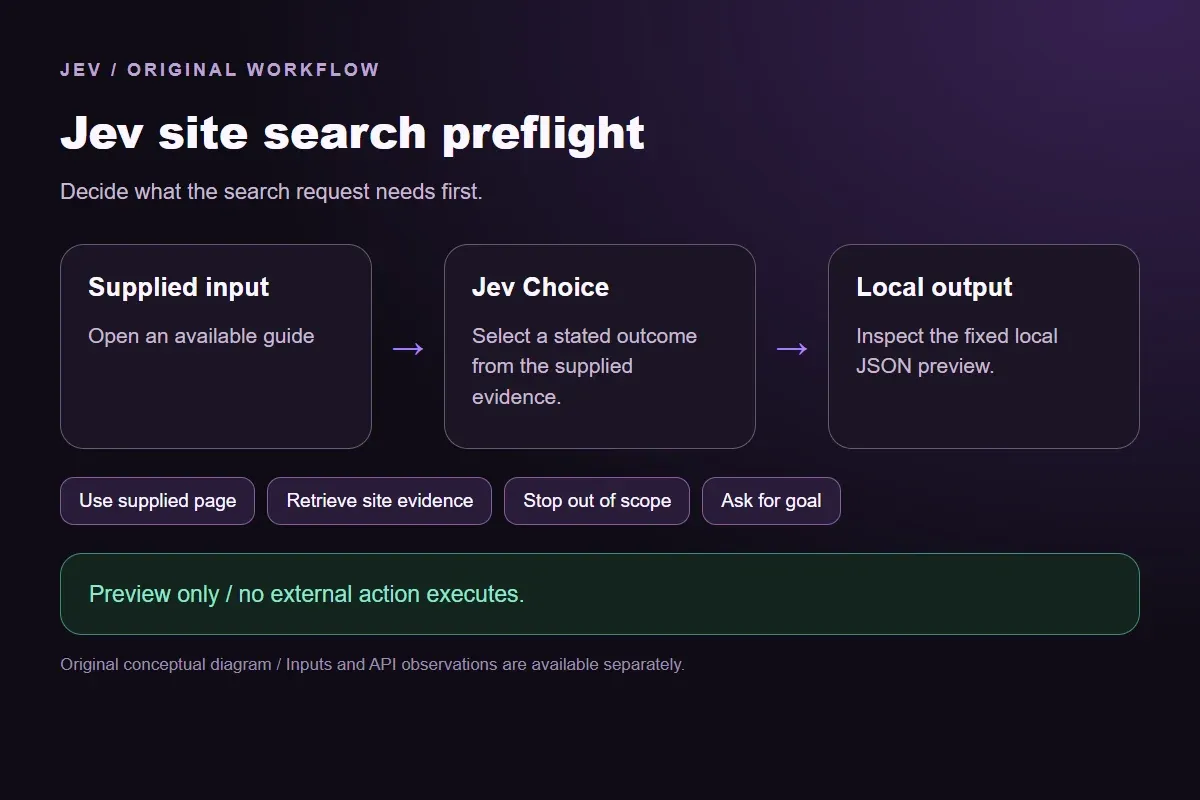

Original Jev site search preflight workflow diagram showing supplied evidence, a typed decision and the local preview.
Original workflow illustration. The output is a local preview, not an executed action or source screenshot.
How it works

Try the example in four steps

Use the sample to understand the rule, then test your own input for site-search preflight.

  1. Illustration of adding the text or evidence for a decision

    Add the information to check

    Compare the query with the site's scope and known destinations.

  2. Illustration of defining a question and its allowed choices

    Confirm the question and labels

    Open the decision rules and keep the intended distinction between Use supplied page, Retrieve site evidence, Stop out of scope, Ask for goal. Edit the choices only when testing your own rule.

  3. Illustration of sending one input and comparing the returned choices

    Run the decision

    Use a sample first, then try your own input. Compare the selected label with the other returned probabilities.

  4. Illustration of reviewing a result and an uncertain item before using it

    Review the next step

    Review uncertain or unexpected results before using a result. The label is a decision about the supplied information, not an executed action.

Our API test

What the six original inputs returned.

What the six original inputs returned.
Original test inputFixture expectationObserved labelLeading probability
Open an available guideUse supplied pageUse supplied page81%
Ask a factual API questionRetrieve site evidenceRetrieve site evidence85%
Unrelated sports questionStop out of scopeStop out of scope100%
Missing search goalAsk for goalAsk for goal99%
Open the pricing destinationUse supplied pageUse supplied page100%
Pricing answer needs evidenceRetrieve site evidenceUse supplied page57%
  • 5 of 6 original fixture expectations matched. Contrary outputs are preserved in the table and downloads; these checks are not held-out accuracy or production suitability.
  • Measured adapter round trips: 481-1205 ms. Estimated input cost: $0.00002482-$0.00002528 per request. These observations are not a latency guarantee or invoice.

6 actual Jev API calls on October 1, 2026. Original synthetic inputs check this rubric and handoff; they do not establish held-out accuracy. Probabilities are model outputs.Verified

Understand the results

Source and example scope

The authentication-guide sample explicitly requests navigation to a listed destination.

Read the example notes

Its output is Use supplied page. The offline report shows that route but does not choose a generated URL or open the page. A production adapter should resolve the named destination from its own allowlisted catalog and retain normal authorization and navigation rules.

The credential-rotation sample asks a how-to question whose answer content is absent

The credential-rotation sample asks a how-to question whose answer content is absent.

Read the example notes

It selects Retrieve site evidence even though authentication is a known destination. The destination label alone cannot establish the steps. A retrieval layer must collect the relevant passage, and any later answer should stay grounded in that evidence rather than filling the gap from a route label.

The sports example is clearly outside the stated task-service documentation scope

The sports example is clearly outside the stated task-service documentation scope.

Read the example notes

Stop out of scope is a policy result for this fictional site, not a general claim that Jev cannot classify sports text. Changing the site scope changes the routing problem. Keep the scope beside the query when evaluating a deployment so a blocked result can be audited.

Using the result in your application

The vague query gives neither a subject nor an intended page.

Read the example notes

Ask for goal preserves that missing information. An internal search engine could still offer navigation suggestions separately, but this rubric does not treat a popular page as a known user intention. The demo returns a pending local report rather than fabricating a search topic.

The two pricing examples are a useful paired test

The two pricing examples are a useful paired test.

Read the example notes

One asks to visit a known destination; the other asks about plan contents without supplying them. Their shared topic does not imply the same route. Try editing only the requested operation while keeping the destination map fixed. Compare the actual response rather than displaying a saved answer for both requests.

Retrieval systems need separate production safeguards

A production system needs separate evaluation of retrieval relevance, corpus freshness, access control and answer grounding.

Read the example notes

None of those components runs in this replay. The original fixture records the preflight request and complete distribution, then prints a fixed route report. It is not evidence that an end-to-end search system answers correctly or saves a measured amount of inference work.

The factual pricing sample did not follow its original expectation

The factual pricing sample did not follow its original expectation.

Read the example notes

Jev selected Use supplied page at 57%, ahead of Retrieve site evidence at 42%, even though the rule says a factual pricing answer needs evidence. The other five fixture expectations matched. We preserve the contrary label and full distribution, with no reroll or replacement.

This is a limitation of this tested preflight question: do not deploy it as a guarantee that factual requests always reach retrieval. If the product requires a strict navigation/answer boundary, add explicit user intent controls or enforce that boundary in application code and evaluate a changed contract separately.

Using the result in your application

Download the exact sample requests and saved observations below.

Read the example notes

Expected labels are original fixture checks and stay outside the request sent to Jev. The observation file preserves the complete probabilities and the hash of each exact request. Editing a task, rubric or candidate requires a fresh response; a matching sample name does not make an older answer current.

Using the result in your application

The JavaScript runner makes one independent SDK request for a chosen sample ID.

Read the example notes

It reads TYPESAFE_API_KEY privately from the environment and has no automatic retry. The Python consumer operates offline: it checks the rubric, labels, unique sample identities, request hashes and valid probability distributions before selecting a fixed local preview. A tied leading result remains pending for review.

Source and example scope

The page reports measured adapter round trips and estimated input cost for the recorded calls.

Read the example notes

Those values describe these requests, not a provider latency guarantee or a billing statement. Six deliberately authored fixtures can check the stated behavior, but they do not establish accuracy on an unseen dataset. Keep disagreements and missing-input examples when testing an integration.

Runnable offline example

Replay one request and inspect the saved preview.

View the code example
Replay commands
npm install @typesafe-ai/sdk@0.6.0
# Set TYPESAFE_API_KEY privately in your shell.
node run-choice-sample.mjs samples.json auth-page
python preview_choice_workflow_v2.py samples.json saved-api-results.json
Scope of this demo

Where does this decision fit?

Useful with explicit supplied evidence

  • Route an original website query before retrieval or answer generation: use an explicitly supplied destination, retrieve site evidence, stop an out-of-scope request, or ask for a missing goal. Jev does not embed, retrieve or write the answer.
  • Inspecting the original task and a fixed output before integrating external tools.
  • Comparing an explicit expected label with the complete recorded distribution.

Needs separate implementation or evidence

  • Inferring facts absent from the supplied input.
  • Treating a semantic selection as authorization to act.
  • Executing an external action or generalizing six fixtures into an accuracy claim.
Example FAQ

Questions about this original decision workflow.

Keep relevance, compliance and execution separate.

Does this search a website or database?

No. It classifies the supplied query before those steps. Retrieval and embeddings are separate application components.

Why does a pricing question request retrieval?

The fixture supplies a page name but no plan contents. A factual answer needs evidence; asking to open that page is a different operation.

Can the model invent an internal URL?

No URL-generation step is implemented. The fixed preview identifies a route, and a production application should resolve destinations from its own allowed catalog.

Are the source's accuracy figures verified here?

No. These six original inputs check this explicit preflight rule. They do not reproduce a source dataset or establish search accuracy and token savings.

What happens after Retrieve site evidence?

This demo stops at the local report. A real system would retrieve authorized content, inspect its relevance and ground any later answer in that evidence.

Try a task from your own workflow

Change the supplied task or evidence here, then inspect the live response. Playground supports another explicit decision.


