



Jev search term intent

Classify a search term's buying intent

Read a search term to distinguish an explicit purchase request from research or help with an existing product. Ambiguous terms remain unclear; the result does not establish search volume.

Separate buying language from research and support.Live API
Try an example

Original synthetic input. Edit the task or evidence to make a new API request.

Source: Workflow inspiration on X

Source and example scope

The inputs, rubric and preview are original. This window demonstrates the stated decision only; it does not reproduce the source application or its measurements.

Classify the expressed intent of this search term.

Decision rules and labels
BuyResearchExisting-use helpUnclear
A real response from the Jev API

Edit any input to explore a different decision. No request is sent until you run it.

Your next decision

Not run yet

Choose an example or write your own input, then run it to see the ranked choices.

Results are not stored by this site. Your submitted text is processed by the API provider.

The decision

How does Jev search term intent use its evidence?

Jev search term intent reads the intent actually expressed in a search term before a separate marketing workflow handles it.

An API-collected marketing post suggested checking Google Ads search terms for buyer intent. This page tests an original four-outcome text rubric. It does not read an ad account, claim conversion lift or implement the broader marketing automation described in the source.

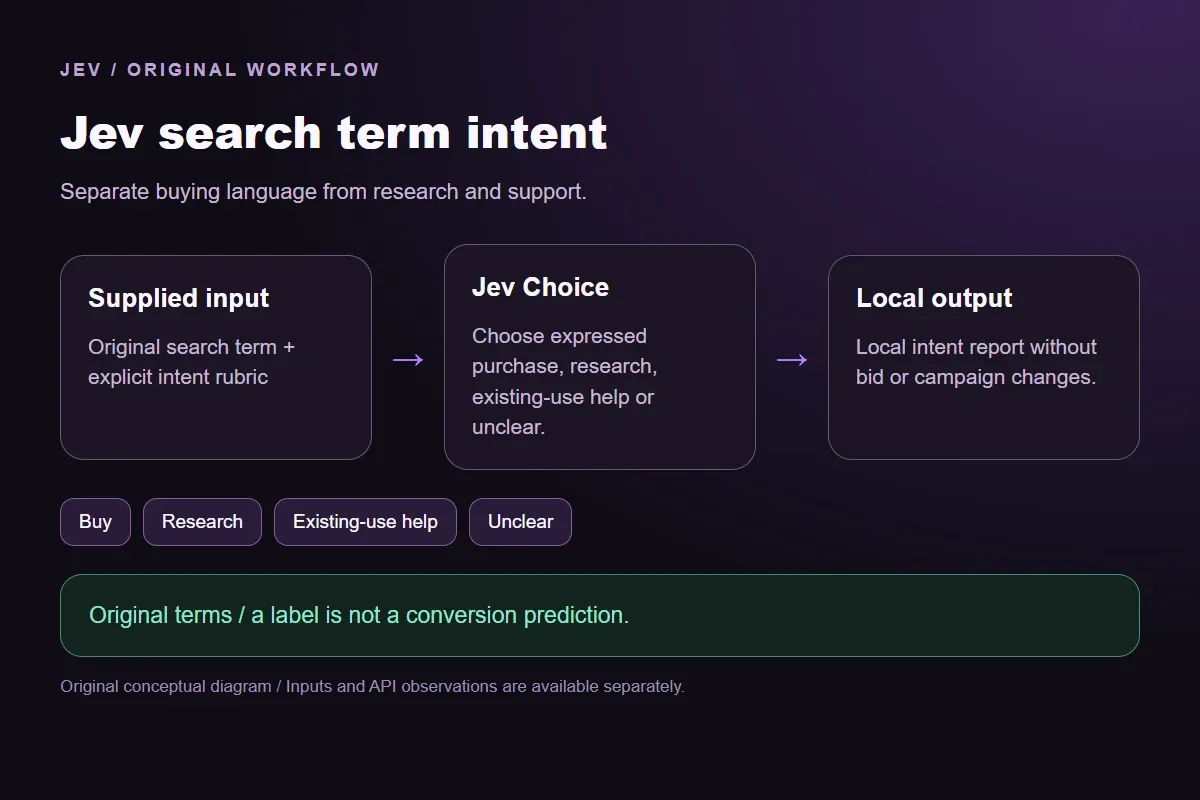
A product noun is not a purchase request. Comparison and support terms can mention the same product while expressing a different need. The model receives the term and the exact outcome meanings; the local report retains its category without producing a bid recommendation.

Original Jev search term intent workflow diagram showing supplied evidence, a typed decision and the local preview.
Original workflow illustration. The output is a local preview, not an executed action or source screenshot.
How it works

Try the example in four steps

Use the sample to understand the rule, then test your own input for search intent classification.

  1. Illustration of adding the text or evidence for a decision

    Add the information to check

    Read a search term to distinguish an explicit purchase request from research or help with an existing product.

  2. Illustration of defining a question and its allowed choices

    Confirm the question and labels

    Open the decision rules and keep the intended distinction between Buy, Research, Existing-use help, Unclear. Edit the choices only when testing your own rule.

  3. Illustration of sending one input and comparing the returned choices

    Run the decision

    Use a sample first, then try your own input. Compare the selected label with the other returned probabilities.

  4. Illustration of reviewing a result and an uncertain item before using it

    Review the next step

    Review Unclear before using a result. The label is a decision about the supplied information, not an executed action.

Our API test

What the six original inputs returned.

What the six original inputs returned.
Original test inputObserved labelLeading probability
An explicit purchase requestBuy100%
A product comparisonResearch100%
An already owned itemExisting-use help100%
Only a product nounUnclear95%
A service purchaseBuy97%
A how-it-works questionResearch97%
  • Measured adapter round trips: 469-1257 ms. Estimated input cost: $0.00002117-$0.00002134 per request. These observations are not a latency guarantee or invoice.

6 actual Jev API calls on October 1, 2026. Original synthetic inputs check this rubric and handoff; they do not establish held-out accuracy. Probabilities are model outputs.Verified

Understand the results

The buy fixture explicitly asks to buy a replacement filter

The buy fixture explicitly asks to buy a replacement filter.

Read the example notes

Buy describes the stated language, not whether the user will convert or can afford the product. A marketing integration still needs attribution and business rules to decide what happens after this semantic label. No such account action runs here.

The comparison fixture asks about two filter types

The comparison fixture asks about two filter types.

Read the example notes

Research captures that information-seeking question without treating every product mention as ready to purchase. A useful production taxonomy may need more research subtypes; this bounded demo exposes only the four outcomes visible in the window.

The warning fixture refers to an existing purifier and asks how to fix it

The warning fixture refers to an existing purifier and asks how to fix it.

Read the example notes

Existing-use help separates an owner's problem from acquisition intent. This demo does not diagnose the device or assess replacement needs. The same product language can support a different classification when the user's stated relationship changes.

The bare noun air purifier provides no request or relationship

The bare noun air purifier provides no request or relationship.

Read the example notes

Unclear retains that ambiguity. The model is not supplied with browsing history, query sessions or conversion data, and the preview does not add them. Extra context would produce a different request rather than validate this old observation.

Source and example scope

The hire fixture asks for a service transaction instead of ordering a product.

Read the example notes

Buy includes hiring under the explicit rubric. This fixture checks that the definition applies beyond shopping verbs. It does not establish local service availability, lead fit or authorization to contact a technician.

The dust question asks why a filter works as it does

The dust question asks why a filter works as it does.

Read the example notes

Research concerns that explanatory intent. Keep this original expectation, every returned probability and any mismatch when evaluating new terms. A classifier trained or tested on real marketing data requires a documented labeling method and data handling separate from this tutorial.

Using the result in your application

Download the exact sample requests and saved observations below.

Read the example notes

Expected labels are original fixture checks and stay outside the request sent to Jev. The observation file preserves the complete probabilities and the hash of each exact request. Editing a task, rubric or candidate requires a fresh response; a matching sample name does not make an older answer current.

Using the result in your application

The JavaScript runner makes one independent SDK request for a chosen sample ID.

Read the example notes

It reads TYPESAFE_API_KEY privately from the environment and has no automatic retry. The Python consumer operates offline: it checks the rubric, labels, unique sample identities, request hashes and valid probability distributions before selecting a fixed local preview. A tied leading result remains pending for review.

Source and example scope

The page reports measured adapter round trips and estimated input cost for the recorded calls.

Read the example notes

Those values describe these requests, not a provider latency guarantee or a billing statement. Six deliberately authored fixtures can check the stated behavior, but they do not establish accuracy on an unseen dataset. Keep disagreements and missing-input examples when testing an integration.

Runnable offline example

Replay one request and inspect the saved preview.

View the code example
Replay commands
npm install @typesafe-ai/sdk@0.6.0
# Set TYPESAFE_API_KEY privately in your shell.
node run-choice-sample.mjs samples.json purchase
python preview_choice_workflow_v2.py samples.json saved-api-results.json
Scope of this demo

Where does this decision fit?

Useful with explicit supplied evidence

  • Classify a supplied search term as an explicit purchase, research, post-purchase support or unclear intent under a fixed marketing rubric. Original terms only; no ad account, bid change, conversion prediction or user profile.
  • Inspecting the original task and a fixed output before integrating external tools.
  • Comparing an explicit expected label with the complete recorded distribution.

Needs separate implementation or evidence

  • Inferring facts absent from the supplied input.
  • Treating a semantic selection as authorization to act.
  • Executing an external action or generalizing six fixtures into an accuracy claim.
Example FAQ

Questions about this original decision workflow.

Keep relevance, compliance and execution separate.

What does search term intent classify?

It classifies the request expressed in an original term using the four supplied outcome meanings.

Is Buy a conversion probability?

No. It describes explicit purchase or hire language, not the probability of a sale.

Does the tool change Google Ads bids?

No. Its output is a fixed local report and has no ad-account connection.

Why retain Unclear for a product word?

A product name alone does not state whether the user wants to buy, compare or fix it.

Can I edit the intent rubric?

Yes. A changed rubric needs a fresh API response; the recorded fixture results belong to the original contract.

Try a task from your own workflow

Change the supplied task or evidence here, then inspect the live response. Playground supports another explicit decision.