Jev review provenance check

Check what makes a review separate from its builder

Provide builder and reviewer instance IDs together with the reviewer's input manifest. Distinguish artifact-only separate review from self-review or supplied builder context without proving review quality.

Record who reviews the artifact and what they can see.Live API
Try an example

Original synthetic input. Edit the task or evidence to make a new API request.

Source: Workflow inspiration on X

Source and example scope

The inputs, rubric and preview are original. This window demonstrates the stated decision only; it does not reproduce the source application or its measurements.

Use builder.instanceId, reviewer.instanceId and reviewer.visibleInputs.

Decision rules and labels
Artifact-only separate reviewSelf-reviewBuilder-context suppliedNeed provenance
A real response from the Jev API

Edit any input to explore a different decision. No request is sent until you run it.

Your next decision

Not run yet

Choose an example or write your own input, then run it to see the ranked choices.

Results are not stored by this site. Your submitted text is processed by the API provider.

The decision

How does Jev review provenance check use the supplied records?

Jev review provenance check reviews builder and reviewer identities alongside the exact declared input manifest.

The source discusses builder self-review and review context. Our original implementation exposes instance IDs and input kinds as editable records. A changed display name does not create a separate instance; a distinct instance can still receive the builder conversation. Jev classifies the declared manifest, and code displays the next review-setup step. It does not inspect provider sessions or grade the patch.

A new role name is not a new instance. A separate reviewer can also receive the builder's rationale, which is a different setup from seeing the artifact and requirements alone. This classifier reports the described setup; it does not determine whether a review is correct or unbiased.
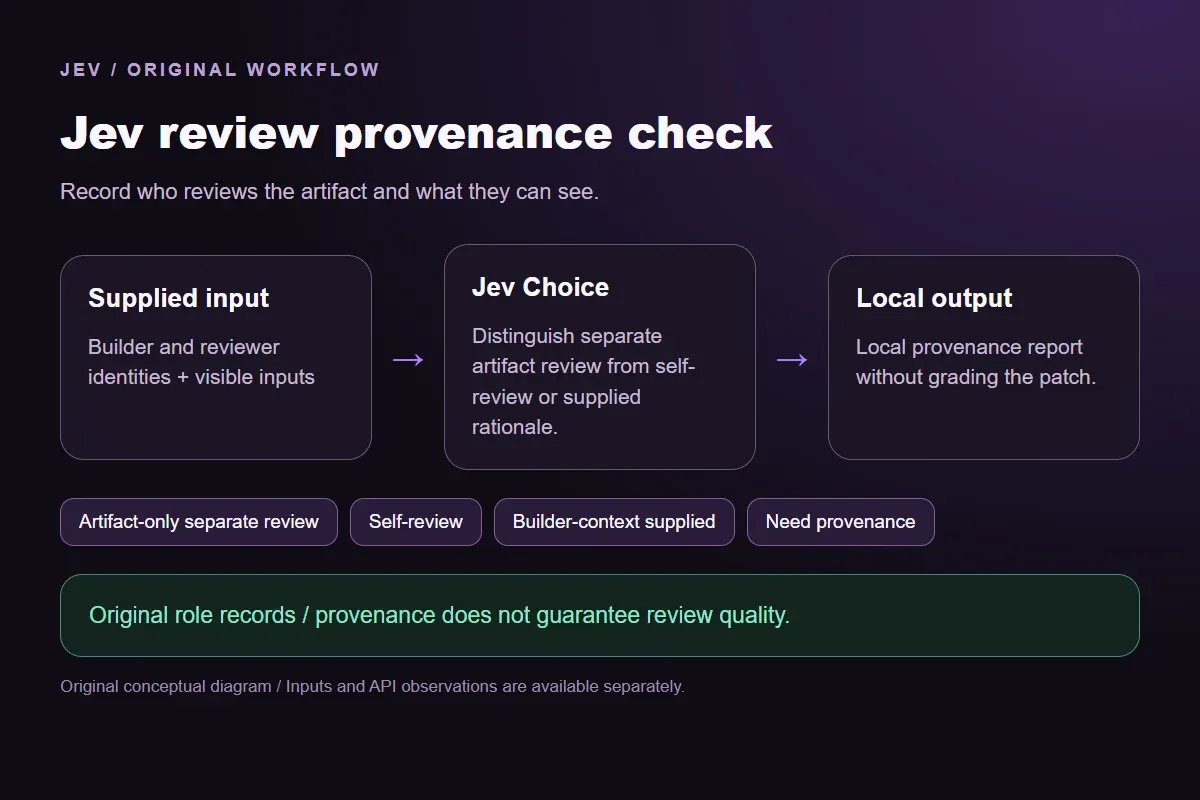

Original Jev review provenance check workflow diagram showing supplied evidence, a typed decision and the local preview.
Original workflow illustration. The output is a local preview, not an executed action or source screenshot.
How it works

Try the example in four steps

Use the sample to understand the rule, then test your own input for review provenance check.

  1. Illustration of adding the text or evidence for a decision

    Add the information to check

    Provide builder and reviewer instance IDs together with the reviewer's input manifest.

  2. Illustration of defining a question and its allowed choices

    Confirm the question and labels

    Open the decision rules and keep the intended distinction between Artifact-only separate review, Self-review, Builder-context supplied, Need provenance. Edit the choices only when testing your own rule.

  3. Illustration of sending one input and comparing the returned choices

    Run the decision

    Use a sample first, then try your own input. Compare the selected label with the other returned probabilities.

  4. Illustration of reviewing a result and an uncertain item before using it

    Review the next step

    Review Artifact-only separate review, Self-review, Need provenance before using a result. The label is a decision about the supplied information, not an executed action.

Our API test

What the six original inputs returned.

What the six original inputs returned.
Original test inputObserved labelLeading probability
A separate artifact-only reviewerArtifact-only separate review100%
One instance with two role namesSelf-review100%
A distinct reviewer with builder rationaleBuilder-context supplied100%
Unspecified reviewer identityNeed provenance97%
Shared requirements without builder reasoningArtifact-only separate review100%
A separate reviewer given the prior chatBuilder-context supplied100%
  • Measured adapter round trips: 445-1158 ms. Estimated input cost: $0.00002638-$0.00002927 per request. These observations are not a latency guarantee or invoice.

6 actual Jev API calls on October 2, 2026. Original synthetic inputs check this rubric and handoff; they do not establish held-out accuracy. Probabilities are model outputs.Verified

Understand the results

Separate review inputs do not prove review quality

The separate-review fixture explicitly identifies distinct instances and a bounded artifact-only view. Artifact-only separate review records that provenance. It does not certify the reviewer's skill, independence of judgment or factual correctness. Those properties need an actual review and evidence of its findings.

The renamed-role fixture keeps the same instance as builder and reviewer

The renamed-role fixture keeps the same instance as builder and reviewer. Self-review follows that identity despite the new title. A production audit should retain instance provenance rather than infer separation from labels such as reviewer or auditor.

The plan fixture gives a distinct reviewer the builder's rationale

The plan fixture gives a distinct reviewer the builder's rationale. Builder-context supplied makes the visible input difference explicit. This demo does not claim that the context necessarily biases a particular review; it prevents the setup from being described as artifact-only.

The unspecified-identity fixture lacks instance and input evidence

The unspecified-identity fixture lacks instance and input evidence. Need provenance preserves both gaps. A project should record who produced the artifact and what the reviewer actually received before making a claim about separation.

The shared-requirements fixture permits the reviewer to see the user's requirements and artifact

The shared-requirements fixture permits the reviewer to see the user's requirements and artifact. The rubric distinguishes these from the builder's internal plan or rationale. The original expectation is Artifact-only separate review, with no claim about a real model or review outcome.

The full-chat fixture gives a separate reviewer the builder's reasoning along with earlier messages

The full-chat fixture gives a separate reviewer the builder's reasoning along with earlier messages.

Read the example notes

Builder-context supplied concerns that supplied context. A real review process needs access control, recorded inputs, actual findings and independent validation. This page changes no review workflow and grades no patch.

The offline report contains the selected provenance label and this workflow identifier

The offline report contains the selected provenance label and this workflow identifier.

Read the example notes

It does not contain a patch grade, model preference or claim about reviewer performance. Keeping this output contract fixed makes the original setup descriptions reproducible. A real review audit would need recorded instance identity and actual access-controlled inputs in addition to the semantic description.

Using the result in your application

The input manifest separates instance identity from the visible input kinds.

Read the example notes

Read the IDs and the artifact, requirements, builder-reasoning or builder-chat-history entries before running the request. The unknown fixture keeps both reviewer identity and its manifest null. Code maps the actual leader to provenanceOutcome, builderContextSupplied and nextStep; every packet remains pending. Those fields describe the supplied setup and the work still needed, not proof of an independent review or a content approval.

New responses are required because the structured manifest changes every exact request. Earlier prose-card observations remain available in the audit history.

Using the result in your application

Download the exact sample requests and saved observations below.

Read the example notes

Expected labels are original fixture checks and stay outside the request sent to Jev. The observation file preserves the complete probabilities and the hash of each exact request. Editing a task, rubric or candidate requires a fresh response; a matching sample name does not make an older answer current.

Using the result in your application

The JavaScript runner makes one independent SDK request for a chosen sample ID.

Read the example notes

It reads TYPESAFE_API_KEY privately from the environment and has no automatic retry. The Python consumer operates offline: it checks the rubric, labels, unique sample identities, request hashes and valid probability distributions before selecting a fixed local preview. A tied leading result remains pending for review.

Source and example scope

The page reports measured adapter round trips and estimated input cost for the recorded calls.

Read the example notes

Those values describe these requests, not a provider latency guarantee or a billing statement. Six deliberately authored fixtures can check the stated behavior, but they do not establish accuracy on an unseen dataset. Keep disagreements and missing-input examples when testing an integration.

Runnable offline example

Replay one request and inspect the saved preview.

View the code example
Replay commands
npm install @typesafe-ai/sdk@0.6.0
# Set TYPESAFE_API_KEY privately in your shell.
node run-choice-sample.mjs samples.json independent
python preview_choice_workflow_v2.py samples.json saved-api-results.json
Scope of this demo

Where does this decision fit?

Useful with explicit supplied evidence

  • Classify explicit builder and reviewer instance records plus the reviewer input manifest. Produce a local review-input packet separating self-review, supplied builder context, artifact-only input and missing provenance. No provider session is created or inspected, and no patch is approved.
  • Inspecting the original task and a fixed output before integrating external tools.
  • Comparing an explicit expected label with the complete recorded distribution.

Needs separate implementation or evidence

  • Inferring facts absent from the supplied input.
  • Treating a semantic selection as authorization to act.
  • Executing an external action or generalizing six fixtures into an accuracy claim.
Example FAQ

Questions about this original decision workflow.

Keep relevance, compliance and execution separate.

What does review provenance check report?

It reports the stated builder/reviewer identities and the context visible to the reviewer.

Does a separate reviewer guarantee correct findings?

No. Provenance describes the setup, not the quality or independence of its conclusions.

Can renaming the builder create an independent instance?

No. The rubric follows the supplied instance identity.

Are user requirements allowed in artifact-only review?

Yes. The defined setup includes the artifact and requirements while excluding builder reasoning.

Does this demo review actual code?

No. It reviews original role and input records and produces a local report.

Try a task from your own workflow

Change the supplied task or evidence here, then inspect the live response. Playground supports another explicit decision.


