Jev pull request scope review

Check whether a pull request stays within the request

Compare the requested change with the actual patch. Identify a supported scope match, an unrelated behavior change or insufficient patch evidence without claiming to review unseen code.

Check the patch against the actual request.Live API
Try an example

Original synthetic input. Edit the task or evidence to make a new API request.

Source: Workflow inspiration on X

Source and example scope

The inputs, rubric and preview are original. This window demonstrates the stated decision only; it does not reproduce the source application or its measurements.

Does the supplied patch stay within the stated requested change?

Decision rules and labels
Scope matchScope mismatchInsufficient patch
A real response from the Jev API

Edit any input to explore a different decision. No request is sent until you run it.

Your next decision

Not run yet

Choose an example or write your own input, then run it to see the ranked choices.

Results are not stored by this site. Your submitted text is processed by the API provider.

The decision

How does Jev pull request scope review use the supplied evidence?

Jev pull request scope review compares a change request with the patch supplied beside it. Our first original example asks for a button label change and shows exactly that edit. Another adds a retry change the request explicitly excludes. The question concerns that boundary, not whether either implementation passes tests or should merge.

An API-collected X post about assessing pull requests with TypeSafe Jev inspired this exercise. We read a maintainer's review action that accepts PR metadata and changed-file patches. This page does not install that action, fetch a GitHub repository or reproduce the source's deployment and model comparisons. All patches here are original synthetic inputs.

A title such as fix a typo is weak evidence of what a patch does. The changed lines make the comparison inspectable. The missing-diff sample deliberately supplies a completion claim without those lines. Insufficient patch is useful here because it preserves a request for evidence instead of treating a plausible description as the change itself.
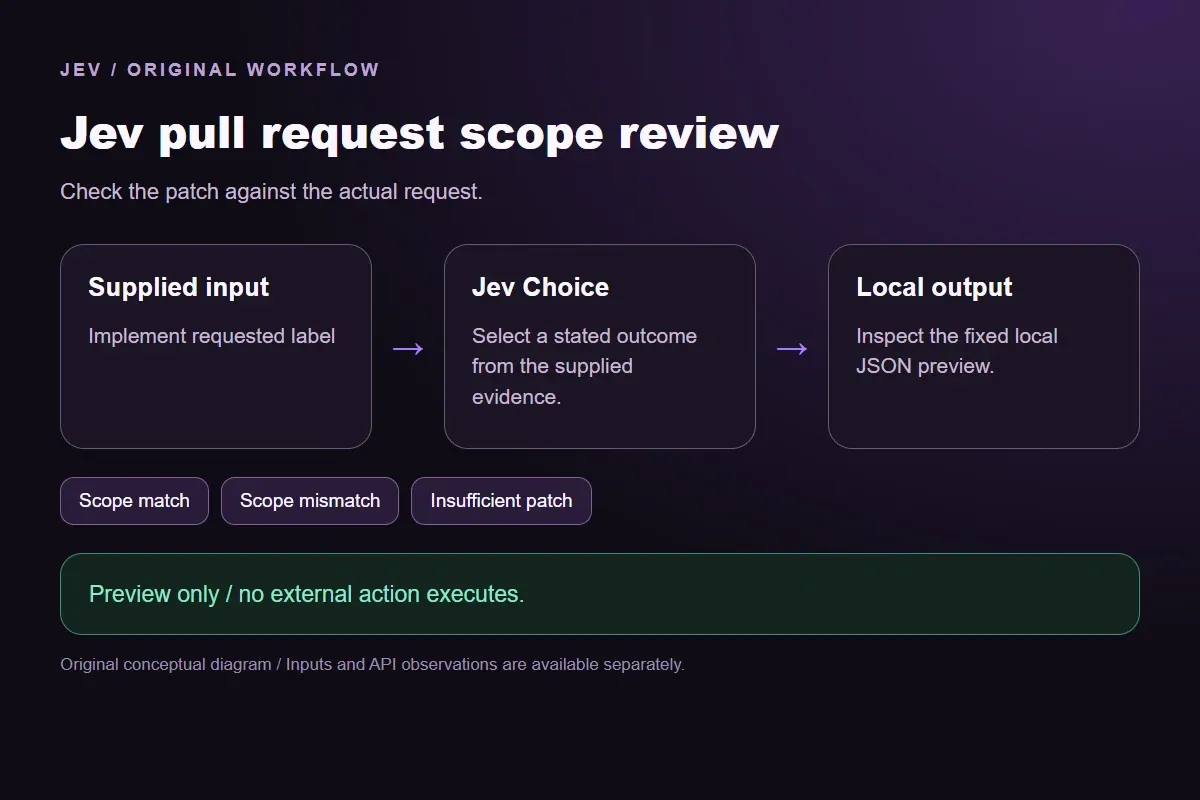

Original Jev pull request scope review workflow diagram showing supplied evidence, a typed decision and the local preview.
Original workflow illustration. The output is a local preview, not an executed action or source screenshot.
How it works

Try the example in four steps

Use the sample to understand the rule, then test your own input for pull request scope check.

  1. Illustration of adding the text or evidence for a decision

    Add the information to check

    Compare the requested change with the actual patch.

  2. Illustration of defining a question and its allowed choices

    Confirm the question and labels

    Open the decision rules and keep the intended distinction between Scope match, Scope mismatch, Insufficient patch. Edit the choices only when testing your own rule.

  3. Illustration of sending one input and comparing the returned choices

    Run the decision

    Use a sample first, then try your own input. Compare the selected label with the other returned probabilities.

  4. Illustration of reviewing a result and an uncertain item before using it

    Review the next step

    Review Insufficient patch before using a result. The label is a decision about the supplied information, not an executed action.

Our API test

What the six original inputs returned.

What the six original inputs returned.
Original test inputObserved labelLeading probability
Implement requested labelScope match58%
Unrequested retry behaviorScope mismatch100%
Contradict requested sortingScope mismatch90%
Summary without diffInsufficient patch100%
Unseen helper implementationInsufficient patch82%
Implement explicit empty-list handlingScope match88%
  • Measured adapter round trips: 466-1173 ms. Estimated input cost: $0.00002276-$0.00002377 per request. These observations are not a latency guarantee or invoice.

6 actual Jev API calls on October 1, 2026. Original synthetic inputs check this rubric and handoff; they do not establish held-out accuracy. Probabilities are model outputs.Verified

Understand the results

The label-only sample contains a tiny, fully visible change

The label-only sample contains a tiny, fully visible change.

Read the example notes

Its fixture expectation is Scope match because the changed value follows the requested wording and no other changed lines appear. This says nothing about where the label renders, whether localization is complete or whether a different file has an undisclosed change. A real adapter must define its patch coverage.

The retry sample separates a correct requested edit from an extra behavioral edit

The retry sample separates a correct requested edit from an extra behavioral edit.

Read the example notes

A patch can satisfy part of a request while still exceeding it. The rubric labels the entire supplied change Scope mismatch when unrelated behavior is explicitly visible. Keep the original diff when presenting that verdict so the reviewer can inspect the boundary rather than relying on a label alone.

Contradict requested sorting

The sorting example checks contradiction rather than an extra file.

Read the example notes

Its stated target is newest first, but the supplied comparator remains oldestFirst. Function names and the stated comparator meaning form the evidence in this synthetic case. If a real helper has an unexpected implementation, its source or test evidence must be added; a familiar name does not prove its behavior.

The blank-email example replaces a visible guard with a helper whose body is absent

The blank-email example replaces a visible guard with a helper whose body is absent.

Read the example notes

It is not classified as definitely wrong. The missing implementation prevents this supplied patch from establishing the requested behavior. A follow-up packet can add the helper body and relevant tests, then make a fresh request. Preserve the earlier incomplete packet and its response.

The empty-list sample adds a stated early return and leaves the shown nonempty path unchanged

The empty-list sample adds a stated early return and leaves the shown nonempty path unchanged.

Read the example notes

That gives a contrasting matching example beyond text edits. These six fixtures test the chosen scope rule, not a general code-review benchmark. Include patches with renamed files, generated code and truncated diffs in a separate evaluation before integrating a real PR collector.

Keep deterministic checks in production review

A production review workflow still needs deterministic checks for checkout identity, patch size, compiler results and test status.

Read the example notes

It also needs a trusted permission boundary before any comment, approval or merge. Our offline report has mergeAuthorized false even for Scope match. Nothing in the downloaded replay invokes Git, checks out a submitted branch or executes patch contents.

Using the result in your application

Download the exact sample requests and saved observations below.

Read the example notes

Expected labels are original fixture checks and stay outside the request sent to Jev. The observation file preserves the complete probabilities and the hash of each exact request. Editing a task, rubric or candidate requires a fresh response; a matching sample name does not make an older answer current.

Using the result in your application

The JavaScript runner makes one independent SDK request for a chosen sample ID.

Read the example notes

It reads TYPESAFE_API_KEY privately from the environment and has no automatic retry. The Python consumer operates offline: it checks the rubric, labels, unique sample identities, request hashes and valid probability distributions before selecting a fixed local preview. A tied leading result remains pending for review.

Source and example scope

The page reports measured adapter round trips and estimated input cost for the recorded calls.

Read the example notes

Those values describe these requests, not a provider latency guarantee or a billing statement. Six deliberately authored fixtures can check the stated behavior, but they do not establish accuracy on an unseen dataset. Keep disagreements and missing-input examples when testing an integration.

Runnable offline example

Replay one request and inspect the saved preview.

View the code example
Replay commands
npm install @typesafe-ai/sdk@0.6.0
# Set TYPESAFE_API_KEY privately in your shell.
node run-choice-sample.mjs samples.json format
python preview_choice_workflow_v2.py samples.json saved-api-results.json
Scope of this demo

Where does this decision fit?

Useful with explicit supplied evidence

  • Compare a supplied pull-request patch with its stated change request, distinguishing scope match, scope mismatch and insufficient patch evidence. This original semantic assessment never merges, approves or executes submitted code.
  • Inspecting the original task and a fixed output before integrating external tools.
  • Comparing an explicit expected label with the complete recorded distribution.

Needs separate implementation or evidence

  • Inferring facts absent from the supplied input.
  • Treating a semantic selection as authorization to act.
  • Executing an external action or generalizing six fixtures into an accuracy claim.
Example FAQ

Questions about this original decision workflow.

Keep relevance, compliance and execution separate.

Does Scope match mean the patch is correct?

No. It describes alignment with the supplied request and visible changed lines. Tests, security review, runtime behavior and merge authorization remain separate checks.

Does this page fetch my GitHub pull request?

No. It sends the original text you supply to the site's server-side Jev endpoint. A production GitHub evidence collector is outside this demo.

Why keep the missing-patch result?

A PR title or completion claim cannot show the actual edit. Insufficient patch identifies that missing evidence without inventing changed code.

Can a matching patch contain an unrelated change?

Under this explicit rule, a visible unrelated behavioral change produces Scope mismatch even when part of the patch fulfills the request. Inspect the complete supplied diff beside the result.

Will the replay approve or merge anything?

No. It validates recorded requests and prints a fixed local report with mergeAuthorized false. It never calls GitHub, runs Git or executes code from the patch.

Try a task from your own workflow

Change the supplied task or evidence here, then inspect the live response. Playground supports another explicit decision.


