



Jev podcast segment role

Identify the role of a podcast script segment

Supply a script segment and its context. Distinguish an introduction, substantive explanation, topic transition and sponsor message before organizing the episode; the example does not generate audio.

Label the function of a supplied script segment.Live API
Try an example

Original synthetic input. Edit the task or evidence to make a new API request.

Source: Workflow inspiration on X

Source and example scope

The inputs, rubric and preview are original. This window demonstrates the stated decision only; it does not reproduce the source application or its measurements.

Classify scriptText using segmentContext.

Decision rules and labels
IntroductionExplanationTransitionSponsorNeed context
A real response from the Jev API

Edit any input to explore a different decision. No request is sent until you run it.

Your next decision

Not run yet

Choose an example or write your own input, then run it to see the ranked choices.

Results are not stored by this site. Your submitted text is processed by the API provider.

The decision

How does the Jev podcast segment role demo classify scripts?

The Jev podcast segment role demo labels what a script segment is doing within an episode. A welcome, an explanation, a bridge and an advertisement serve different functions even when they mention the same subject.

The API-collected source asks whether Jev could help an automated two-host podcast decide what goes into the show. This independent example checks segment function rather than deciding which stories deserve publication. It does not reproduce that show, inspect its recordings or judge its editorial choices.

The original script fragments describe a fictional episode about restoring files. Their roles are explicit enough to inspect, while a short unsupported line remains unresolved. A label can help organize a supplied script; it cannot establish transcript accuracy, sponsorship disclosure compliance or readiness to publish.

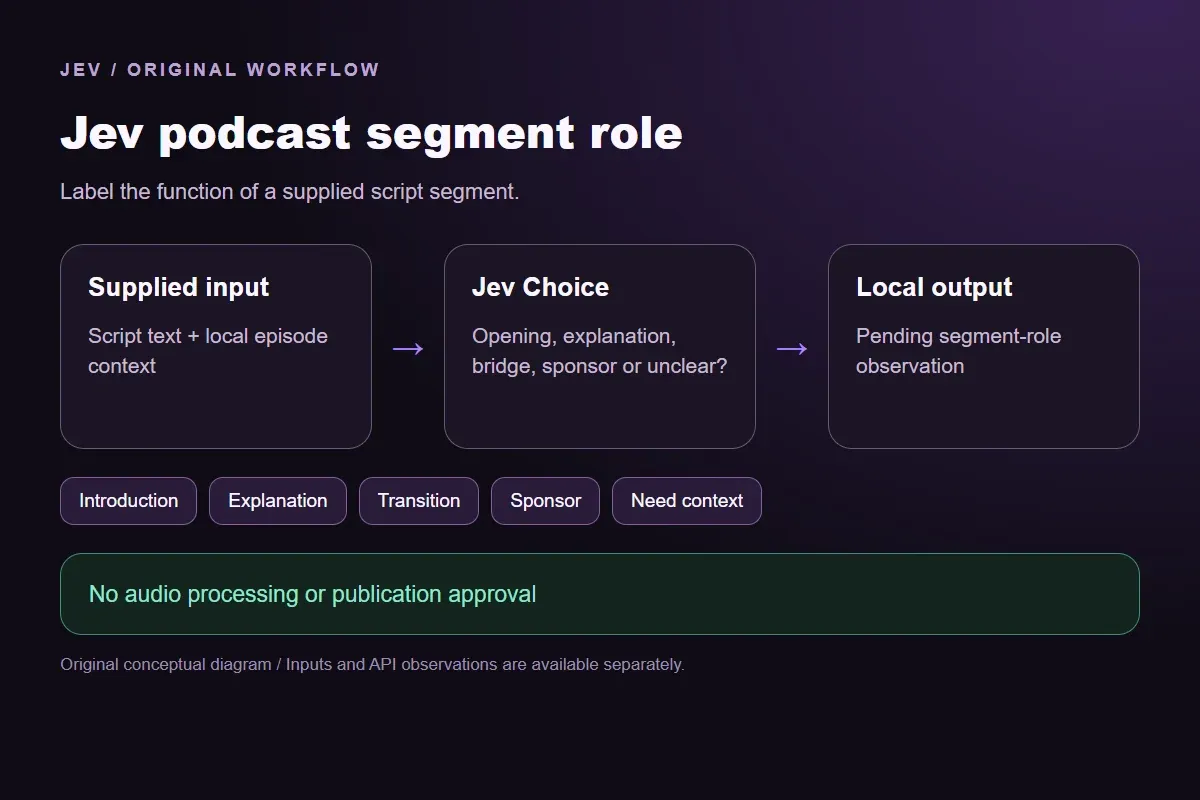
Original Jev podcast segment role workflow diagram showing supplied evidence, a typed decision and the local preview.
Original workflow illustration. The output is a local preview, not an executed action or source screenshot.
How it works

Try the example in four steps

Use the sample to understand the rule, then test your own input for podcast segment classification.

  1. Illustration of adding the text or evidence for a decision

    Add the information to check

    Supply a script segment and its context.

  2. Illustration of defining a question and its allowed choices

    Confirm the question and labels

    Open the decision rules and keep the intended distinction between Introduction, Explanation, Transition, Sponsor, Need context. Edit the choices only when testing your own rule.

  3. Illustration of sending one input and comparing the returned choices

    Run the decision

    Use a sample first, then try your own input. Compare the selected label with the other returned probabilities.

  4. Illustration of reviewing a result and an uncertain item before using it

    Review the next step

    Review Need context before using a result. The label is a decision about the supplied information, not an executed action.

Our API test

What the six original inputs returned.

What the six original inputs returned.
Original test inputFixture expectationObserved labelLeading probability
Welcome and episode previewIntroductionIntroduction100%
Substantive topic explanationExplanationExplanation100%
Bridge to the next topicTransitionTransition100%
Explicit sponsor messageSponsorSponsor87%
A line without a clear roleNeed contextNeed context100%
No supplied scriptNeed contextNeed context100%
  • 6 of 6 original fixture expectations matched. Contrary outputs are preserved in the table and downloads; these checks are not held-out accuracy or production suitability.
  • Measured adapter round trips: 455-1749 ms. Estimated input cost: $0.00002339-$0.00002449 per request. These observations are not a latency guarantee or invoice.

6 actual Jev API calls on October 2, 2026. Original synthetic inputs check this rubric and handoff; they do not establish held-out accuracy. Probabilities are model outputs.Verified

Understand the results

Welcome and episode preview

The opening welcomes listeners, names the episode and previews its topic.

Read the example notes

Introduction refers to those visible functions, not merely to being the first sample in the list. No episode recording or publishing schedule is attached. The pending packet preserves a script-role observation. If a real opening also includes an advertisement, the application should define how to handle the mixed functions rather than silently forcing this single-role rubric onto the longer segment.

Substantive topic explanation

The explanatory fragment describes how retaining a second copy helps after accidental deletion.

Read the example notes

It develops the current topic rather than greeting the audience or moving to another topic. Explanation does not certify the advice as a complete backup strategy. The snippet is deliberately simple fictional text. Factual and product review would need separate evidence, and any revised wording must be judged with its own request instead of inheriting the saved label.

A topic bridge from local to off-site storage

The bridge says that the episode has finished discussing local copies and will now examine off-site storage.

Read the example notes

Transition follows from the explicit relationship between those two topics. It does not determine where to cut an audio file or how long a pause should be. The window receives script text and context only. A production editor would still own the timeline, track boundaries and any actual movement of the segment.

Source and example scope

The sponsor fragment explicitly identifies a paid sponsor and presents that sponsor's offer.

Read the example notes

Sponsor is a role label for the supplied text. It does not authenticate a commercial relationship, validate the offer or confirm that a jurisdiction's disclosure requirements are met. The brand name and offer are fictional. The sample lets a developer inspect an advertising boundary without borrowing a real show's promotion or implying endorsement by its author.

An ambiguous fragment without topic context

The ambiguous fragment says That makes sense without indicating the topic or its place in the conversation.

Read the example notes

Need context keeps the role unresolved. The line could follow an explanation, introduce a transition or respond to a sponsor message. A familiar conversational phrase cannot supply the missing relationship. Attach the actual surrounding script before making another judgment; repeating the same short input would not reveal the absent context.

Source and example scope

The last input leaves scriptText empty.

Read the example notes

Need context records that the material to classify is absent. It does not mean the API failed, the episode has no opening or the author should delete a segment. A production ingestion step could detect an empty field in code before paying for a semantic request. This fixture retains the empty input to expose how the declared model contract treats missing evidence.

Source and example scope

Fixture expectations are authored before the calls. Any contrary model choice remains visible beside its expectation and complete distribution; no repeated judgment is used to obtain a preferred label.

Using the result in your application

Download the exact sample requests and saved observations below.

Read the example notes

Expected labels are original fixture checks and stay outside the request sent to Jev. The observation file preserves the complete probabilities and the hash of each exact request. Editing a task, rubric or candidate requires a fresh response; a matching sample name does not make an older answer current.

Using the result in your application

The JavaScript runner makes one independent SDK request for a chosen sample ID.

Read the example notes

It reads TYPESAFE_API_KEY privately from the environment and has no automatic retry. The Python consumer operates offline: it checks the rubric, labels, unique sample identities, request hashes and valid probability distributions before selecting a fixed local preview. A tied leading result remains pending for review.

Source and example scope

The page reports measured adapter round trips and estimated input cost for the recorded calls.

Read the example notes

Those values describe these requests, not a provider latency guarantee or a billing statement. Six deliberately authored fixtures can check the stated behavior, but they do not establish accuracy on an unseen dataset. Keep disagreements and missing-input examples when testing an integration.

Runnable offline example

Replay one request and inspect the saved preview.

View the code example
Replay commands
npm install @typesafe-ai/sdk@0.6.0
# Set TYPESAFE_API_KEY privately in your shell.
node run-choice-sample.mjs samples.json intro
python preview_choice_workflow_v2.py samples.json saved-api-results.json
Scope of this demo

Where does this decision fit?

Useful with explicit supplied evidence

  • Classify the function of a supplied podcast script segment as an episode introduction, topic explanation, transition, sponsor message or unresolved role. Use the actual script and local context. No audio is transcribed, speaker identified, story approved or episode published.
  • Inspecting the original task and a fixed output before integrating external tools.
  • Comparing an explicit expected label with the complete recorded distribution.

Needs separate implementation or evidence

  • Inferring facts absent from the supplied input.
  • Treating a semantic selection as authorization to act.
  • Executing an external action or generalizing six fixtures into an accuracy claim.
Example FAQ

Questions about this original decision workflow.

Keep relevance, compliance and execution separate.

Does this select stories for an episode?

No. It labels the function of supplied script text. Story relevance, source quality and publication readiness are separate editorial decisions.

Does it process audio or identify speakers?

No. This example receives text and its supplied context. It performs no transcription, diarization or audio editing.

What if one segment has multiple roles?

This demonstration expects one resolvable role. Split the segment or define an explicit mixed-role policy before applying it to a longer script.

Does Sponsor prove a paid relationship?

No. It means the supplied script explicitly presents a paid promotion. Real sponsorship records, offer validation and disclosure review remain separate.

Can I test the surrounding script?

Yes. Supply the relevant text and context in the window. The edited state creates a new API request rather than reusing a saved fixture answer.

Try a task from your own workflow

Change the supplied task or evidence here, then inspect the live response. Playground supports another explicit decision.