Jev paired language replay

Compare review-status labels across languages

Try sentences stating that a review is complete, outstanding or unspecified. Compare the same English output labels across supplied languages; the example classifies meaning rather than translating text.

Compare equivalent statements with one fixed label contract.Live API
Try an example

Original synthetic input. Edit the task or evidence to make a new API request.

Source: Workflow inspiration on X

Source and example scope

The inputs, rubric and preview are original. This window demonstrates the stated decision only; it does not reproduce the source application or its measurements.

Which review state is stated in the supplied sentence, regardless of its language?

Decision rules and labels
CompleteAwaiting reviewUnknown
A real response from the Jev API

Edit any input to explore a different decision. No request is sent until you run it.

Your next decision

Not run yet

Choose an example or write your own input, then run it to see the ranked choices.

Results are not stored by this site. Your submitted text is processed by the API provider.

The decision

How does Jev paired language replay use the supplied evidence?

Jev paired language replay compares original English, Spanish and Chinese statements using one fixed review-status question. A completed-review sentence appears in English and Spanish; an outstanding-review sentence appears in English and Chinese. A third pair supplies no review information. All six requests return the same set of permitted English labels.

An API-collected X discussion mentioned evaluating Jev on messy multilingual context. This exercise isolates a few manually written text pairs rather than reproducing the source memory or chunking pipeline. It runs actual TypeSafe Jev calls with the Choice contract. No translation service, public multilingual dataset or source effectiveness result is adopted.

The labels are fixed while the sentence language changes. This lets a developer inspect how the same output contract travels through the application. The original fixture defines the intended equivalence of each pair. The offline consumer compares returned labels only; it cannot verify that arbitrary translations preserve every nuance.
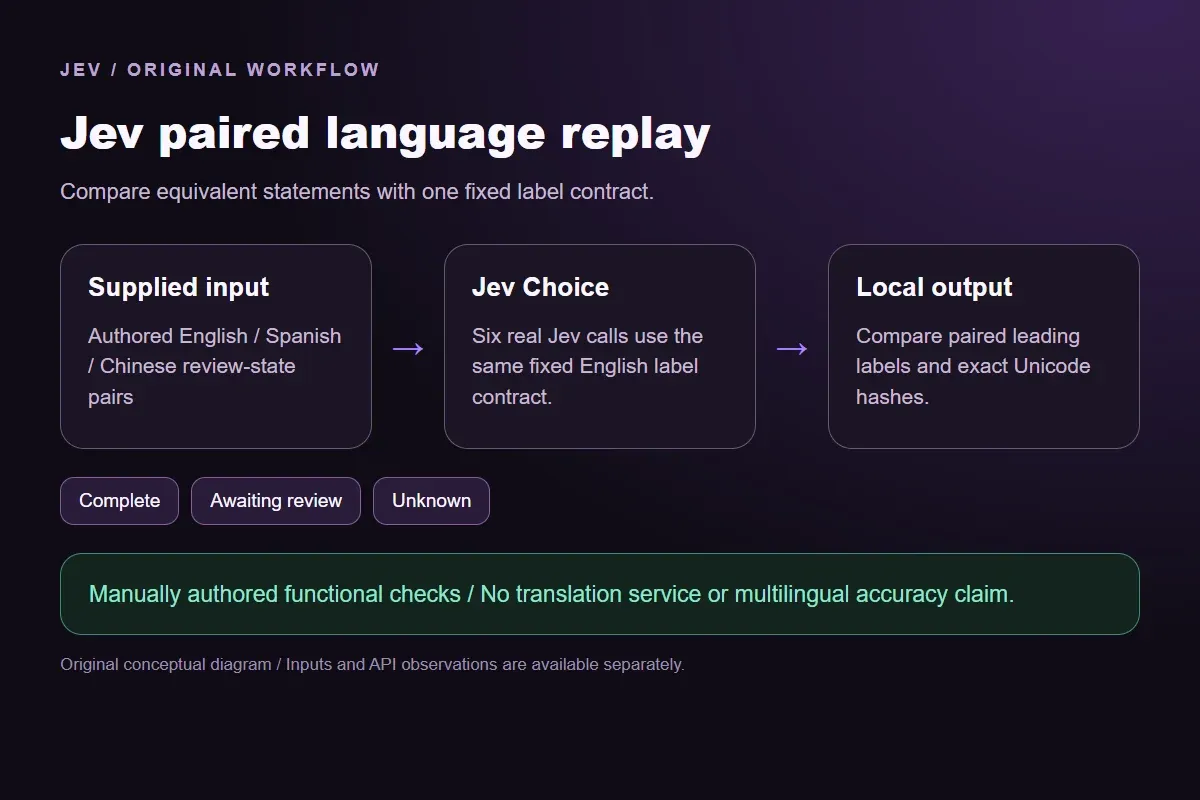

Original Jev paired language replay workflow diagram showing supplied evidence, a typed decision and the local preview.
Original workflow illustration. The output is a local preview, not an executed action or source screenshot.
How it works

Try the example in four steps

Use the sample to understand the rule, then test your own input for multilingual status labels.

  1. Illustration of adding the text or evidence for a decision

    Add the information to check

    Try sentences stating that a review is complete, outstanding or unspecified.

  2. Illustration of defining a question and its allowed choices

    Confirm the question and labels

    Open the decision rules and keep the intended distinction between Complete, Awaiting review, Unknown. Edit the choices only when testing your own rule.

  3. Illustration of sending one input and comparing the returned choices

    Run the decision

    Use a sample first, then try your own input. Compare the selected label with the other returned probabilities.

  4. Illustration of reviewing a result and an uncertain item before using it

    Review the next step

    Review Awaiting review, Unknown before using a result. The label is a decision about the supplied information, not an executed action.

Our API test

What the six original inputs returned.

What the six original inputs returned.
Original test inputFixture expectationObserved labelLeading probability
Completed review / EnglishCompleteComplete100%
Completed review / SpanishCompleteComplete100%
Outstanding review / EnglishAwaiting reviewAwaiting review100%
Outstanding review / ChineseAwaiting reviewAwaiting review100%
No review information / EnglishUnknownUnknown97%
No review information / SpanishUnknownUnknown91%
  • 6 of 6 original fixture expectations matched. Contrary outputs are preserved in the table and downloads; these checks are not held-out accuracy or production suitability.
  • Measured adapter round trips: 474-1247 ms. Estimated input cost: $0.00002008-$0.00002058 per request. These observations are not a latency guarantee or invoice.

6 actual Jev API calls on October 1, 2026. Original synthetic inputs check this rubric and handoff; they do not establish held-out accuracy. Probabilities are model outputs.Verified

Understand the results

Using the result in your application

The completed-review pair says the required review has finished in English and Spanish.

Read the example notes

Complete is the original expected label for both sentences. The exact Spanish wording is stored beside its request hash, not replaced by the English sentence before calling the model. Expected labels stay in the fixture and are not sent as instructions.

Source and example scope

The outstanding-review pair uses English and Chinese.

Read the example notes

Both authored statements explicitly say the required review has not completed and remains outstanding. Awaiting review is the expected fixed English label. This checks a small semantic boundary and Unicode transport; it does not test every language, regional usage or style of expressing an unfinished task.

The no-information pair describes an existing draft and gives no review status

The no-information pair describes an existing draft and gives no review status.

Read the example notes

Unknown is the expected label in both languages. The model should not infer that a draft has been reviewed or is necessarily awaiting review. That distinction is the same supplied-evidence rule used in the positive and outstanding examples.

Using the result in your application

The v3 offline consumer validates each exact request, including its Unicode context, rubric and choices.

Read the example notes

The hash uses UTF-8 content and preserves the original sentence. A manually substituted English context would invalidate the corresponding Spanish or Chinese result. The downloaded SDK runner sends one selected original request and performs no translation step.

Using the result in your application

The pair report shows both leader lists and sameUniqueLeadingChoice for two untied answers.

Read the example notes

A different unique label produces false; a tie produces null and keeps the local output pending. The comparison is mechanical and does not establish linguistic correctness. The saved distributions provide more information than the shared label alone.

Source and example scope

A serious multilingual evaluation needs independent labels, native-language review, realistic documents and enough cases to expose failures.

Read the example notes

These six authored sentences are functional checks, not that evaluation. Keep negation, mixed-language context, absent evidence and local terminology in a separate dataset. Our fixed output retains textTranslated false, and no translated text or generated explanation is produced.

Source and example scope

The table and downloads preserve original expectations and every actual response. The offline comparison shows the observed unique leaders for each authored pair. Any mismatch stays visible; these manually written sentences do not constitute a multilingual benchmark.

Using the result in your application

Download the exact sample requests and saved observations below.

Read the example notes

Expected labels are original fixture checks and stay outside the request sent to Jev. The observation file preserves the complete probabilities and the hash of each exact request. Editing a task, rubric or candidate requires a fresh response; a matching sample name does not make an older answer current.

Using the result in your application

The JavaScript runner makes one independent SDK request for a chosen sample ID.

Read the example notes

It reads TYPESAFE_API_KEY privately from the environment and has no automatic retry. The Python consumer operates offline: it checks the rubric, labels, unique sample identities, request hashes and valid probability distributions before selecting a fixed local preview. A tied leading result remains pending for review.

Source and example scope

The page reports measured adapter round trips and estimated input cost for the recorded calls.

Read the example notes

Those values describe these requests, not a provider latency guarantee or a billing statement. Six deliberately authored fixtures can check the stated behavior, but they do not establish accuracy on an unseen dataset. Keep disagreements and missing-input examples when testing an integration.

Runnable offline example

Replay one request and inspect the saved preview.

View the code example
Replay commands
npm install @typesafe-ai/sdk@0.6.0
# Set TYPESAFE_API_KEY privately in your shell.
node run-choice-sample.mjs samples.json complete-en
python preview_choice_workflow_v3.py samples.json saved-api-results.json
Scope of this demo

Where does this decision fit?

Useful with explicit supplied evidence

  • Compare original equivalent review-status statements in English, Spanish and Chinese using the same explicit Jev rubric and fixed English labels. Six actual calls retain paired outcomes and exact Unicode request hashes. These authored text pairs are functional checks, not a multilingual accuracy benchmark.
  • Inspecting the original task and a fixed output before integrating external tools.
  • Comparing an explicit expected label with the complete recorded distribution.

Needs separate implementation or evidence

  • Inferring facts absent from the supplied input.
  • Treating a semantic selection as authorization to act.
  • Executing an external action or generalizing six fixtures into an accuracy claim.
Example FAQ

Questions about this original decision workflow.

Keep relevance, compliance and execution separate.

Does the demo translate the input?

No. It sends the original supplied sentence to Jev and returns a fixed English label. The preview has textTranslated false.

Does matching a pair prove multilingual accuracy?

No. These are manually authored functional checks. A multilingual benchmark needs independent labels, native-language review and a broader realistic dataset.

Why keep Unknown in both languages?

An existing draft does not establish its review state. The fixed rule preserves the absence of information regardless of the sentence language.

Are Unicode characters preserved in the downloads?

Yes. Each original context is included in its request and validated against its exact UTF-8 hash. Replacing it with a translated sentence creates a different request.

Can the offline comparison judge the quality of a translation?

No. It compares recorded leading labels. The intended equivalence of these original pairs is supplied by the fixture author and needs separate linguistic review for new examples.

Try a task from your own workflow

Change the supplied task or evidence here, then inspect the live response. Playground supports another explicit decision.


