Jev outreach history check

Jev outreach history check. Check the relationship before starting outreach.

Jev outreach history check: Checks contact history before a first-contact pitch and keeps existing relationships separate from a new prospect.

Check the relationship before starting outreach.Live API
Try an example

Original synthetic input. Edit the task or evidence to make a new API request.

Source: Workflow inspiration on X

Source and example scope

The inputs, rubric and preview are original. This window demonstrates the stated decision only; it does not reproduce the source application or its measurements.

Review proposed first-contact outreach against supplied history.

Decision rules and labels
Existing customerOpen conversationDo not contactFirst contactNeed history
A real response from the Jev API

Edit any input to explore a different decision. No request is sent until you run it.

Your next decision

Not run yet

Choose an example or write your own input, then run it to see the ranked choices.

Results are not stored by this site. Your submitted text is processed by the API provider.

The decision

How does Jev outreach history check use its evidence?

Jev outreach history check checks contact history before a first-contact pitch and keeps existing relationships separate from a new prospect.

The source post describes checking relationships before outreach. Our original records isolate that preflight rather than reproducing its recruiting system, CRM or video. All contact names and situations are fictional. The window sends a real Jev request and displays the bounded outcome.

A lead can fit a sales profile and still be the wrong person for a first-contact sequence. A current customer belongs with its account owner; an open conversation belongs with the existing thread. This exercise checks that relationship state only. It does not score willingness to buy or grant permission to contact someone.
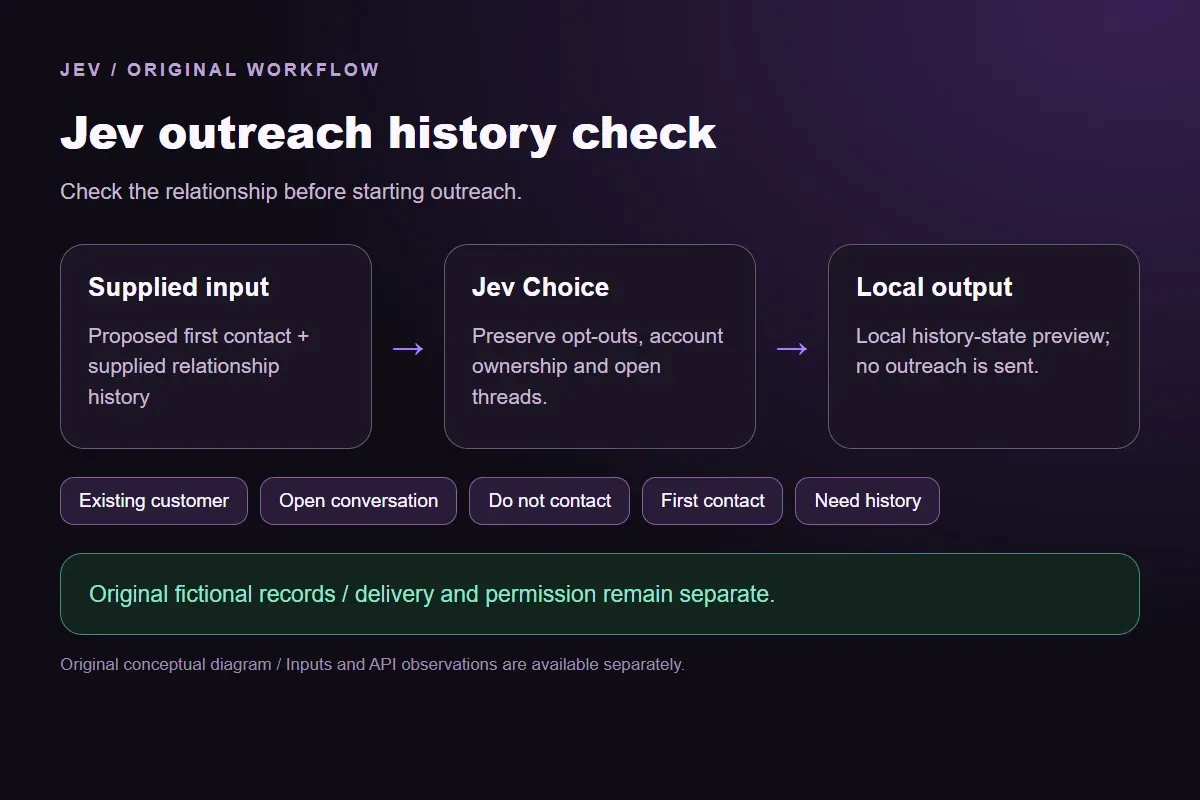

Original Jev outreach history check workflow diagram showing supplied evidence, a typed decision and the local preview.
Original workflow illustration. The output is a local preview, not an executed action or source screenshot.
How it works

Inspect the decision in four steps.

Keep the evidence and the returned output attached to the same request.

  1. Illustration of adding the text or evidence for a decision

    Supply the actual task

    Proposed first-contact pitch. History: active customer contract; account owner Mira; no opt-out. The model sees this original task and the provided evidence.

  2. Illustration of defining a question and its allowed choices

    Define the permitted outcomes

    Use the explicit rubric in the window. Every label has a stated meaning; missing evidence cannot create an unavailable action.

  3. Illustration of sending one input and comparing the returned choices

    Inspect the complete response

    Compare all offered probabilities and preserve the actual leading choice. A provider failure is separate from a semantic no-match or review outcome.

  4. Illustration of reviewing a result and an uncertain item before using it

    Preview the local handoff

    Replay the saved observations with the offline consumer. The mapped JSON stays local and no external action executes.

Our API test

What the six original inputs returned.

What the six original inputs returned.
Original test inputObserved labelLeading probability
An account already existsExisting customer96%
An unresolved sales conversationOpen conversation98%
A recorded opt-outDo not contact88%
A checked empty historyFirst contact94%
Unavailable contact recordsNeed history79%
A resolved historical threadFirst contact95%
  • Measured adapter round trips: 494-1342 ms. Estimated input cost: $0.00002205-$0.00002255 per request. These observations are not a latency guarantee or invoice.

6 actual Jev API calls on October 1, 2026. Original synthetic inputs check this rubric and handoff; they do not establish held-out accuracy. Probabilities are model outputs.Verified

How can you reproduce this decision and inspect its output?

Original example note 1

The customer fixture names a current contract and an account owner. Existing customer retains that relationship so a proposed cold pitch can be reviewed in the account context. The preview neither looks up a CRM nor changes an owner. A production application must retrieve current authorized records before asking the same question.

Original example note 2

The open-thread fixture has no contract but does have an unresolved pricing conversation. Starting another sequence would lose that context. Open conversation names the existing state without predicting a purchase or writing a reply. Closing or reassigning the conversation is a separate action with its own application rules.

Original example note 3

The opt-out fixture includes both a current customer and an explicit marketing stop request. The rubric makes the stop request take priority. Its expected label is Do not contact. This example exercises that precedence; it does not provide a complete legal consent model or authorize another kind of communication.

Original example note 4

The checked-empty fixture explicitly says the relevant records contain no relationship or restriction. First contact means that narrow history condition is satisfied. It does not mean the address is valid, the recipient wants a message, or a campaign is authorized. The local result remains a preview and sends nothing.

Original example note 5

Unavailable records are different from records that have been checked and found empty. Need history preserves that difference. The application can fetch permitted history and make a new request; using a plausible probability to fill a missing CRM record would silently change what this decision is based on.

Original example note 6

The closed-thread fixture tests whether an old resolved conversation is mistaken for an open one. The supplied history states its closure and the absence of a contract or opt-out. Every observation remains attached to its exact input, including these status words. Updating a thread status needs a fresh evaluation.

Original example note 7

Download the exact sample requests and saved observations below. Expected labels are original fixture checks and stay outside the request sent to Jev. The observation file preserves the complete probabilities and the hash of each exact request. Editing a task, rubric or candidate requires a fresh response; a matching sample name does not make an older answer current.

Original example note 8

The JavaScript runner makes one independent SDK request for a chosen sample ID. It reads TYPESAFE_API_KEY privately from the environment and has no automatic retry. The Python consumer operates offline: it checks the rubric, labels, unique sample identities, request hashes and valid probability distributions before selecting a fixed local preview. A tied leading result remains pending for review.

Original example note 9

The page reports measured adapter round trips and estimated input cost for the recorded calls. Those values describe these requests, not a provider latency guarantee or a billing statement. Six deliberately authored fixtures can check the stated behavior, but they do not establish accuracy on an unseen dataset. Keep disagreements and missing-input examples when testing an integration.

How can you reproduce this decision and inspect its output?

Runnable offline example

Replay one request and inspect the saved preview.

View the code example
Replay commands
npm install @typesafe-ai/sdk@0.6.0
# Set TYPESAFE_API_KEY privately in your shell.
node run-choice-sample.mjs samples.json customer
python preview_choice_workflow_v2.py samples.json saved-api-results.json
Scope of this demo

Where does this decision fit?

Useful with explicit supplied evidence

  • Determine whether a proposed first-contact outreach conflicts with an existing supplied customer, open conversation or explicit opt-out record. Original fictional contact history only; no message is sent and no prospect qualification is inferred.
  • Inspecting the original task and a fixed output before integrating external tools.
  • Comparing an explicit expected label with the complete recorded distribution.

Needs separate implementation or evidence

  • Inferring facts absent from the supplied input.
  • Treating a semantic selection as authorization to act.
  • Executing an external action or generalizing six fixtures into an accuracy claim.
Example FAQ

Questions about this original decision workflow.

Keep relevance, compliance and execution separate.

What does relationship preflight check?

It checks supplied customer, conversation and opt-out history for a proposed first-contact pitch. It does not qualify a lead.

Does First contact send a message?

No. It is a local preview of the stated history condition. Delivery and authorization remain separate.

Why does an opt-out take priority?

That precedence is explicit in this original rubric. It prevents an active customer record from erasing the supplied stop request.

Can missing history count as an empty history?

No. Need history preserves unavailable records; First contact requires an explicitly checked absence.

Are these actual CRM contacts?

No. The records and names are fictional, and this demo never accesses a CRM.

Try a task from your own workflow

Change the supplied task or evidence here, then inspect the live response. Playground supports another explicit decision.