Jev obstacle action choice

Choose a maneuver for a described game obstacle

Describe the approaching obstacle and the supplied clearance rules. Compare jump, duck and run choices, preserving missing height or clearance details instead of guessing a game action.

Choose the maneuver. Keep timing in code.Live API
Try an example

Original synthetic input. Edit the task or evidence to make a new API request.

Source: Workflow inspiration on X

Source and example scope

The inputs, rubric and preview are original. This window demonstrates the stated decision only; it does not reproduce the source application or its measurements.

Choose the maneuver for the stated approaching obstacle.

Decision rules and labels
JumpDuckRunNeed more context
A real response from the Jev API

Edit any input to explore a different decision. No request is sent until you run it.

Your next decision

Not run yet

Choose an example or write your own input, then run it to see the ranked choices.

Results are not stored by this site. Your submitted text is processed by the API provider.

The decision

How does Jev obstacle action choice use the supplied evidence?

Jev obstacle action choice reads the obstacle and its clearance to select one maneuver. The six samples test ground obstacles, different bird heights and unresolved geometry.

A dinosaur-game controller can separate the question of which maneuver fits an obstacle from the question of when to press a key. This original demonstration handles only the first question. The context describes the obstacle and the relevant clearance in words. Jev returns Jump, Duck, Run or Need more context. The downloadable consumer records a pending maneuver without controlling a character.

The API-collected source describes a game experiment that also separates narrow model choice from code-owned physics and timing. We use that division to build six synthetic descriptions, not to reconstruct the game or verify its recorded performance. A cactus, a bird at head height and a clear lane need different evidence. A bird with unspecified height has no justified maneuver under the supplied rule.

These fixtures test a decision contract. They do not test frame rate, reaction time, survival duration or how a moving obstacle is detected. The actual API round trips appear with their saved responses. A game would still need to schedule actions against its own physics. Unknown geometry and contradictory notes remain explicit outcomes instead of producing an invented clearance estimate.
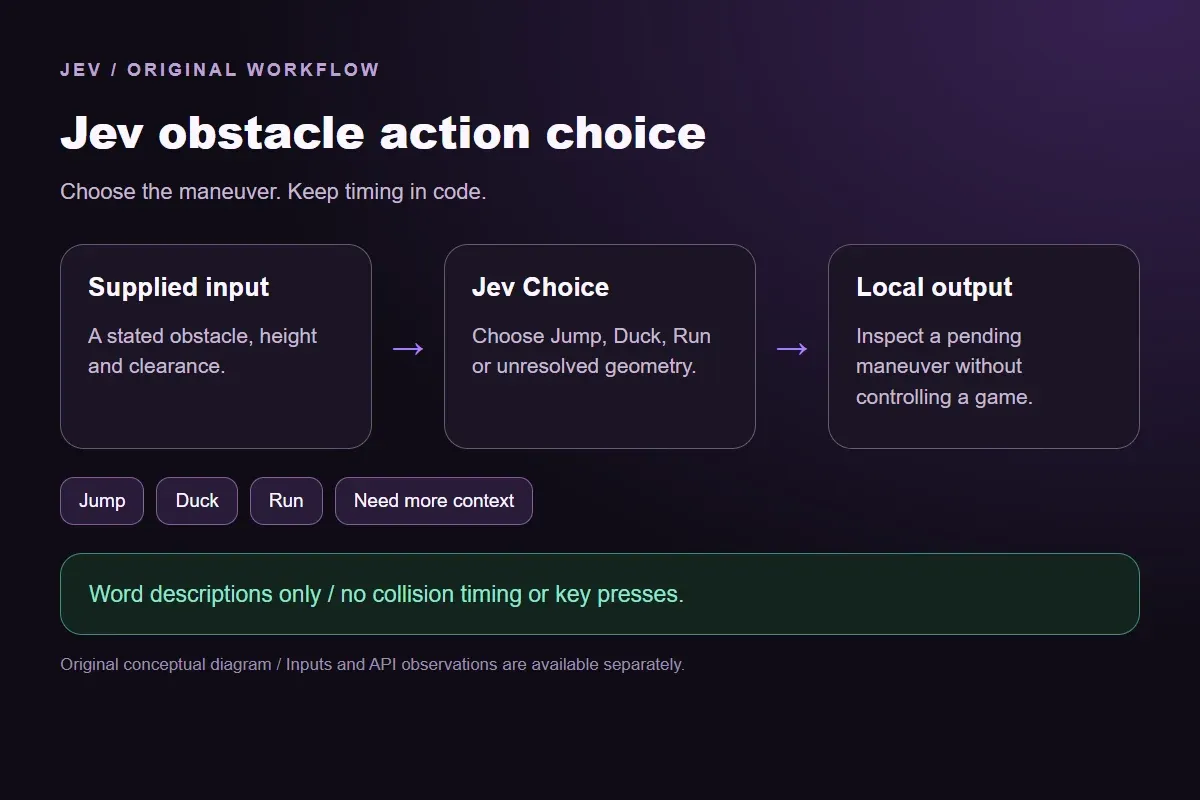

Original Jev obstacle action choice workflow diagram showing supplied evidence, a typed decision and the local preview.
Original workflow illustration. The output is a local preview, not an executed action or source screenshot.
How it works

Try the example in four steps

Use the sample to understand the rule, then test your own input for game obstacle choice.

  1. Illustration of adding the text or evidence for a decision

    Add the information to check

    Describe the approaching obstacle and the supplied clearance rules.

  2. Illustration of defining a question and its allowed choices

    Confirm the question and labels

    Open the decision rules and keep the intended distinction between Jump, Duck, Run, Need more context. Edit the choices only when testing your own rule.

  3. Illustration of sending one input and comparing the returned choices

    Run the decision

    Use a sample first, then try your own input. Compare the selected label with the other returned probabilities.

  4. Illustration of reviewing a result and an uncertain item before using it

    Review the next step

    Review Need more context before using a result. The label is a decision about the supplied information, not an executed action.

Our API test

What the six original inputs returned.

What the six original inputs returned.
Original test inputFixture expectationObserved labelLeading probability
Ground cactusJumpJump100%
Head-height birdDuckDuck98%
Clear laneRunRun100%
High birdRunRun95%
Unknown bird heightNeed more contextNeed more context100%
Contradictory clearanceNeed more contextNeed more context99%
  • 6 of 6 original fixture expectations matched. Contrary outputs are preserved in the table and downloads; these checks are not held-out accuracy or production suitability.
  • Measured adapter round trips: 450-1192 ms. Estimated input cost: $0.00002234-$0.00002318 per request. These observations are not a latency guarantee or invoice.

6 actual Jev API calls on October 3, 2026. Original synthetic inputs check this rubric and handoff; they do not establish held-out accuracy. Probabilities are model outputs.Verified

Understand the results

Using the result in your application

The cactus fixture states both the obstruction and the rule that one jump clears it.

Read the example notes

The model does not calculate a trajectory or discover a jump height. Its task is to match supplied geometry to the permitted maneuver. The preview is pending even if Jump leads the distribution. It gives developers a readable decision record before a separate controller decides whether and when an action is executable.

The head-height fixture states that ducking passes below the bird and jumping collides

The head-height fixture states that ducking passes below the bird and jumping collides.

Read the example notes

That evidence distinguishes it from a ground obstacle. An integration should preserve these words with the answer because the label alone does not explain which geometry was submitted. Changing the height or removing the crouching-clearance statement changes the question and requires a new response rather than a cached maneuver.

The clear-lane case makes the absence of an obstacle explicit

The clear-lane case makes the absence of an obstacle explicit.

Read the example notes

Run therefore means continue the stated motion, not that the API has inspected a live screen. This example receives no image, frame or telemetry. A missing observation would be a different input from an observed clear lane. The fixture keeps that distinction visible so a controller cannot treat unavailable sensor data as a verified empty path.

Source and example scope

The high-bird fixture supplies enough clearance for ordinary running.

Read the example notes

It tests whether the obstacle noun alone triggers Duck. The declared rule makes height relevant; two descriptions can both mention a bird and require different outcomes. A returned Run label records the supplied passage only. It cannot verify the actual size, speed or location of an obstacle in the source game or another implementation.

Source and example scope

The unknown-height bird has no clearance information.

Read the example notes

Duck, Jump and Run could each be appropriate in a different geometry. The authored expectation retains Need more context because the submitted text does not choose among them. The model still makes a typed decision about evidence sufficiency. It does not need to invent a common bird height or rely on another fixture's dimensions to complete this case.

Source and example scope

The conflicting-clearance fixture supplies two incompatible statements without a priority rule.

Read the example notes

Keeping the result unresolved is different from picking whichever statement appears last. A developer can add an authoritative observation and issue a new request, but the old contradictory input remains useful for regression. If Jev chooses a maneuver instead, the original disagreement stays in the result table and downloaded distribution.

Source and example scope

Fixture expectations are authored before the calls. Any contrary model choice remains visible beside its expectation and complete distribution; no repeated judgment is used to obtain a preferred label.

Using the result in your application

Download the exact sample requests and saved observations below.

Read the example notes

Expected labels are original fixture checks and stay outside the request sent to Jev. The observation file preserves the complete probabilities and the hash of each exact request. Editing a task, rubric or candidate requires a fresh response; a matching sample name does not make an older answer current.

Using the result in your application

The JavaScript runner makes one independent SDK request for a chosen sample ID.

Read the example notes

It reads TYPESAFE_API_KEY privately from the environment and has no automatic retry. The Python consumer operates offline: it checks the rubric, labels, unique sample identities, request hashes and valid probability distributions before selecting a fixed local preview. A tied leading result remains pending for review.

Source and example scope

The page reports measured adapter round trips and estimated input cost for the recorded calls.

Read the example notes

Those values describe these requests, not a provider latency guarantee or a billing statement. Six deliberately authored fixtures can check the stated behavior, but they do not establish accuracy on an unseen dataset. Keep disagreements and missing-input examples when testing an integration.

Runnable offline example

Replay one request and inspect the saved preview.

View the code example
Replay commands
npm install @typesafe-ai/sdk@0.6.0
# Set TYPESAFE_API_KEY privately in your shell.
node run-choice-sample.mjs samples.json ground-cactus
python preview_choice_workflow_v2.py samples.json saved-api-results.json
Scope of this demo

Where does this decision fit?

Useful for a stated maneuver rule

  • Selecting between jumping a ground obstacle and ducking below a head-height bird.
  • Distinguishing an explicitly clear lane from unavailable geometry.
  • Inspecting a conflicting clearance description before it reaches a controller.

Tasks for a game controller

  • Measuring obstacle distance or speed from a live screen.
  • Scheduling a key press against collision physics.
  • Claiming a game score or survival time from these text fixtures.
Example FAQ

Questions about obstacle action choice.

This demo selects a maneuver from text. A real game controller still owns physics and timing.

Does the live window play the dinosaur game?

No. It classifies the submitted text and prints a local pending maneuver. It has no game loop, keyboard controller or physics simulation.

Why is Run separate from missing context?

Run requires stated clearance. Missing geometry is not proof of a clear lane, so the unresolved option preserves that gap.

Can the result determine when to jump?

No. Position, speed, frame scheduling and collision timing are outside this contract. A separate controller must handle them using actual game state.

What do the six tests establish?

They show the original submitted descriptions, expectations and real Jev distributions. They are functional checks of this rubric, not a measured game score or general accuracy estimate.

Try a task from your own workflow

Change the supplied task or evidence here, then inspect the live response. Playground supports another explicit decision.