Try messages under rules for harassment, cross-stream relays and unsolicited gameplay instructions. Compare allowable reactions with violations and ambiguous context before choosing a moderation action.
Review one message against the channel rulesLive API
The decision
A channel policy gives the labels meaning.
The example channel is a spoiler-free game stream that does not want unsolicited gameplay instructions or updates relayed from another live stream. Those preferences are part of this demo policy. They are not presented as universal platform rules, and a different channel could choose different boundaries.
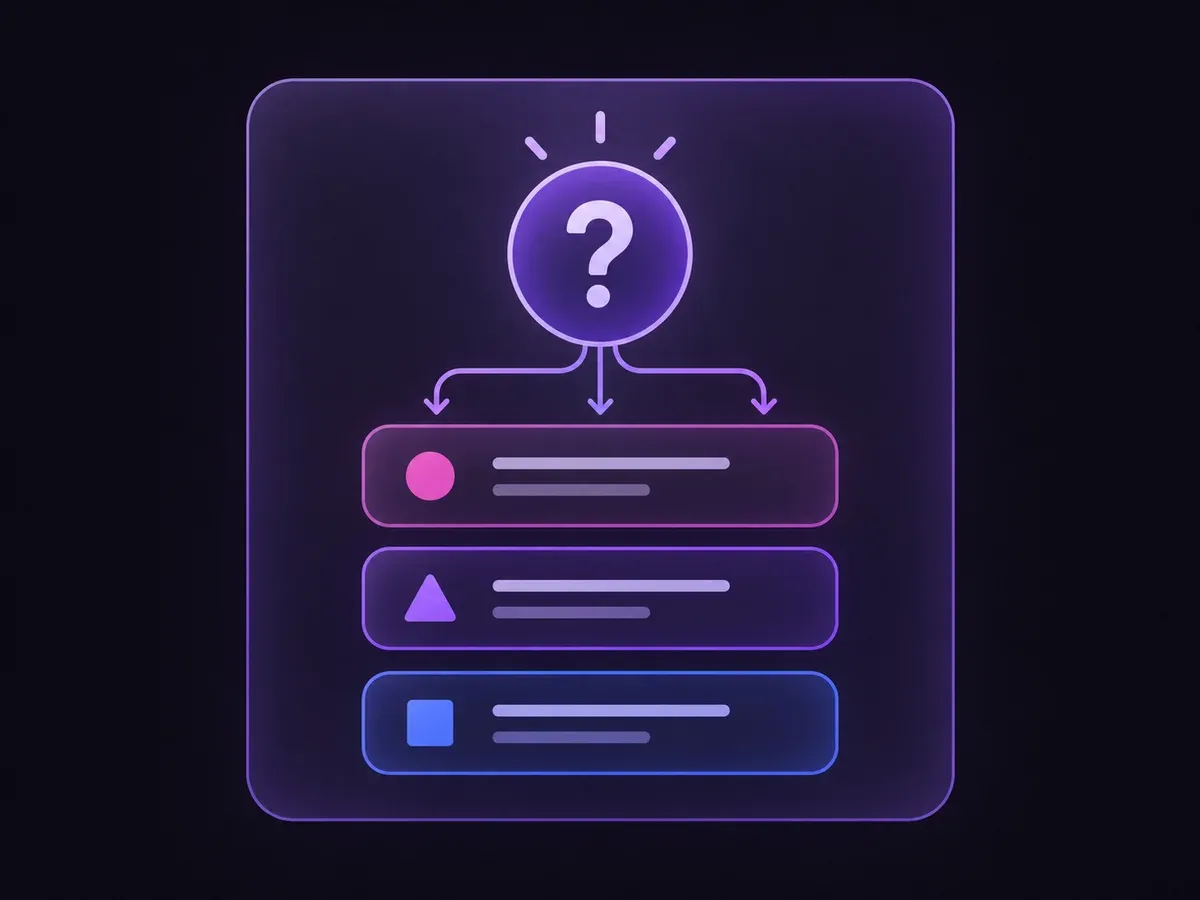
Jev receives a message and the supplied context, then chooses one of five labels. An ordinary reaction or genuine question can be allowed. A command directing the next move is classified separately from a report about another streamer. A direct personal insult has its own category. Unclear quotations and competing categories stay in Needs review.
The X source describes a streaming-comment filter with separate categories and display actions. This page implements only an independently authored text-classification exercise. Twitch's developer documentation offers a useful separation: held messages can be reviewed before a moderator approves or denies them. Our demo returns a label; it does not connect to Twitch or another streaming service.
AI-generated concept illustration of chat triage; not a platform interface or real viewer conversation.
How it works
Review chat in four explicit steps.
Classify the message, then decide what to do with it.
01
Write the channel policy
Define unwanted instructions, relays and targeted insults, plus an option for unclear cases.
02
Preserve relevant context
Include whether advice was requested and enough surrounding text to understand a quotation.
03
Inspect the category
Compare ordinary questions with unwanted commands and ambiguous messages. Keep the probability distribution with the label.
04
Let moderation own the action
Use the label to organize review. Hiding, blurring, warning or banning needs separate application logic and human oversight.
Our API test
Six messages, including a close review boundary.
Six messages, including a close review boundary.
Original chat message
Observed label
Leading probability
Positive reaction
Allow
100%
Genuine question
Allow
99%
Unrequested moves
Unsolicited instructions
100%
Other stream relay
Cross-stream relay
97%
Targeted insult
Harassment
100%
Ambiguous quotation
Needs review
57%
Six live Jev requests on September 27, 2026. The ambiguous quotation split between Needs review (57%) and Harassment (42%), illustrating why a leading label is not certainty. Synthetic functional checks, not an accuracy benchmark.Verified
Understand the results
The instructions sample explicitly says advice was not requested
The instructions sample explicitly says advice was not requested.
Read the example notes
Change that context to say the streamer asked for guidance, then reconsider whether the message violates your rule. If the policy does not explain requested advice clearly enough, revise it before trusting the result. Context is part of the decision, not decoration.
The quotation sample repeats an insult without telling us who is being quoted or why
The quotation sample repeats an insult without telling us who is being quoted or why.
Read the example notes
It might be reporting an incident, endorsing an insult or describing something unrelated. This example sends it for review rather than inventing the missing conversation. In a real queue, preserve the surrounding messages so a moderator can resolve it.
Using the result in your application
Download observed-chat.json and run-choice-sample.mjs into a private Node.js project.
Read the example notes
Tested setup: Node.js 24.18.0 and @typesafe-ai/sdk 0.6.0. Run npm init -y and npm install @typesafe-ai/sdk@0.6.0. Set TYPESAFE_API_KEY privately, then run node run-choice-sample.mjs observed-chat.json quote. The runner sends one request without retries.
Source and example scope
The fixture preserves every exact message, policy, choice and recorded distribution.
Read the example notes
The Node output contains the selected ID, elapsed time and fresh provider result. Small differences between runs are possible. These six synthetic checks illustrate the policy; they do not estimate moderation accuracy, replace channel moderators or reproduce the source filter's speed.