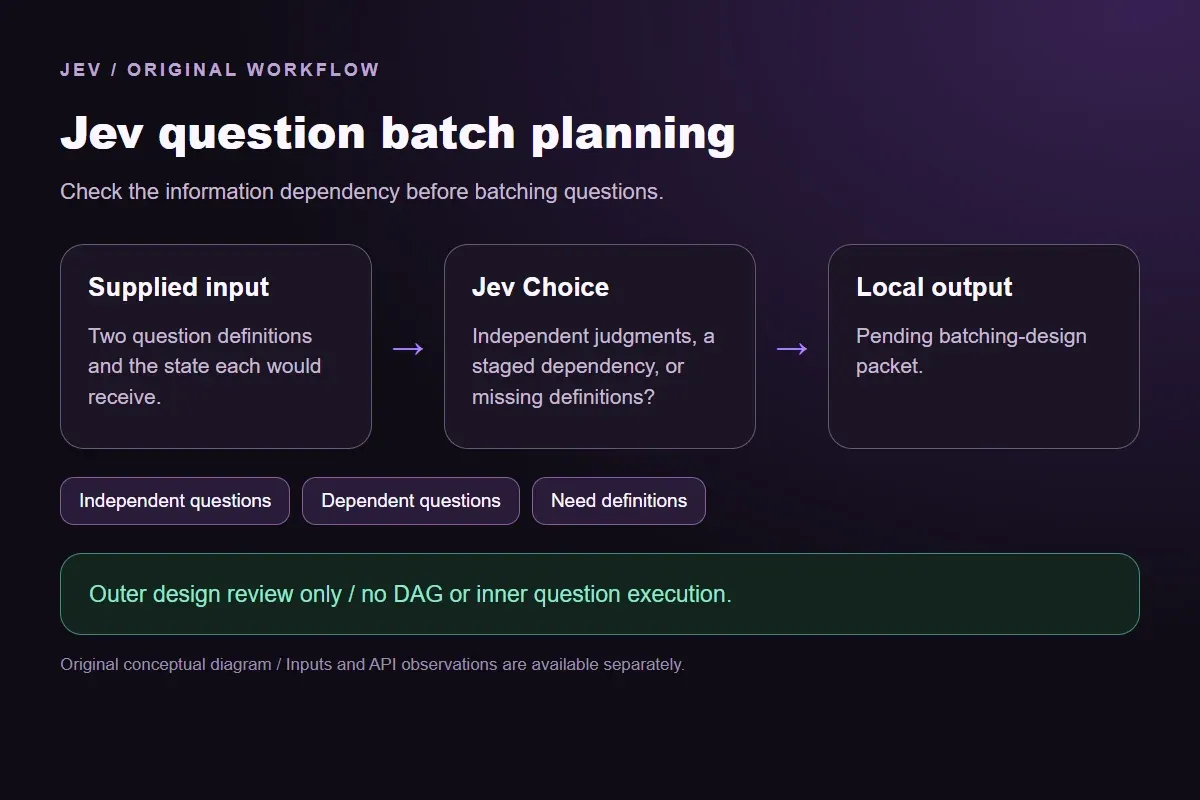




Jev question batch planning

Check whether two questions can be answered independently

Provide both question definitions and their shared state. Compare independent judgments with a question that needs an earlier answer or external observation before considering batching.

Check the information dependency before batching questions.Live API
Try an example

Original synthetic input. Edit the task or evidence to make a new API request.

Source: Workflow inspiration on X

Source and example scope

The inputs, rubric and preview are original. This window demonstrates the stated decision only; it does not reproduce the source application or its measurements.

Assess questionPair and availableState.

Decision rules and labels
Independent questionsDependent questionsNeed definitions
A real response from the Jev API

Edit any input to explore a different decision. No request is sent until you run it.

Your next decision

Not run yet

Choose an example or write your own input, then run it to see the ranked choices.

Results are not stored by this site. Your submitted text is processed by the API provider.

The decision

How does Jev question batch planning use the supplied evidence?

Jev question batch planning checks whether two question definitions can be answered independently from shared state. It distinguishes that design from a question that needs an earlier answer or a later tool observation, and keeps missing definitions unresolved.

The API-collected source describes typed component contracts, a DAG execution engine and deterministic replay. This original miniature example reviews a question dependency before such an engine is built. It does not implement that stack, run nodes or reproduce its tracing system.

Each editable record names both questions and the state they would receive. The outer API call judges the proposed relationship only. A separate implementation would create and run the actual typed questions, measure its request costs and apply the resulting control flow in code.

Original Jev question batch planning workflow diagram showing supplied evidence, a typed decision and the local preview.
Original workflow illustration. The output is a local preview, not an executed action or source screenshot.
How it works

Try the example in four steps

Use the sample to understand the rule, then test your own input for question batch planning.

  1. Illustration of adding the text or evidence for a decision

    Add the information to check

    Provide both question definitions and their shared state.

  2. Illustration of defining a question and its allowed choices

    Confirm the question and labels

    Open the decision rules and keep the intended distinction between Independent questions, Dependent questions, Need definitions. Edit the choices only when testing your own rule.

  3. Illustration of sending one input and comparing the returned choices

    Run the decision

    Use a sample first, then try your own input. Compare the selected label with the other returned probabilities.

  4. Illustration of reviewing a result and an uncertain item before using it

    Review the next step

    Review Need definitions before using a result. The label is a decision about the supplied information, not an executed action.

Our API test

What the six original inputs returned.

What the six original inputs returned.
Original test inputFixture expectationObserved labelLeading probability
Two independent text facetsIndependent questionsIndependent questions98%
Argument question needs selected toolDependent questionsDependent questions95%
Explicit hypothetical branchIndependent questionsIndependent questions73%
Later question needs a completed writeDependent questionsDependent questions89%
Second definition missingNeed definitionsNeed definitions94%
Separate passage judgments over one queryIndependent questionsIndependent questions99%
  • 6 of 6 original fixture expectations matched. Contrary outputs are preserved in the table and downloads; these checks are not held-out accuracy or production suitability.
  • Measured adapter round trips: 472-1182 ms. Estimated input cost: $0.00002369-$0.00002444 per request. These observations are not a latency guarantee or invoice.

6 actual Jev API calls on October 2, 2026. Original synthetic inputs check this rubric and handoff; they do not establish held-out accuracy. Probabilities are model outputs.Verified

Understand the results

The text-facet fixture asks for sentiment and topic over the same visible paragraph

The text-facet fixture asks for sentiment and topic over the same visible paragraph.

Read the example notes

Independent questions means neither definition needs the other answer to construct its input. That design could be implemented as multiple typed questions in one request. This page does not perform those inner classifications or report their latency. It records the real outer design-review response, keeping a proposed request layout separate from an observed multi-question execution.

Argument question needs selected tool

The argument fixture first selects a tool, then asks for an argument schema that will only be fetched after that selection.

Read the example notes

Dependent questions describes the missing second-stage input. Putting both definitions in the same request does not make a later fetched schema available earlier. An implementation could retrieve all permitted schemas up front and explicitly define branch-specific questions, but that would be a different state contract and should receive a fresh design review.

Explicit hypothetical branch

The speculative fixture asks whether a message is a cancellation and, separately, asks for a cancellation reason under an explicit hypothetical premise.

Read the example notes

Independent questions concerns the supplied premise and complete message text. The second question need not see the first answer to evaluate its conditional branch. Code would consume the reason only if that branch applies. This distinction prevents conditional use of an answer from being confused with dependence on another answer during inference.

Later question needs a completed write

The write-effect fixture asks for a destination and then checks a file that can exist only after a later write.

Read the example notes

Dependent questions preserves the external effect between those stages. A model cannot inspect a future filesystem observation merely because the planned questions share a request. A real application would choose the destination, enforce permissions, perform the write in code and attach a verified resulting observation before asking the second question. This example performs none of those operations.

Second definition missing

The undefined fixture includes one question and no second definition.

Read the example notes

Need definitions keeps the design unresolved rather than assume that every missing question is independent. Supply the actual instructions, candidate outcomes and state requirements before reviewing the pair. Naming a node or declaring a DAG edge is not enough to show what information its judgment uses. The local packet remains pending and does not invent a second question or fill a missing schema.

The passage fixture evaluates two separately supplied passages against the same query

The passage fixture evaluates two separately supplied passages against the same query.

Read the example notes

Independent questions means each has its own evidence and does not rely on the other passage's answer. A later ranking or filtering step can combine their outputs in code. That downstream combination does not make the underlying judgments interdependent. The six original design fixtures are functional boundary cases; they establish no universal batching speedup or reduction in the cost of another system.

Source and example scope

Fixture expectations are authored before the calls. Any contrary model choice remains visible beside its expectation and complete distribution; no repeated judgment is used to obtain a preferred label.

Using the result in your application

Download the exact sample requests and saved observations below.

Read the example notes

Expected labels are original fixture checks and stay outside the request sent to Jev. The observation file preserves the complete probabilities and the hash of each exact request. Editing a task, rubric or candidate requires a fresh response; a matching sample name does not make an older answer current.

Using the result in your application

The JavaScript runner makes one independent SDK request for a chosen sample ID.

Read the example notes

It reads TYPESAFE_API_KEY privately from the environment and has no automatic retry. The Python consumer operates offline: it checks the rubric, labels, unique sample identities, request hashes and valid probability distributions before selecting a fixed local preview. A tied leading result remains pending for review.

Source and example scope

The page reports measured adapter round trips and estimated input cost for the recorded calls.

Read the example notes

Those values describe these requests, not a provider latency guarantee or a billing statement. Six deliberately authored fixtures can check the stated behavior, but they do not establish accuracy on an unseen dataset. Keep disagreements and missing-input examples when testing an integration.

Runnable offline example

Replay one request and inspect the saved preview.

View the code example
Replay commands
npm install @typesafe-ai/sdk@0.6.0
# Set TYPESAFE_API_KEY privately in your shell.
node run-choice-sample.mjs samples.json facets
python preview_choice_workflow_v2.py samples.json saved-api-results.json
Scope of this demo

Where does this decision fit?

Useful with explicit supplied evidence

  • Audit a supplied pair of semantic question definitions for independent execution over shared state, a dependency on an earlier answer or effect, or missing definitions. Emit a pending batching-design packet. No questions are batched or DAG nodes executed by this design-review demo.
  • Inspecting the original task and a fixed output before integrating external tools.
  • Comparing an explicit expected label with the complete recorded distribution.

Needs separate implementation or evidence

  • Inferring facts absent from the supplied input.
  • Treating a semantic selection as authorization to act.
  • Executing an external action or generalizing six fixtures into an accuracy claim.
Example FAQ

Questions about this original decision workflow.

Keep relevance, compliance and execution separate.

Does this actually batch two inner judgments?

No. One outer Jev call reviews the proposed design. The page does not run the inner question pair or a DAG.

Can a hypothetical question be independent?

Yes, when its premise is explicit and its required state is already supplied. Code later decides whether that branch is applicable.

Can the second question see the first answer in the same request?

No. Questions evaluated together use supplied state. A question needing an earlier answer requires state construction after that answer.

Does a downstream combination imply dependence?

No. Independent outputs can be combined in code after inference. Dependence here concerns the information needed to answer each question.

Are batching speed and cost measured here?

No. Times and estimated costs refer to the recorded outer design-review calls. An actual multi-question implementation needs its own measurements.

Try a task from your own workflow

Change the supplied task or evidence here, then inspect the live response. Playground supports another explicit decision.