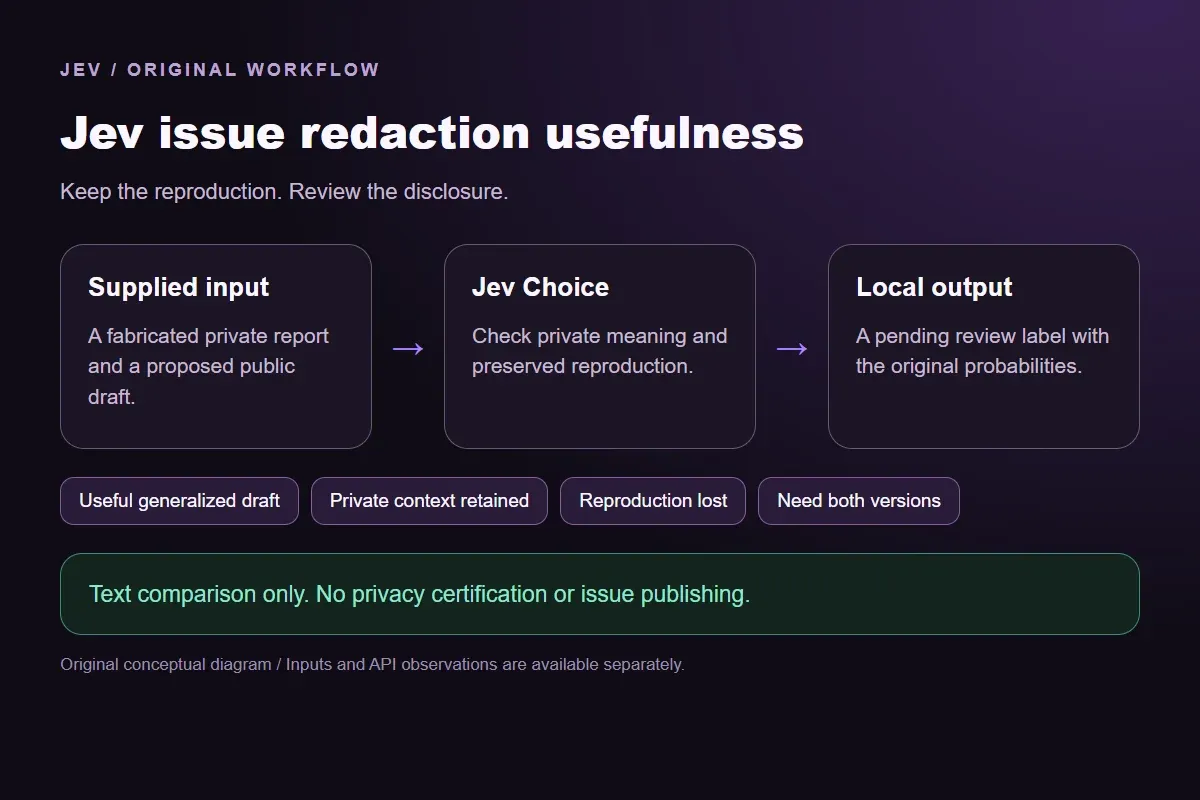
Jev issue redaction usefulness reviews whether a proposed public bug description keeps a useful reproduction while dropping the private context supplied with it. Paste both versions into the window. Jev returns a bounded review label; a local packet keeps the result pending for a separate privacy and publishing review.
The question considers meaning as well as literal text. Removing a customer name does not help if the draft still describes that customer through an internal-only rollout. At the other extreme, removing every useful step can leave a harmless but unhelpful complaint. The sample inputs make those two problems separate outcomes instead of calling every shorter draft acceptable.
An API-collected post about IssueRelay inspired this workflow. Its primary repository describes private support intake, bounded Jev triage and human-reviewed GitHub escalation. Our page implements its own text comparison before any publication. It neither installs IssueRelay nor replaces its privacy gate, owner confirmation, credential checks or issue-creation policy.
Use the generalized, internal-name and vague-redaction samples first. They start with the same original report but preserve different information in the proposed draft. The original API observations show how this explicit rule interpreted each version. All customer and rollout details here are fabricated; the demonstration does not contain real support messages or publish a GitHub issue.