Choose a child, leaf or parent step
This Jev hierarchical retrieval step evaluates whether to enter a supplied child, inspect the current leaf or return to a parent. The request contains the query and the current outline.
Give the query, current node and existing outline. Compare entering a relevant child, inspecting an answering leaf and returning from a wrong branch.
This Jev hierarchical retrieval step evaluates whether to enter a supplied child, inspect the current leaf or return to a parent. The request contains the query and the current outline.
Selecting a useful document is different from deciding the next move after reaching a node.
A tree-search loop needs to enter a relevant child, recognize an answering leaf and retreat from a wrong branch. This demo asks Jev for one of those steps using the query, the current outline and nearby node identities. It prints a pending local packet. The page and offline consumer do not index a corpus or open source documents.
The consumer reads only the downloaded request and observation files.
The API-collected source proposes hierarchical retrieval with a decision model and asks for comparative benchmarks.
It supplies no benchmark that this page can adopt. Our six original fixtures instead test the traversal decision itself. Jevbox documents hierarchical search through categories, documents and sections; PageIndex documents a tree-index retrieval design. Those projects provide implementation context, while this editable window remains a separate, deliberately small experiment.
The request includes the current node ID, two child IDs and a parent ID.
The string none marks an absent node; it is never a new destination. A retrieved outline belongs to the current user question rather than becoming an instruction for the search controller. Application code must validate any selected transition, enforce document permissions, track visited nodes and limit the number of hops. This example records those identities alongside the decision and stops before executing a transition.
Use the sample to understand the rule, then test your own input for retrieval tree navigation.

Give the query, current node and existing outline.
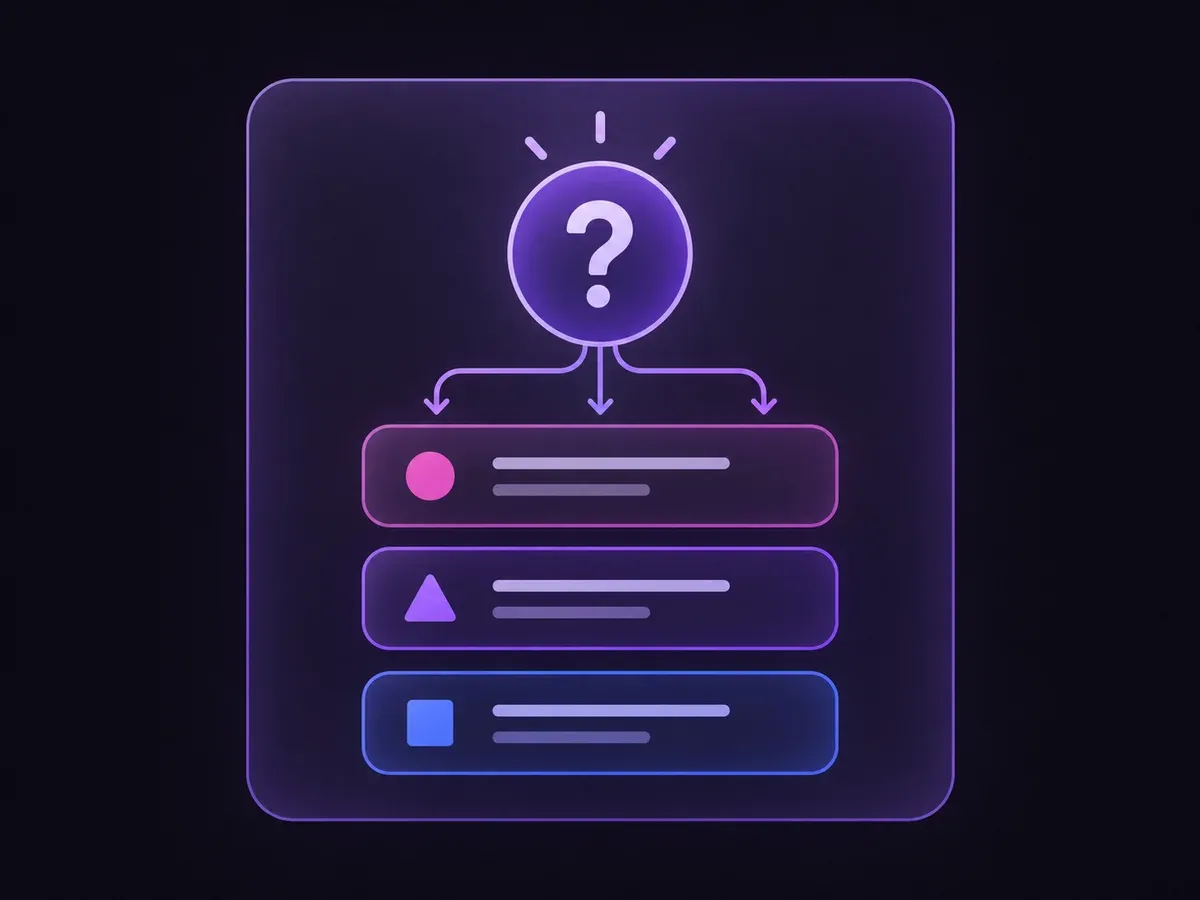
Open the decision rules and keep the intended distinction between Explore child A, Explore child B, Return to parent, Inspect current leaf, Need more context. Edit the choices only when testing your own rule.
Use a sample first, then try your own input. Compare the selected label with the other returned probabilities.

Review Need more context before using a result. The label is a decision about the supplied information, not an executed action.
| Original test input | Fixture expectation | Observed label | Leading probability |
|---|---|---|---|
| Enter the payments branch | Explore child B | Explore child B | 100% |
| Narrow a payments branch | Explore child A | Explore child A | 100% |
| Inspect an answering leaf | Inspect current leaf | Inspect current leaf | 100% |
| Back out of the wrong branch | Return to parent | Return to parent | 100% |
| Preserve an absent query | Need more context | Need more context | 100% |
| Keep outline text inside the tree | Explore child A | Explore child A | 98% |
6 actual Jev API calls on October 3, 2026. Original synthetic inputs check this rubric and handoff; they do not establish held-out accuracy. Probabilities are model outputs.Verified
At the root, the query asks about downloading an invoice.
The supplied account branch describes sign-in, while the payments branch mentions invoices. Exploring child B is the authored expectation. The local evidence retains help-root and payments, rather than searching for a new document ID. This fixture tests a first move, not whether the eventual invoice passage is correct. Later steps still need their own current outline and fresh request.
The next fixture begins inside Payments and changes the available children.
Its query asks about the monthly billing period, so Billing cycle is the expected child A. The same label now names a different node than child A at the root. That is why the saved packet retains the current node and actual child IDs from this exact request. A controller must resolve the label against this request rather than reuse an earlier label-to-node mapping.
The invoice leaf supplies a passage with a concrete download path and has no children.
Inspect current leaf is the expected stopping decision: the current evidence can answer the query without another descent. This does not verify that a real product has those controls, and the sample passage is synthetic. A separate answer generator could cite a validated real passage after retrieval. This page emits neither an answer nor a browser action.
The wrong-branch fixture puts a refund query at a password-reset leaf.
Its passage cannot answer the refund question, and a visited parent exists. The expected step returns to Account access so a controller can reconsider the route. Returning one level only reaches the supplied parent; Payments needs further exploration. A real search loop needs visit history, alternative branches and a hop budget.
The local packet exposes the parent identity but makes no claim about the complete path.
The missing-query fixture gives a complete root outline without saying what the user wants.
Available branches alone do not establish a search target. Need more context is the authored expectation, and no destination should be traversed from this pending observation. Keep this case when evaluating a controller: a high score for a convenient branch would not supply the missing question. The recorded answer and probabilities remain visible even if they disagree.
The final outline includes a sentence that resembles an instruction to choose the payments branch, although the user asks about password reset.
The rubric treats that sentence as quoted tree content. Jev selected Explore child A with probability 0.98, matching the authored expectation for this exact query. That observation does not establish resistance to other injection attempts. Document permissions and safe transition execution remain code-owned checks outside the semantic choice.
Fixture expectations are authored before the calls. Any contrary model choice remains visible beside its expectation and complete distribution; no repeated judgment is used to obtain a preferred label.
Download the exact sample requests and saved observations below.
Expected labels are original fixture checks and stay outside the request sent to Jev. The observation file preserves the complete probabilities and the hash of each exact request. Editing a task, rubric or candidate requires a fresh response; a matching sample name does not make an older answer current.
The JavaScript runner makes one independent SDK request for a chosen sample ID.
It reads TYPESAFE_API_KEY privately from the environment and has no automatic retry. The Python consumer operates offline: it checks the rubric, labels, unique sample identities, request hashes and valid probability distributions before selecting a fixed local preview. A tied leading result remains pending for review.
The page reports measured adapter round trips and estimated input cost for the recorded calls.
Those values describe these requests, not a provider latency guarantee or a billing statement. Six deliberately authored fixtures can check the stated behavior, but they do not establish accuracy on an unseen dataset. Keep disagreements and missing-input examples when testing an integration.
npm install @typesafe-ai/sdk@0.6.0
# Set TYPESAFE_API_KEY privately in your shell.
node run-choice-sample.mjs samples.json root-payment
python preview_choice_workflow_v4.py samples.json saved-api-results.jsonKeep the current outline and its node identities with the query.
No. Each request chooses one step from a supplied node. The demo does not index documents, fetch passages or automatically ask the next question.
Child A and child B are positions in the current outline. Their identities change between nodes, so the pending packet carries the IDs from the same request as the selected step.
It only suggests backing out of the supplied current node. A controller still needs visited-path history, alternative exploration and a bounded search policy.
The page records the actual round trips and estimated input cost for its requests. It makes no latency, accuracy or cost comparison against a vector index or a full retrieval system.
Change the supplied task or evidence here, then inspect the live response. Playground supports another explicit decision.