Source and example scope
Replay each saved synthetic request and compare the observed label with its authored expectation. Differences remain visible; these six inputs are functional examples, not a production benchmark.
Give the result claim and the systems included in the method. Compare attribution to a tested system with an unsupported transfer or an explicit architecture analogy.
The transferred-result preset gives Jev a speed result from an experiment that tested only the fictional CedarSmall model. The claim changes the owner of the measurement, even though the method explicitly names its actual subject.
An architecture analogy can be useful without transferring a result. The analogy preset compares a decision-scoring idea while keeping every measurement attributed to CedarSmall. That boundary differs from saying both systems achieved the same outcome.
This demonstration checks attribution in supplied text. It does not verify the experiment, measure speed or authenticate a report. The fictional examples are original tests of this rule; their invented result claims are not Jev benchmark findings.
A tested system name does not prove that a particular metric belongs to that system when several models were evaluated. That needs a separate result-to-model mapping.
Original attribution-review adaptation of a source that explicitly distinguishes its open-model experiments from Jev API testing. Its reported results remain author claims. The six editable inputs and outcome rules are original synthetic demonstrations.
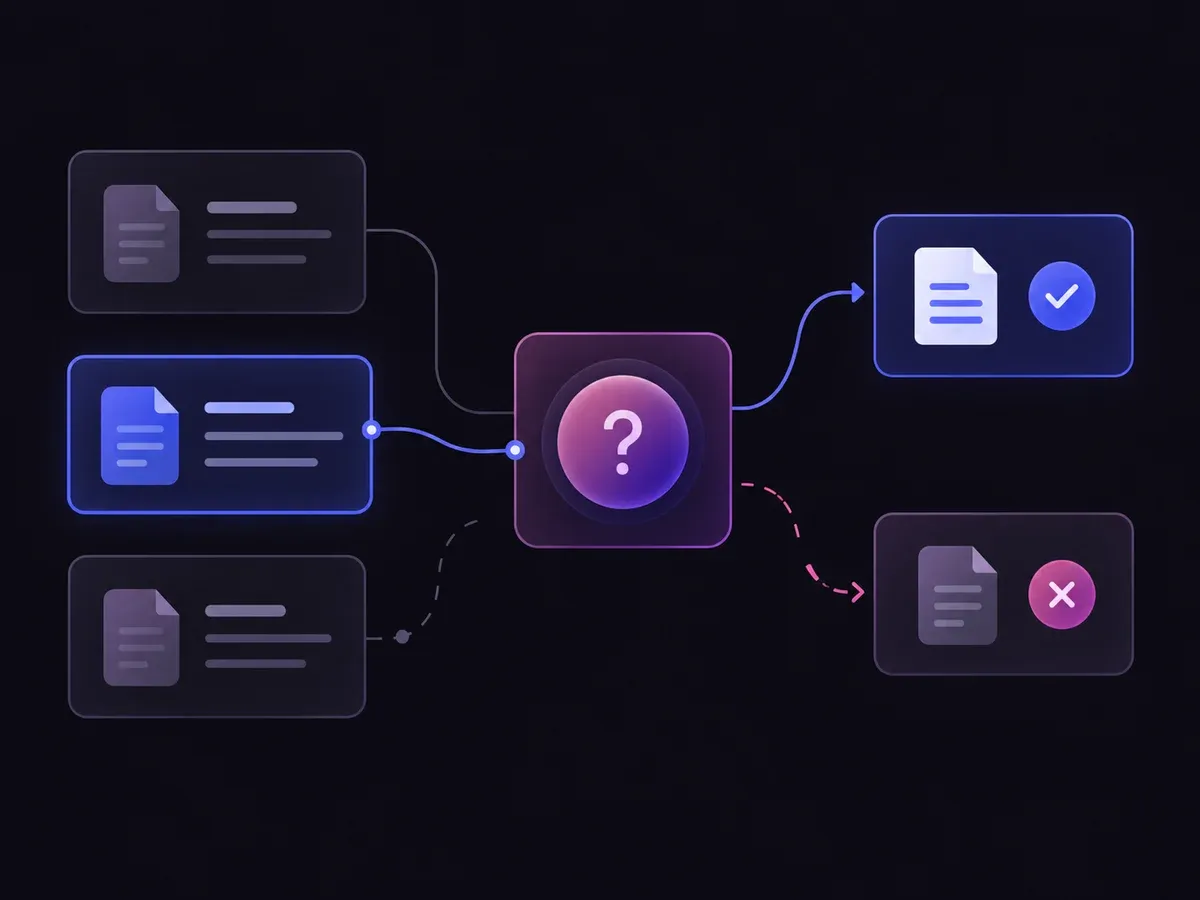
Use the sample to understand the rule, then test your own input for experiment result attribution.

Give the result claim and the systems included in the method.

Open the decision rules and keep the intended distinction between Attribution matches, Attribution expanded, Architecture analogy, Need method. Edit the choices only when testing your own rule.

Use a sample first, then try your own input. Compare the selected label with the other returned probabilities.

Review Need method before using a result. The label is a decision about the supplied information, not an executed action.
| Original input | Observed label | Leading probability |
|---|---|---|
| Correct test subject | Attribution matches | 99.0% |
| Result transferred | Attribution expanded | 100% |
| Explicit analogy | Attribution matches | 49.0% |
| Compatible is not identical | Attribution expanded | 97.0% |
| Ambiguous model name | Need method | 98.0% |
| Missing method | Need method | 94.0% |
These are six original synthetic inputs, tested once per request revision. The percentage is the leading option probability, not measured accuracy. Authored expectations and any disagreements remain in the downloadable evidence. 5 of 6 results matched the authored fixture expectations. For Explicit analogy, the expectation was Architecture analogy; the observed choice was Attribution matches.Verified
Replay each saved synthetic request and compare the observed label with its authored expectation. Differences remain visible; these six inputs are functional examples, not a production benchmark.
The single-request SDK runner uses your private TYPESAFE_API_KEY. The offline consumer reads saved observations, checks request hashes and prints a pending output. It does not call the model or change any external system.
npm install @typesafe-ai/sdk@0.6.0
# Set TYPESAFE_API_KEY privately in your shell.
node run-choice-sample.mjs samples.json case-1
python preview_choice_workflow.py samples.json saved-api-results.jsonWhat the supplied evidence can establish, and what it leaves open.
Yes, as an explicitly scoped analogy. Its measurements still belong to that local model and do not become Jev API results.
No. It establishes only that the claim refers to a system named in the supplied method. The experiment and its measurements still require their own evidence.
No. It is the option distribution for this request. The saved examples compare model outputs with authored expectations and preserve any disagreement.
The window shows an error and supplies no fresh judgment. Missing-evidence labels describe the input; they are not substitutes for network or provider errors.
Edit the evidence in the window above, or open the Playground to create a different decision rule.