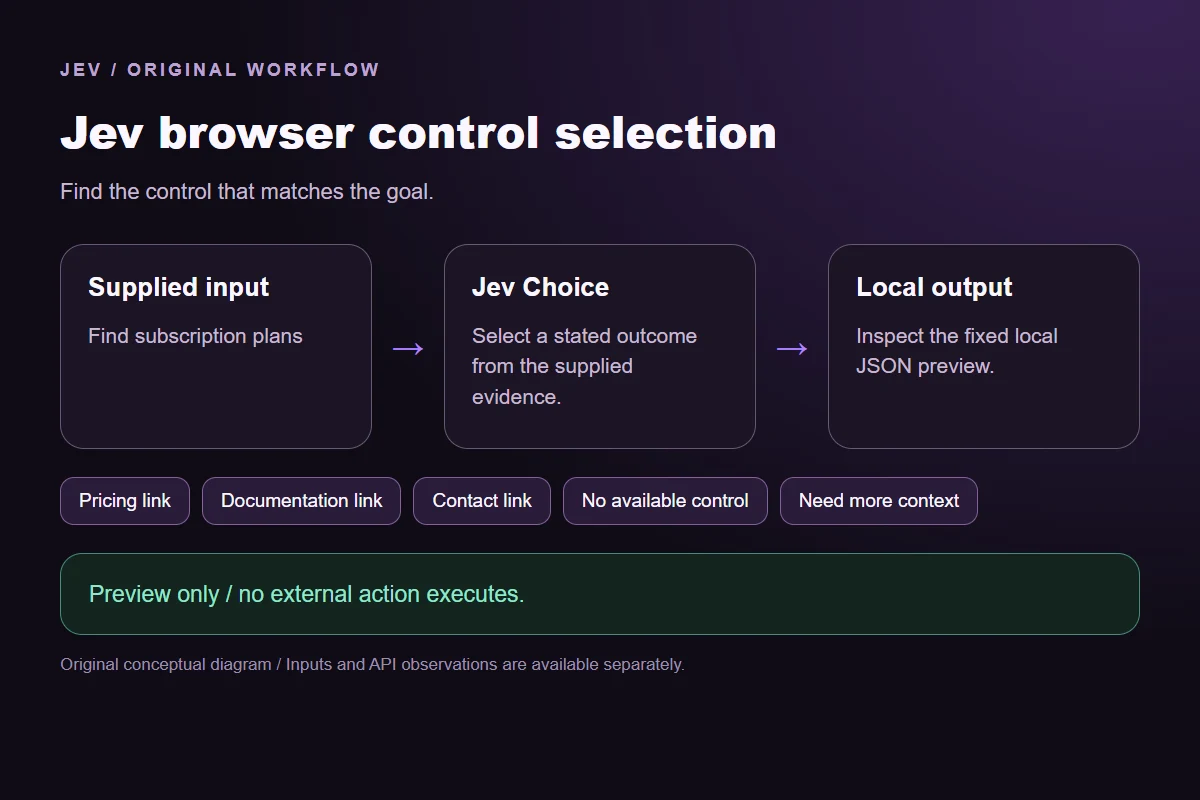
The three matched samples ask for different destinations while keeping the snapshot fixed. You can inspect the plan link's href next to the recorded choice, then compare the documentation task. The fixture uses demo.example deliberately: it is illustrative data, not a destination this consumer visits. These identifiers belong to the local snapshot only.
The account-settings sample is a clear goal with no supplied match. The purchase request is also unsupported: opening plan information is not the same action as buying a plan. A browser controller should not turn a navigation candidate into a transaction merely because the words are related. No available control preserves that boundary.
The unspecified destination has a different problem. The snapshot may contain the right page, but the request gives no basis for choosing it. Need more context lets the application ask for the intended destination. Do not treat a high probability on a popular navigation item as evidence of a user's missing intention.
A real DOM snapshot must be collected separately. The maintainer examples extract controls and keep their identities alongside the offered labels. Our fixture starts after that step. It does not establish whether extraction included a hidden menu, an iframe, a disabled button or a control represented only by a picture. Test those cases in the browser adapter you intend to use.
Snapshot freshness matters after a response too. A page can navigate or replace an element while an API request is pending. The saved-result hash binds the answer to the text snapshot; it does not prove the live DOM still has that element. A real executor needs to recheck the page identity, allowed origin and current control state before performing the separately authorized action.
Try changing the navigation goal to request a support form while leaving all three links intact. Then compare a goal asking to change the account password. That second request requires a control outside this inventory. Preserve both outcomes in a new test set. The purpose is to inspect target selection, not to demonstrate complete end-to-end browser automation.
Download the exact sample requests and saved observations below. Expected labels are original fixture checks and stay outside the request sent to Jev. The observation file preserves the complete probabilities and the hash of each exact request. Editing a task, rubric or candidate requires a fresh response; a matching sample name does not make an older answer current.
The JavaScript runner makes one independent SDK request for a chosen sample ID. It reads TYPESAFE_API_KEY privately from the environment and has no automatic retry. The Python consumer operates offline: it checks the rubric, labels, unique sample identities, request hashes and valid probability distributions before selecting a fixed local preview. A tied leading result remains pending for review.
The page reports measured adapter round trips and estimated input cost for the recorded calls. Those values describe these requests, not a provider latency guarantee or a billing statement. Six deliberately authored fixtures can check the stated behavior, but they do not establish accuracy on an unseen dataset. Keep disagreements and missing-input examples when testing an integration.
Exact sample requests
Saved API observations
Single-request SDK runner
Offline preview consumer
Try another decision in Playground
Compare the example directory
Read the Jev model overview