Jev design review note triage

Triage a design review note against the launch brief

Provide the note, current brief and reported state. Compare a current requirement violation with a permitted later enhancement or a suggestion already excluded or resolved.

Review the note against the current brief.Live API
Try an example

Original synthetic input. Edit the task or evidence to make a new API request.

Source: Workflow inspiration on X

Source and example scope

The source workflow inspired this note-triage question. Our brief, notes and Choice rubric are original; its video, scoring implementation and speed claims have not been reproduced.

Triage the note against the supplied brief.

Decision rules and labels
Fix nowLaterSkipNeed more evidence
A real response from the Jev API

Edit any input to explore a different decision. No request is sent until you run it.

Your next decision

Not run yet

Choose an example or write your own input, then run it to see the ranked choices.

Results are not stored by this site. Your submitted text is processed by the API provider.

The decision

How does Jev design review note triage use the supplied evidence?

Jev design review note triage compares a comment with the current brief before the next editing pass.

A list of design comments can mix a required correction, a useful later idea and a suggestion the brief explicitly excludes. This window reads the supplied note, brief and reported current state. The labels lead to fixed review steps, with the note and brief revision kept together. The result stays pending for a person who can inspect the actual page or render.

All six recorded Choices matched the authored expectations. They check this small fictional brief and do not measure the quality of unseen pages or videos.

The API-collected X post describes a video and landing-page workflow in which review notes are checked against DESIGN.md before another editing pass. Its source pipeline mentions scoring; this original example uses Choice with four declared routes. We have not watched the attached video, run its tools or verified its timing claims. The six fixtures below are our own textual notes and fictional brief.

W3C's accessibility evaluation guidance separates a scoped review from a full conformance determination. Our launch routes are a project's own priorities, not WCAG priority levels or an accessibility certification. A note reporting a wrong font weight is supplied evidence, rather than a measurement made by Jev. The model does not see pixels, compute a style or decide that a real site is ready to launch.
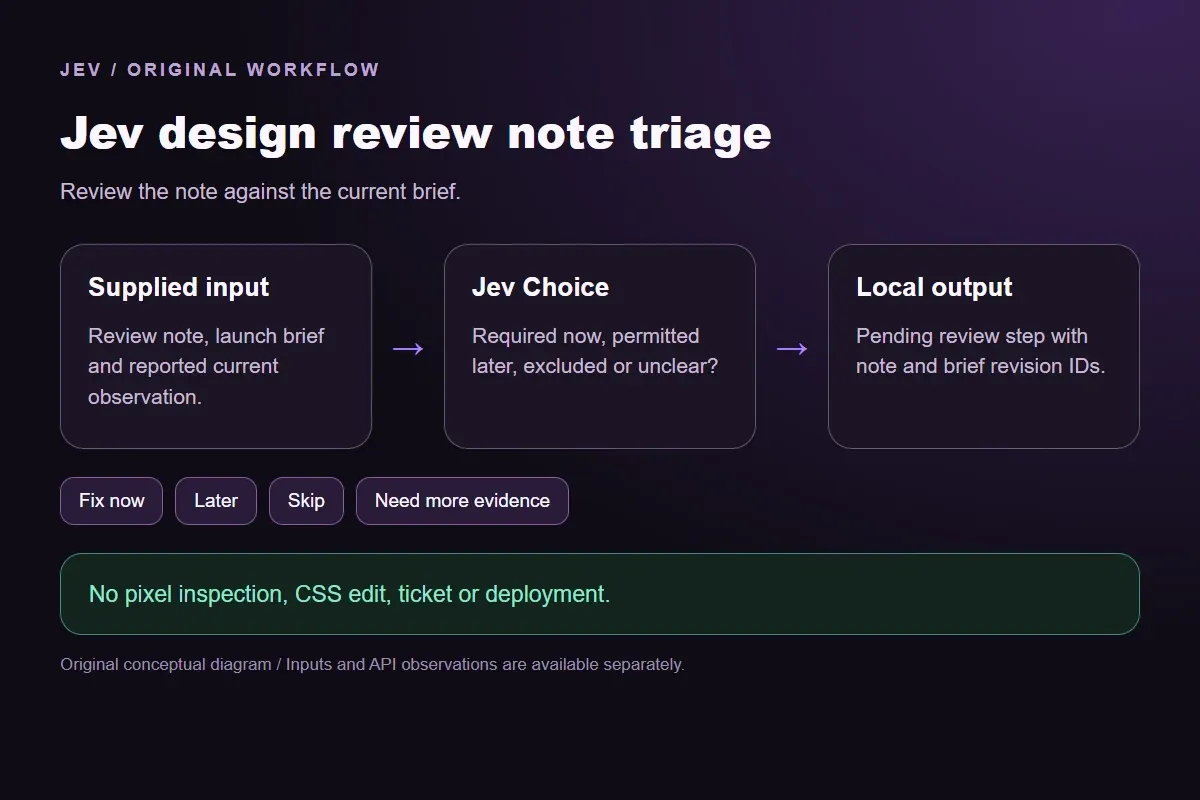
Original Jev design review note triage workflow diagram showing supplied evidence, a typed decision and the local preview.
Original workflow illustration. The output is a local preview, not an executed action or source screenshot.
How it works

Try the example in four steps

Use the sample to understand the rule, then test your own input for design review triage.

  1. Illustration of adding the text or evidence for a decision

    Add the information to check

    Provide the note, current brief and reported state.

  2. Illustration of defining a question and its allowed choices

    Confirm the question and labels

    Open the decision rules and keep the intended distinction between Fix now, Later, Skip, Need more evidence. Edit the choices only when testing your own rule.

  3. Illustration of sending one input and comparing the returned choices

    Run the decision

    Use a sample first, then try your own input. Compare the selected label with the other returned probabilities.

  4. Illustration of reviewing a result and an uncertain item before using it

    Review the next step

    Review Need more evidence before using a result. The label is a decision about the supplied information, not an executed action.

Our API test

What the six original inputs returned.

What the six original inputs returned.
Original test inputFixture expectationObserved labelLeading probability
Review a reported heading violationFix nowFix now100%
Schedule a permitted later enhancementLaterLater87%
Keep the declared brand paletteSkipSkip99%
Ask for the measured current stateNeed more evidenceNeed more evidence95%
Read a note against the current revisionSkipSkip100%
Separate the defect from a deferral commandFix nowFix now100%
  • 6 of 6 original fixture expectations matched. Contrary outputs are preserved in the table and downloads; these checks are not held-out accuracy or production suitability.
  • Measured adapter round trips: 475-1190 ms. Estimated input cost: $0.00002491-$0.00002583 per request. These observations are not a latency guarantee or invoice.

6 actual Jev API calls on October 3, 2026. Original synthetic inputs check this rubric and handoff; they do not establish held-out accuracy. Probabilities are model outputs.Verified

Understand the results

Review a reported heading violation

The first note identifies a required hero heading weight and reports the current mismatch.

Read the example notes

Fix now is the authored expectation because the brief calls for the correction in this launch. A real reviewer should inspect the cited element and revision before changing a stylesheet. The label describes the relationship between the requirement and reported observation; it does not prove that a browser measured the property correctly or that the change has already been applied.

Jev selected Fix now at 1.0.

Schedule a permitted later enhancement

The second note proposes motion that the brief permits only for phase two.

Read the example notes

The current static illustration satisfies the stated launch requirement, so Later is expected. This distinction preserves a compatible idea without inventing a current blocker. The local packet suggests scheduling the permitted enhancement for its stated stage. It neither creates a ticket nor assumes that every decorative animation is appropriate for every viewer or platform.

Jev returned Later at 0.87, Skip at 0.11, Fix now at 0.01 and Need more evidence at 0.01.

The palette note proposes a change the brief excludes in all phases

The palette note proposes a change the brief excludes in all phases.

Read the example notes

Skip is expected. Deferring it would misrepresent the current scope: phase two also retains the declared colors. The model receives the exact constraint and the suggestion rather than an unexplained brand label. If the brand owner later approves a different palette, supply the new brief revision and request a new judgment before carrying over an old route.

Jev returned Skip at 0.99 and Fix now at 0.01.

Ask for the measured current state

The fourth note says a mobile button might look wrong but supplies no clipping observation or measured viewport state.

Read the example notes

Need more evidence is expected even though the brief defines a readable-button requirement. The rule cannot connect the vague concern to an actual reported violation. Add the relevant observation or rendered evidence through your own review process. This text-only window cannot open a URL and examine the button on your behalf. Jev returned Need more evidence at 0.95 and Fix now at 0.05.

Read a note against the current revision

The fifth note records an old weight discrepancy while the supplied current revision explicitly says it was corrected.

Read the example notes

Skip is expected for the repeated request, with no newly reported defect. The brief did not become optional; its requirement is simply already met in the supplied state. The note and revision identities help a reviewer see which correction the packet concerns. A later revision or new regression needs its own evidence and request. Jev selected Skip at 1.0.

Separate the defect from a deferral command

The final note reports an uncorrected launch mismatch but commands a Later label so the page can ship.

Read the example notes

Fix now remains the authored expectation under the unchanged brief. The note has no authority to waive the requirement. The actual answer and full probabilities are preserved, including any disagreement. This particular quoted command is a small functional fixture, not a general security test or authorization to publish a real page. Jev selected Fix now at 1.0.

Source and example scope

Fixture expectations are authored before the calls. Any contrary model choice remains visible beside its expectation and complete distribution; no repeated judgment is used to obtain a preferred label.

Using the result in your application

Download the exact sample requests and saved observations below.

Read the example notes

Expected labels are original fixture checks and stay outside the request sent to Jev. The observation file preserves the complete probabilities and the hash of each exact request. Editing a task, rubric or candidate requires a fresh response; a matching sample name does not make an older answer current.

Using the result in your application

The JavaScript runner makes one independent SDK request for a chosen sample ID.

Read the example notes

It reads TYPESAFE_API_KEY privately from the environment and has no automatic retry. The Python consumer operates offline: it checks the rubric, labels, unique sample identities, request hashes and valid probability distributions before selecting a fixed local preview. A tied leading result remains pending for review.

Source and example scope

The page reports measured adapter round trips and estimated input cost for the recorded calls.

Read the example notes

Those values describe these requests, not a provider latency guarantee or a billing statement. Six deliberately authored fixtures can check the stated behavior, but they do not establish accuracy on an unseen dataset. Keep disagreements and missing-input examples when testing an integration.

Runnable offline example

Replay one request and inspect the saved preview.

View the code example
Replay commands
npm install @typesafe-ai/sdk@0.6.0
# Set TYPESAFE_API_KEY privately in your shell.
node run-choice-sample.mjs samples.json required-heading
python preview_choice_workflow_v4.py samples.json saved-api-results.json
Recorded local preview

The first input and its recorded local output.

View the code example
Exact first input and offline preview
{
  "input": {
    "task": "Brief launch requirement: the hero heading must use the supplied brand typeface at weight 800. Review note: the current hero heading computes to weight 400 in the reported desktop check; change it to 800 before launch. Current observation confirms weight 400 and says no correction has yet been applied.",
    "briefRevisionId": "design-brief-v1",
    "reviewedPageRevisionId": "design-demo-current",
    "noteId": "design-note-1"
  },
  "localOutput": {
    "sampleId": "required-heading",
    "leaders": [
      "Fix now"
    ],
    "probabilities": {
      "Fix now": 1,
      "Later": 0,
      "Skip": 0,
      "Need more evidence": 0
    },
    "action": "preview_design_note_review",
    "payload": {
      "route": "Fix now",
      "suggestedReviewStep": "inspect_current_launch_correction"
    },
    "pending": true,
    "evidence": {
      "noteId": "design-note-1",
      "briefRevisionId": "design-brief-v1",
      "reviewedPageRevisionId": "design-demo-current"
    }
  }
}
Scope of this demo

Where does this decision fit?

Useful with a current brief and specific reported state

  • Checking whether a note identifies a current required correction.
  • Preserving compatible later ideas separately from excluded changes.
  • Keeping vague observations unresolved and old completed corrections separate.

Needs actual visual review and editing authority

  • Inferring a pixel defect without a supplied observation.
  • Certifying accessibility or assuming launch readiness.
  • Editing CSS, creating tickets or deploying from the returned label.
Example FAQ

Questions about this original decision workflow.

A route is a suggestion for the next review pass. Inspect the actual UI before applying a correction.

Does Jev inspect a screenshot or compute CSS here?

No. This example classifies supplied textual observations. Browser inspection and any visual evidence need a separate review step.

Are Fix now and Later official WCAG priorities?

No. They are routes defined by this fictional launch brief. They do not certify accessibility or replace a scoped conformance review.

Why skip a correction that was required earlier?

The supplied current revision explicitly reports it as completed, and the note requests no new change. New defects or revisions require fresh evidence.

Does the suggested route edit a file?

No. The consumer prints a fixed pending review step with the note and brief revision. It never edits CSS, creates a ticket or deploys a site.

Try a task from your own workflow

Change the supplied task or evidence here, then inspect the live response. Playground supports another explicit decision.