Jev image brief gap check

Jev image brief gap check. Find the missing requirement before rendering.

Jev image brief gap check: Review a brief against three stated requirements. Return a gap label while keeping image generation and prompt rewriting outside the decision.

Find the missing requirement before rendering.Live API
Try an example

Original synthetic input. Edit the task or evidence to make a new API request.

Source: Workflow inspiration on X

Source and example scope

The inputs, rubric and preview are original. This window demonstrates the stated decision only; it does not reproduce the source application or its measurements.

Which required brief fields are missing?

Decision rules and labels
ReadyMissing subjectMissing audienceMissing formatMultiple gaps
A real response from the Jev API

Edit any input to explore a different decision. No request is sent until you run it.

Your next decision

Not run yet

Choose an example or write your own input, then run it to see the ranked choices.

Results are not stored by this site. Your submitted text is processed by the API provider.

The decision

How does Jev image brief gap check use the supplied evidence?

Jev image brief gap check checks an image request against the requirements supplied for this exercise. The brief needs an explicit visual subject, intended audience and requested format. The model identifies an absent field or returns Ready when all three appear. That label does not promise a good image; it describes this small contract.

An API-collected X post proposed checking a brief before repeatedly rendering it. We turned that idea into original, downloadable text fixtures with explicit gap labels. This page does not run the source's renderer, repeat its timing claim or generate an image from your input. Its body illustration is a separate original diagram of the workflow.

A requirement check needs a defined rule. Our three fields are chosen for this example, not a universal standard for every creative team. If your generator needs dimensions, transparency, brand constraints or licensing notes, add those requirements to a changed contract and evaluate it separately rather than assuming Ready already covers them.
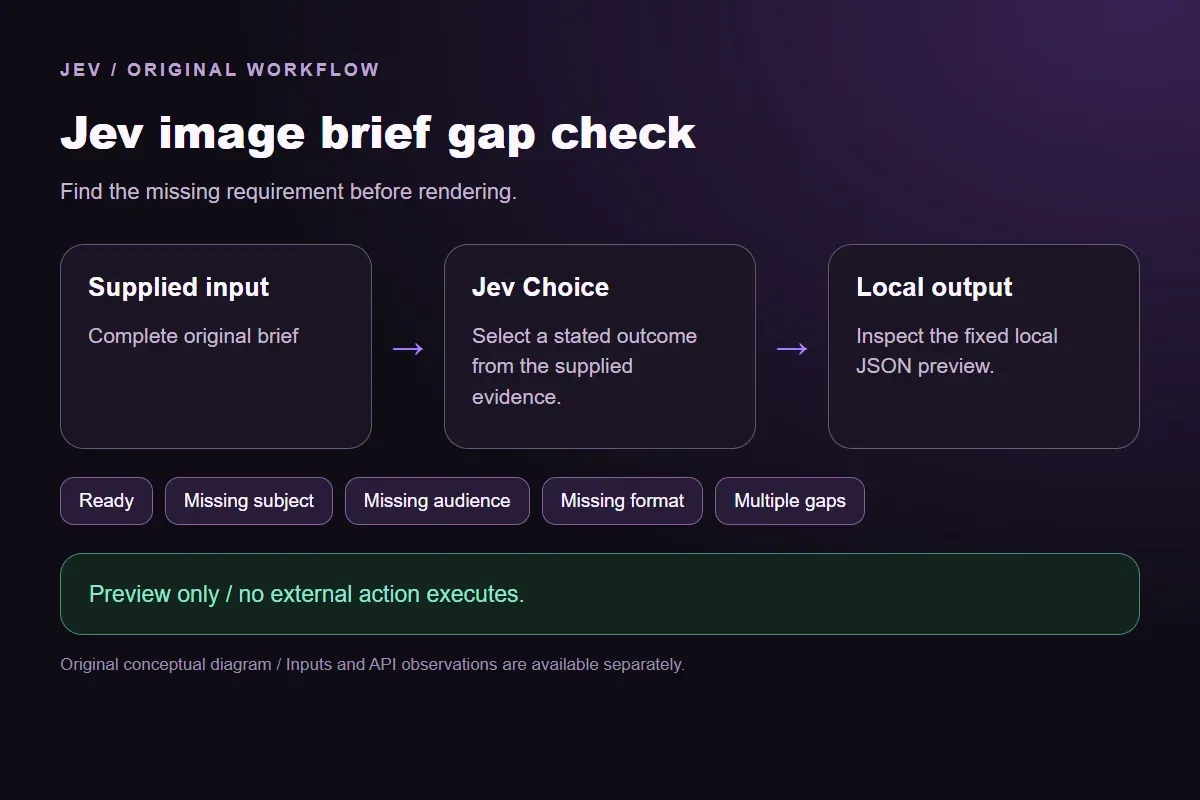

Original Jev image brief gap check workflow diagram showing supplied evidence, a typed decision and the local preview.
Original workflow illustration. The output is a local preview, not an executed action or source screenshot.
How it works

Inspect the decision in four steps.

Keep the evidence and the returned output attached to the same request.

  1. Illustration of adding the text or evidence for a decision

    Supply the actual task

    Visual subject: a diagram of a task queue and typed decision. Intended audience: software developers. Requested format: landscape 3:2 image. The model sees this original task and the provided evidence.

  2. Illustration of defining a question and its allowed choices

    Define the permitted outcomes

    Use the explicit rubric in the window. Every label has a stated meaning; missing evidence cannot create an unavailable action.

  3. Illustration of sending one input and comparing the returned choices

    Inspect the complete response

    Compare all offered probabilities and preserve the actual leading choice. A provider failure is separate from a semantic no-match or review outcome.

  4. Illustration of reviewing a result and an uncertain item before using it

    Preview the local handoff

    Replay the saved observations with the offline consumer. The mapped JSON stays local and no external action executes.

Our API test

What the six original inputs returned.

What the six original inputs returned.
Original test inputObserved labelLeading probability
Complete original briefReady100%
No visual subjectMissing subject97%
No intended audienceMissing audience95%
No requested formatMissing format99%
Only general praiseMultiple gaps100%
Different complete formatReady100%
  • Measured adapter round trips: 492-1766 ms. Estimated input cost: $0.00002327-$0.00002390 per request. These observations are not a latency guarantee or invoice.

6 actual Jev API calls on October 1, 2026. Original synthetic inputs check this rubric and handoff; they do not establish held-out accuracy. Probabilities are model outputs.Verified

How can you reproduce this decision and inspect its output?

Original example note 1

The complete task-queue brief states its subject, audience and landscape ratio in separate sentences. Ready means that all three required fields are visible. The local report keeps imageGenerated false. A real creative pipeline still needs a prompt renderer or generator and a review of the resulting image against the actual design requirements.

Original example note 2

The missing-subject sample supplies audience and format but replaces the subject with general praise. Make it impressive does not identify what should appear. The model's Missing subject label lets an application ask for that information before paying for a rendering call. This demo does not calculate whether such a check reduces production spend.

Original example note 3

The fictional-brand sample tests a different ambiguity. A brand name is supplied, but the target audience is not. The explicit question says that a brand name alone does not satisfy the audience field. That rule prevents the model from inventing the brand's market or replacing an absent audience with a plausible demographic guess.

Original example note 4

The missing-format sample has a subject and audience but says nothing about image shape or output format. It produces a pending format request. A production interface might collect that field with a deterministic form control instead of an AI check. This exercise is useful when the brief arrives as prose and its intended structure must first be interpreted.

Original example note 5

The empty brief lacks all three fields and selects Multiple gaps. The square-icon sample shows that readiness is not tied to the first example's landscape ratio. Both formats satisfy the stated requirement when explicitly supplied. The question checks whether a format exists, not whether a particular ratio is suitable for a placement.

Original example note 6

Keep the original brief, rule version, full distribution and final creative review together when evaluating this preflight. Six deliberately authored examples are functional checks, not evidence of creative quality or avoided retries. The offline consumer prints a missing-field report and performs no writing, generation, upload or publication. A pending gap is information for the next step, not an automatic revised prompt.

Original example note 7

Download the exact sample requests and saved observations below. Expected labels are original fixture checks and stay outside the request sent to Jev. The observation file preserves the complete probabilities and the hash of each exact request. Editing a task, rubric or candidate requires a fresh response; a matching sample name does not make an older answer current.

Original example note 8

The JavaScript runner makes one independent SDK request for a chosen sample ID. It reads TYPESAFE_API_KEY privately from the environment and has no automatic retry. The Python consumer operates offline: it checks the rubric, labels, unique sample identities, request hashes and valid probability distributions before selecting a fixed local preview. A tied leading result remains pending for review.

Original example note 9

The page reports measured adapter round trips and estimated input cost for the recorded calls. Those values describe these requests, not a provider latency guarantee or a billing statement. Six deliberately authored fixtures can check the stated behavior, but they do not establish accuracy on an unseen dataset. Keep disagreements and missing-input examples when testing an integration.

How can you reproduce this decision and inspect its output?

Runnable offline example

Replay one request and inspect the saved preview.

View the code example
Replay commands
npm install @typesafe-ai/sdk@0.6.0
# Set TYPESAFE_API_KEY privately in your shell.
node run-choice-sample.mjs samples.json ready
python preview_choice_workflow_v2.py samples.json saved-api-results.json
Scope of this demo

Where does this decision fit?

Useful with explicit supplied evidence

  • Check an original image brief against three explicitly required creative fields: subject, intended audience and requested format. Identify one missing field, multiple missing fields, or readiness before a separate image generator runs. No image or revised prompt is generated.
  • Inspecting the original task and a fixed output before integrating external tools.
  • Comparing an explicit expected label with the complete recorded distribution.

Needs separate implementation or evidence

  • Inferring facts absent from the supplied input.
  • Treating a semantic selection as authorization to act.
  • Executing an external action or generalizing six fixtures into an accuracy claim.
Example FAQ

Questions about this original decision workflow.

Keep relevance, compliance and execution separate.

Does Ready mean the image will look good?

No. It means the three required fields appear in the supplied brief. The resulting image and broader creative requirements still need separate review.

Can Jev generate the image here?

No. The Choice request returns a stated label. A separate generator would be needed after the brief is complete.

Are the three required fields universal?

No. They are this original fixture's explicit contract. Add your actual production requirements and evaluate a revised question when the task differs.

Why does a brand name not count as an audience?

A name does not specify who the image should address. This rule keeps missing audience information visible instead of inferring a demographic.

Does the preview fill missing fields?

No. It prints a gap report or readiness flag. It neither writes a revised prompt nor stores, generates or publishes an image.

Try a task from your own workflow

Change the supplied task or evidence here, then inspect the live response. Playground supports another explicit decision.