Jev confirmation action label

Check whether a confirmation button names the consequence

Show the active control, its label and surrounding action. Compare a named deletion, payment or access change with generic wording and a harmless acknowledgment.

Is the consequence named on this control?Live API
Try an example

The body names deletion but the target label does not.

Source: API-collected workflow inspiration; original demonstration below

Source and example scope

The API-collected roundup links the cited project. Its pinned source defines the decision adapted here. These synthetic inputs and explicit missing-context outcomes are original to this demonstration. The window returns a label; it does not run the linked application, execute its downstream actions or verify its performance claims.

Inspect the target label and current visible context.

Decision rules and labels
Consequence unnamedAction namedHarmless acknowledgmentNot a confirmationNeed action context
A real response from the Jev API

Edit any input to explore a different decision. No request is sent until you run it.

Your next decision

Not run yet

Choose an example or write your own input, then run it to see the ranked choices.

Results are not stored by this site. Your submitted text is processed by the API provider.

The decision

The dialog can explain deletion while its button still says only Confirm.

The first preset makes deletion explicit in the dialog body. The target label remains generic, so it receives Consequence unnamed. Replacing it with “Delete project” changes the label’s meaning without changing the action.

The saved-settings preset has no further consequential effect; OK simply dismisses a message. The separate-branch preset shows why a clearer label in a mutually exclusive UI state cannot repair the target currently being reviewed.

The cited rule is marked for review. The demonstration neither presses a button nor proves an interface accessible or compliant. It provides an observation about the supplied control and state.

The API-collected roundup links the cited project. Its pinned source defines the decision adapted here. These synthetic inputs and explicit missing-context outcomes are original to this demonstration. The window returns a label; it does not run the linked application, execute its downstream actions or verify its performance claims.

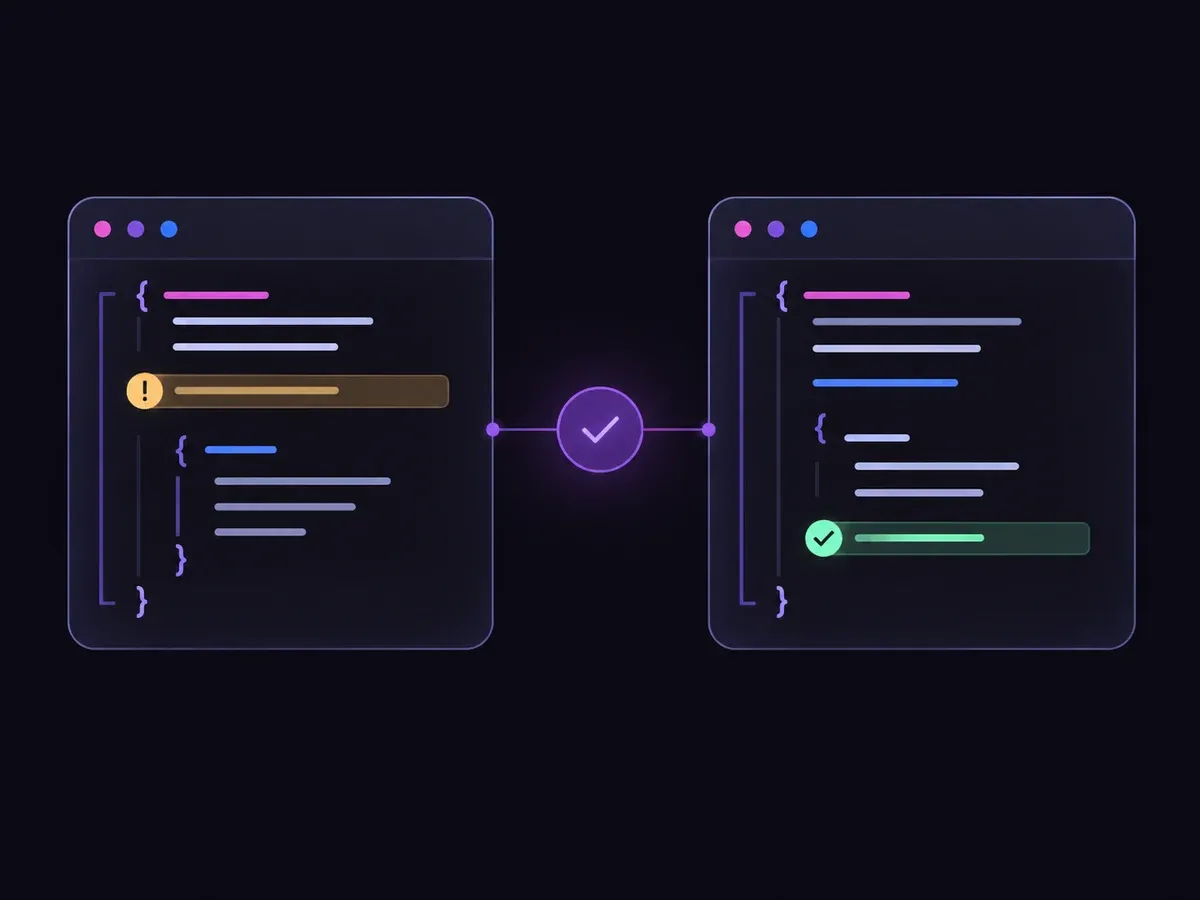
Illustration of checking a code change and reviewing a flagged line
Illustration of the decision flow.
How it works

Try the example in four steps

Use the sample to understand the rule, then test your own input for confirmation button labels.

  1. Illustration of adding the text or evidence for a decision

    Add the information to check

    Show the active control, its label and surrounding action.

  2. Illustration of defining a question and its allowed choices

    Confirm the question and labels

    Open the decision rules and keep the intended distinction between Consequence unnamed, Action named, Harmless acknowledgment, Not a confirmation, Need action context. Edit the choices only when testing your own rule.

  3. Illustration of sending one input and comparing the returned choices

    Run the decision

    Use a sample first, then try your own input. Compare the selected label with the other returned probabilities.

  4. Illustration of reviewing a result and an uncertain item before using it

    Review the next step

    Review Need action context before using a result. The label is a decision about the supplied information, not an executed action.

Our API test

Recorded API observations

Recorded API observations
Original inputObserved labelLeading probability
Delete with ConfirmConsequence unnamed100%
Action-specific labelAction named90.0%
Payment with ProceedConsequence unnamed100%
Saved acknowledgmentHarmless acknowledgment96.0%
Wrong branch cannot helpConsequence unnamed100%
Isolated labelNeed action context95.0%

These are six original synthetic inputs, tested once per request revision. The percentage is the leading option probability, not measured accuracy. Authored expectations and any disagreements remain in the downloadable evidence. 6 of 6 results matched the authored fixture expectations.Verified

Understand the results

Replay the saved synthetic requests to inspect each recorded decision

Replay the saved synthetic requests to inspect each recorded decision. Authored expectations and model disagreements remain available; these examples are not a production accuracy benchmark.

Using the result in your application

The single-request SDK runner uses your private TYPESAFE_API_KEY. The offline consumer reads saved observations, checks request hashes and prints a pending output. It does not call the model or change any external system.

Runnable offline example

Run one sample, then inspect the local packet

View the code example
Single-request replay
npm install @typesafe-ai/sdk@0.6.0
# Set TYPESAFE_API_KEY privately in your shell.
node run-choice-sample.mjs samples.json case-1
python preview_choice_workflow.py samples.json saved-api-results.json
Scope of this demo

Where this decision fits

Useful scope

  • Reviewing destructive-action confirmation copy
  • Checking payment or access-change labels
  • Distinguishing harmless acknowledgments from consequential actions

Outside this demonstration

  • Clicking a live confirmation control
  • Inferring consequences from an isolated label
  • Borrowing context from a different UI state
Example FAQ

Questions about confirmation action label.

Input scope and downstream handling determine what this judgment means.

Is OK always a poor label?

No. It can fit a harmless acknowledgment, such as dismissing a saved-settings message. The action context changes the judgment.

Why does the body text not settle this rule?

The body establishes what will happen; the rule separately asks whether the target button itself names that consequential action.

Is the leading probability an accuracy measurement?

No. It is one value in the returned distribution over this request’s choices. The six synthetic fixtures have authored expectations; they do not measure production accuracy.

What happens on an API failure?

The window displays an error without a fresh judgment. An incomplete-input outcome describes the supplied evidence and is not used as a fallback for provider failure.

Try your own confirmation action label input

Edit the input above, or open the Playground to explore another decision.

