Useful scope
- Finding commit messages that contain only progress labels
- Separating concrete wording from unsupported truth claims
- Preparing a message for a later diff-support review
Separate a checkable description from filler before reviewing whether the diff supports it.
A message such as wip records activity without naming a change. Reject empty email addresses names behavior and a location. This check distinguishes those cases before any claim is compared with code.
Specificity does not prove correctness. The timeout example states a checkable claim while its supplied diff says the opposite. It still belongs under Checkable here; the separate diff-support task handles that contradiction.
Use the label to request a clearer description. The demonstration does not generate replacement text, inspect a repository or create a commit.
These six synthetic inputs and Choice rules are original demonstrations. The API-collected X post links to jev-commit, whose pinned README describes related checks using Noul questions. This page is not that hook, does not execute Git, and does not reproduce its measurements or credential-blocking policy.
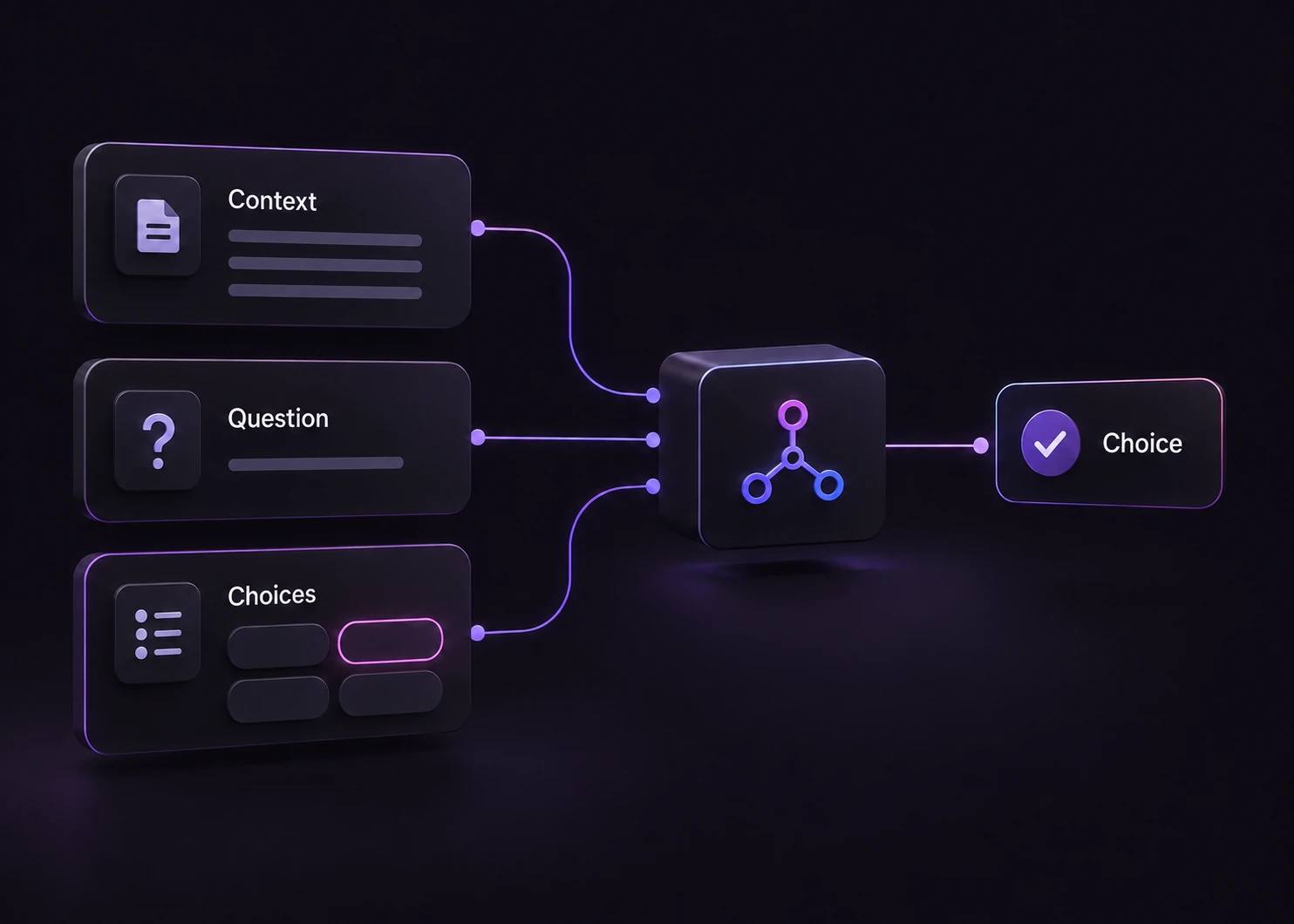
Supply a small, complete input, run the decision and inspect its recorded evidence.

Enter the commit message. Optional diff context can illustrate a boundary, but this rule judges the wording of the message.

The decision rule and the choice labels are sent with the evidence. Keep specificity separate from truth, length and completeness.

The window makes a fresh server-side API request. It displays the highest-probability label, elapsed request time and estimated token cost. A provider failure produces an error, not a missing-evidence label.

Attach the label to a pending message-review note. A reviewer decides whether a rewrite is useful. Download the requests and saved observations. The offline consumer validates their hashes and prints a pending packet without executing it.
| Original input | Observed label | Leading probability |
|---|---|---|
| Specific fix | Checkable | 100% |
| Bare progress | Filler | 100% |
| Short but specific | Checkable | 100% |
| Unclear object | Ambiguous | 100% |
| Specific but contradicted | Checkable | 100% |
| Missing message | Need evidence | 100% |
These are six original synthetic inputs, tested once per request revision. The percentage is the leading option probability, not measured accuracy. Authored expectations and any disagreements remain in the downloadable evidence. 6 of 6 results matched the authored fixture expectations.Verified
Replay the saved synthetic requests and compare each observed label with its authored expectation. Any disagreement stays visible; the model is not rerun to obtain a preferred answer.
The single-request SDK runner uses your private TYPESAFE_API_KEY. The offline consumer reads saved observations, checks request hashes and prints a pending output. It does not call the model or change any external system.
npm install @typesafe-ai/sdk@0.6.0
# Set TYPESAFE_API_KEY privately in your shell.
node run-choice-sample.mjs samples.json case-1
python preview_choice_workflow.py samples.json saved-api-results.jsonInput scope and downstream handling determine what the label can tell you.
Length alone does not decide it. Remove the legacy CSV export endpoint states a checkable change in one sentence.
This rule measures how specific the claim is. Compare it with the actual diff in the separate support check before relying on it.
No. It is the distribution for this request. Six synthetic fixtures check the workflow and preserve disagreements; they are not a production benchmark.
The window shows an error and returns no fresh judgment. The replay runner makes one request without retries. A missing-evidence label is about the input, not a substitute for an API failure.
Edit the supplied evidence above, or open the Playground for a different decision rule.