Source and example scope
Replay the saved synthetic requests and compare each observed label with its authored expectation. Any disagreement stays visible; the model is not rerun to obtain a preferred answer.
Provide one commit-message claim and the before-and-after diff. Compare visible support, contradiction and claims the diff cannot establish, such as unmeasured speed gains.
The null-check input includes the added branch, so the model can compare a concrete claim with concrete code. The timeout input supplies both values and makes the contradiction visible.
Not established differs from Contradicted. A renamed function does not demonstrate a speed improvement, and one changed endpoint does not prove that every endpoint checks authentication. Neither requires inventing an unseen result.
This is a review of supplied text. Run the relevant tests and inspect the full patch when correctness depends on behavior beyond these hunks.
These six synthetic inputs and Choice rules are original demonstrations. The API-collected X post links to jev-commit, whose pinned README describes related checks using Noul questions. This page is not that hook, does not execute Git, and does not reproduce its measurements or credential-blocking policy.
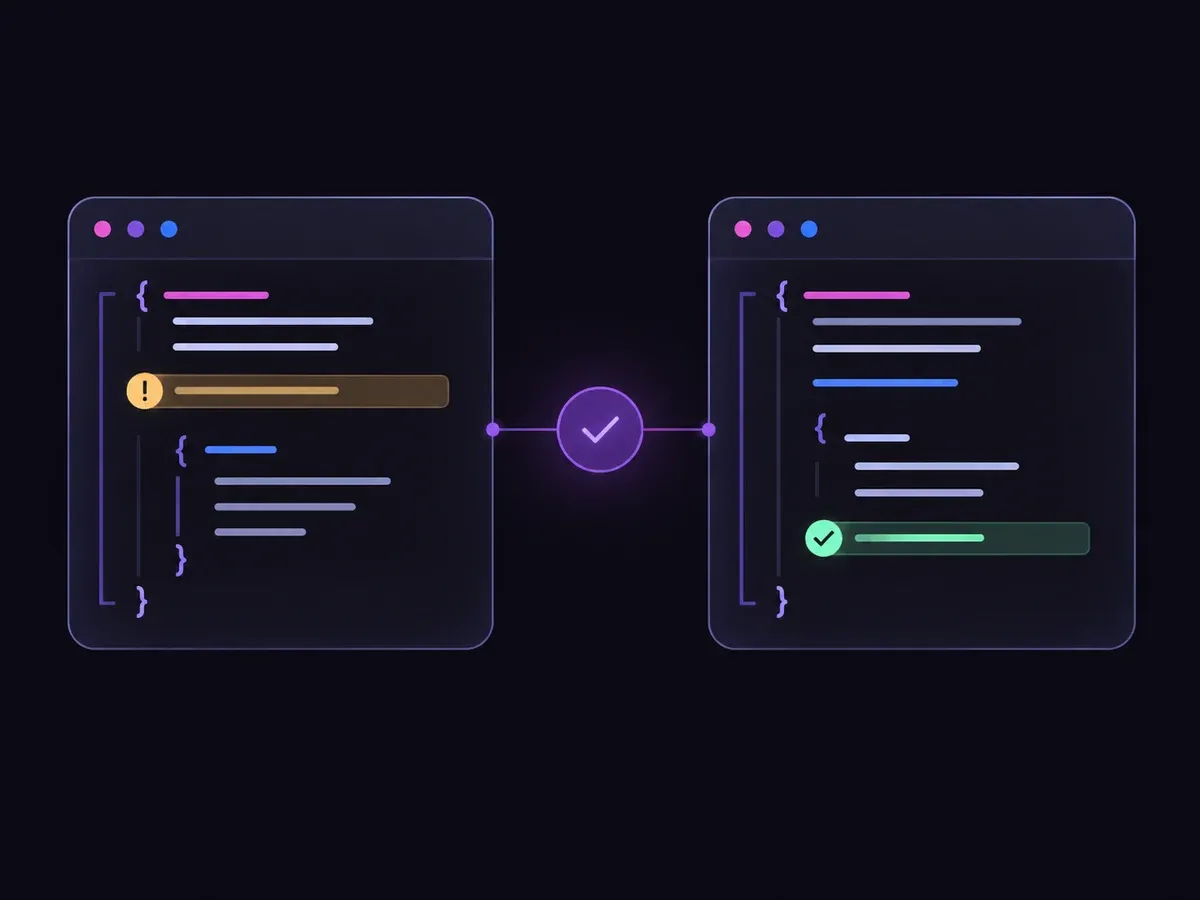
Use the sample to understand the rule, then test your own input for commit claim evidence.

Provide one commit-message claim and the before-and-after diff.

Open the decision rules and keep the intended distinction between Supported, Contradicted, Not established, Need evidence. Edit the choices only when testing your own rule.

Use a sample first, then try your own input. Compare the selected label with the other returned probabilities.

Review Need evidence before using a result. The label is a decision about the supplied information, not an executed action.
| Original input | Observed label | Leading probability |
|---|---|---|
| Null check added | Supported | 87.0% |
| Timeout goes the other way | Contradicted | 100% |
| Speed claim without a measurement | Not established | 97.0% |
| Missing hunk | Need evidence | 99.0% |
| Removal shown | Supported | 98.0% |
| Subset cannot prove global coverage | Not established | 92.0% |
These are six original synthetic inputs, tested once per request revision. The percentage is the leading option probability, not measured accuracy. Authored expectations and any disagreements remain in the downloadable evidence. 6 of 6 results matched the authored fixture expectations.Verified
Replay the saved synthetic requests and compare each observed label with its authored expectation. Any disagreement stays visible; the model is not rerun to obtain a preferred answer.
The single-request SDK runner uses your private TYPESAFE_API_KEY. The offline consumer reads saved observations, checks request hashes and prints a pending output. It does not call the model or change any external system.
npm install @typesafe-ai/sdk@0.6.0
# Set TYPESAFE_API_KEY privately in your shell.
node run-choice-sample.mjs samples.json case-1
python preview_choice_workflow.py samples.json saved-api-results.jsonInput scope and downstream handling determine what the label can tell you.
A specificity check asks whether a claim can be checked. This task supplies the code and asks whether that claim is supported.
No. The fixtures check this text-to-label workflow. They do not execute the supplied code or establish repository correctness.
No. It is the distribution for this request. Six synthetic fixtures check the workflow and preserve disagreements; they are not a production benchmark.
The window shows an error and returns no fresh judgment. The replay runner makes one request without retries. A missing-evidence label is about the input, not a substitute for an API failure.
Edit the supplied evidence above, or open the Playground for a different decision rule.