

Jev clan order conflict

Check whether two game commands conflict

Provide two fictional orders and their priority rule. Compare compatible commands, conflicts resolved by priority and orders that still need clarification.

Check how two commands fit before choosing a move.Live API
Try an example

Original synthetic input. Edit the task or evidence to make a new API request.

Source: Workflow inspiration on X

Source and example scope

The inputs, rubric and preview are original. This window demonstrates the stated decision only; it does not reproduce the source application or its measurements.

Compare commandPair using priorityPolicy.

Decision rules and labels
Compatible ordersPriority resolves conflictClarify conflict
A real response from the Jev API

Edit any input to explore a different decision. No request is sent until you run it.

Your next decision

Not run yet

Choose an example or write your own input, then run it to see the ranked choices.

Results are not stored by this site. Your submitted text is processed by the API provider.

The decision

How does Jev clan order conflict use the supplied evidence?

Jev clan order conflict checks the relationship between two fictional clan commands before a game controller acts. It identifies compatible instructions, conflicts resolved by a stated priority and conflicts that still need clarification.

The API-collected source describes a prompt-driven clan game with Jev in its action loop. This original example audits command relationships using text fixtures. It does not reproduce the source game, run a simulation or report a score, frame rate or action latency.

A command can sound clear by itself and conflict with another command aimed at the same unit. The priority policy and conditions therefore travel with the pair. The local finding remains pending; it never invents a commander hierarchy or selects the winning game move.

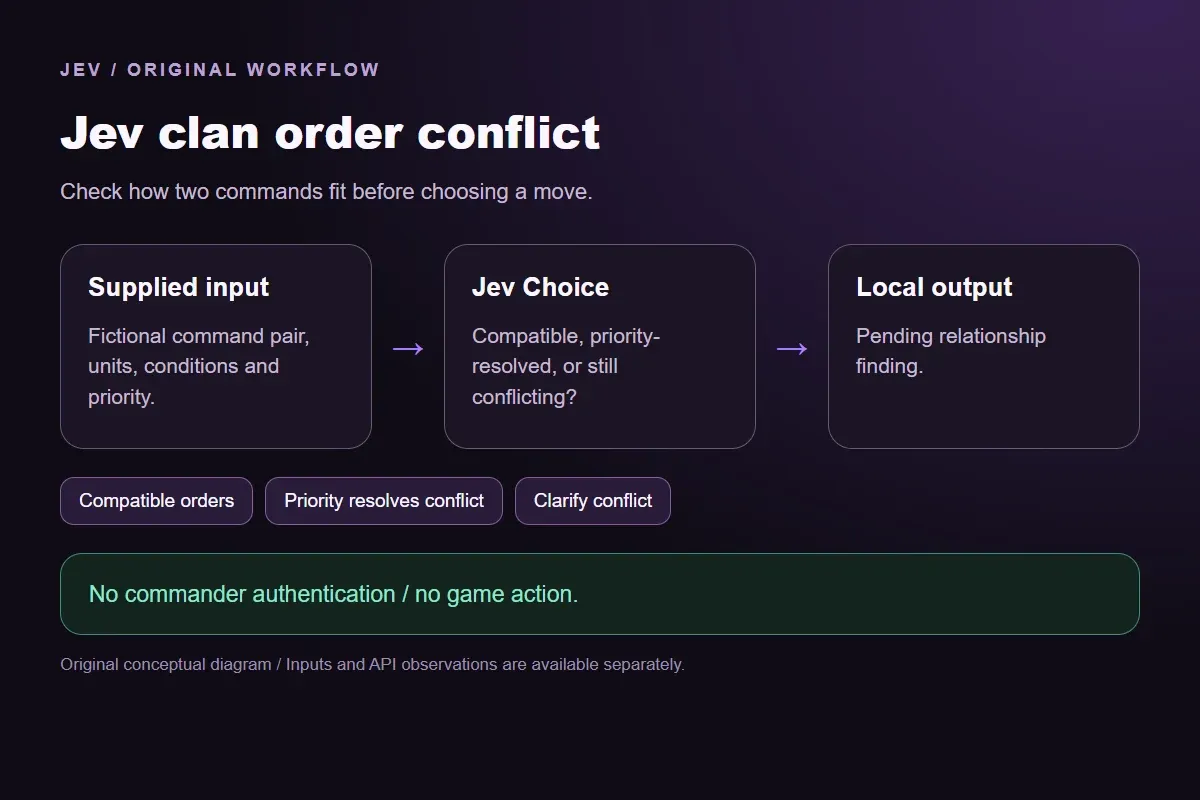
Original Jev clan order conflict workflow diagram showing supplied evidence, a typed decision and the local preview.
Original workflow illustration. The output is a local preview, not an executed action or source screenshot.
How it works

Try the example in four steps

Use the sample to understand the rule, then test your own input for game order conflicts.

  1. Illustration of adding the text or evidence for a decision

    Add the information to check

    Provide two fictional orders and their priority rule.

  2. Illustration of defining a question and its allowed choices

    Confirm the question and labels

    Open the decision rules and keep the intended distinction between Compatible orders, Priority resolves conflict, Clarify conflict. Edit the choices only when testing your own rule.

  3. Illustration of sending one input and comparing the returned choices

    Run the decision

    Use a sample first, then try your own input. Compare the selected label with the other returned probabilities.

  4. Illustration of reviewing a result and an uncertain item before using it

    Review the next step

    Review uncertain or unexpected results before using a result. The label is a decision about the supplied information, not an executed action.

Our API test

What the six original inputs returned.

What the six original inputs returned.
Original test inputFixture expectationObserved labelLeading probability
Aligned defense ordersCompatible ordersCompatible orders100%
Priority resolves opposing commandsPriority resolves conflictPriority resolves conflict100%
Equal-priority contradictionClarify conflictClarify conflict100%
Different units can act togetherCompatible ordersCompatible orders100%
Conditions make orders compatibleCompatible ordersCompatible orders88%
Conflict without priority evidenceClarify conflictClarify conflict100%
  • 6 of 6 original fixture expectations matched. Contrary outputs are preserved in the table and downloads; these checks are not held-out accuracy or production suitability.
  • Measured adapter round trips: 459-1310 ms. Estimated input cost: $0.00002394-$0.00002486 per request. These observations are not a latency guarantee or invoice.

6 actual Jev API calls on October 2, 2026. Original synthetic inputs check this rubric and handoff; they do not establish held-out accuracy. Probabilities are model outputs.Verified

Understand the results

Aligned defense orders

The first pair expresses the same bridge-defense objective with different wording.

Read the example notes

Compatible orders concerns the shared unit and location. It does not claim that defending the bridge is tactically good or physically possible. Those facts are outside the supplied input. This check precedes an action-selection stage: it asks whether the instructions can coexist under the given policy, rather than decide which move has the highest chance of winning the game.

Source and example scope

The priority fixture gives the commander and scout opposing instructions for squad Blue.

Read the example notes

The explicitly supplied hierarchy resolves that relationship. Priority resolves conflict records the presence of a rule; it does not independently verify either role or issue a retreat command. A real controller would validate the roles and apply its priority policy in trusted code. A familiar title such as Commander must not become an invented authority when the actual policy is missing.

Equal-priority contradiction

The equal-priority pair asks the same squad to hold and leave the bridge at the same time.

Read the example notes

Clarify conflict keeps that contradiction open. Neither sentence becomes authoritative merely because it appears first, sounds more urgent or contains a stronger verb. The local packet preserves the two original commands for a person or separate planning system to resolve. It does not merge them into a compromise order that neither officer actually issued.

Source and example scope

The separate-unit fixture assigns bridge defense to Blue and camp scouting to Red.

Read the example notes

Compatible orders follows the explicit statement that the squads are separate and the tasks do not interfere. That supplied statement is a fixture assumption, not an observation from a running game. If a real map or resource limit made those tasks mutually exclusive, the application would need to attach that state. The old response would not establish compatibility after such a change.

The conditional fixture says to hold until the gate falls and retreat after that event

The conditional fixture says to hold until the gate falls and retreat after that event.

Read the example notes

The conditions divide the orders into different phases, so they can coexist. This example compares those semantic conditions without observing whether the gate has actually fallen. Event detection, simulation state and action timing remain separate. A production controller should evaluate the confirmed event state in code and preserve the original command policy alongside whichever phase becomes applicable.

Source and example scope

The missing-priority fixture gives simultaneous advance and retreat orders without identifying their authors.

Read the example notes

Clarify conflict avoids treating an absent hierarchy as equality or guessing which message came later. A caller can attach verified roles and an approved priority rule, then make a new request. The six fictional pairs check this stated relationship rubric only. They do not establish autonomous-control safety, tactical competence or reliable handling of every possible conditional command.

Source and example scope

Fixture expectations are authored before the calls. Any contrary model choice remains visible beside its expectation and complete distribution; no repeated judgment is used to obtain a preferred label.

Using the result in your application

Download the exact sample requests and saved observations below.

Read the example notes

Expected labels are original fixture checks and stay outside the request sent to Jev. The observation file preserves the complete probabilities and the hash of each exact request. Editing a task, rubric or candidate requires a fresh response; a matching sample name does not make an older answer current.

Using the result in your application

The JavaScript runner makes one independent SDK request for a chosen sample ID.

Read the example notes

It reads TYPESAFE_API_KEY privately from the environment and has no automatic retry. The Python consumer operates offline: it checks the rubric, labels, unique sample identities, request hashes and valid probability distributions before selecting a fixed local preview. A tied leading result remains pending for review.

Source and example scope

The page reports measured adapter round trips and estimated input cost for the recorded calls.

Read the example notes

Those values describe these requests, not a provider latency guarantee or a billing statement. Six deliberately authored fixtures can check the stated behavior, but they do not establish accuracy on an unseen dataset. Keep disagreements and missing-input examples when testing an integration.

Runnable offline example

Replay one request and inspect the saved preview.

View the code example
Replay commands
npm install @typesafe-ai/sdk@0.6.0
# Set TYPESAFE_API_KEY privately in your shell.
node run-choice-sample.mjs samples.json aligned
python preview_choice_workflow_v2.py samples.json saved-api-results.json
Scope of this demo

Where does this decision fit?

Useful with explicit supplied evidence

  • Compare two fictional game-clan orders under a stated commander priority policy. Distinguish compatible orders, a conflict resolved by explicit priority and an unresolved conflict. Print a pending relationship report without choosing or executing a unit action.
  • Inspecting the original task and a fixed output before integrating external tools.
  • Comparing an explicit expected label with the complete recorded distribution.

Needs separate implementation or evidence

  • Inferring facts absent from the supplied input.
  • Treating a semantic selection as authorization to act.
  • Executing an external action or generalizing six fixtures into an accuracy claim.
Example FAQ

Questions about this original decision workflow.

Keep relevance, compliance and execution separate.

Does this choose a game move?

No. It audits how two supplied orders relate. Action selection, event detection and the game simulation remain separate.

Where does command priority come from?

The fixture supplies it explicitly. A production controller would validate role identities and own the actual authority policy.

Can two opposite verbs be compatible?

Yes, when they apply to different units or different explicit conditions. The complete supplied pair matters.

Are the examples recordings from the source game?

No. They are original fictional command pairs inspired by the source workflow. The outer API judgments are real observations.

What happens to unresolved conflict?

The fixed local packet stays pending and preserves the finding. This demonstration neither merges the orders nor executes one of them.

Try a task from your own workflow

Change the supplied task or evidence here, then inspect the live response. Playground supports another explicit decision.