Jev change documentation gap

Find documentation gaps caused by a code change

Give the changed behavior and relevant documentation. Compare stale instructions, missing public guidance and an internal change that has no documented user impact.

What documentation issue is supported?Live API
Try an example

The instructions still use a rejected flag.

Source: API-collected workflow inspiration; original demonstration below

Source and example scope

The API-collected roundup links the cited project, whose pinned code provides the decision purpose. This demonstration separately authors its Choice rubric, priorities, missing-context outcomes and synthetic inputs. It neither runs the upstream application nor verifies its performance, security or execution claims.

Compare the change and docs.

Decision rules and labels
Stale guidanceMissing guidanceCoveredNo docs impactNeed docs context
A real response from the Jev API

Edit any input to explore a different decision. No request is sent until you run it.

Your next decision

Not run yet

Choose an example or write your own input, then run it to see the ranked choices.

Results are not stored by this site. Your submitted text is processed by the API provider.

The decision

Stale guidance and missing guidance need different fixes.

An old CLI flag left in the docs can direct a user to a command the updated program rejects. A new required setting that is never described is an omission. The presets distinguish those two repair tasks.

The missing-guidance result requires a documentation set explicitly marked complete for this review. When only an introduction is supplied, the model cannot know whether a setup page elsewhere covers the setting.

This original Choice adaptation makes the documentation observation concrete. It does not inspect a repository, generate replacement instructions or verify that the described code change was deployed.

The API-collected roundup links the cited project, whose pinned code provides the decision purpose. This demonstration separately authors its Choice rubric, priorities, missing-context outcomes and synthetic inputs. It neither runs the upstream application nor verifies its performance, security or execution claims.

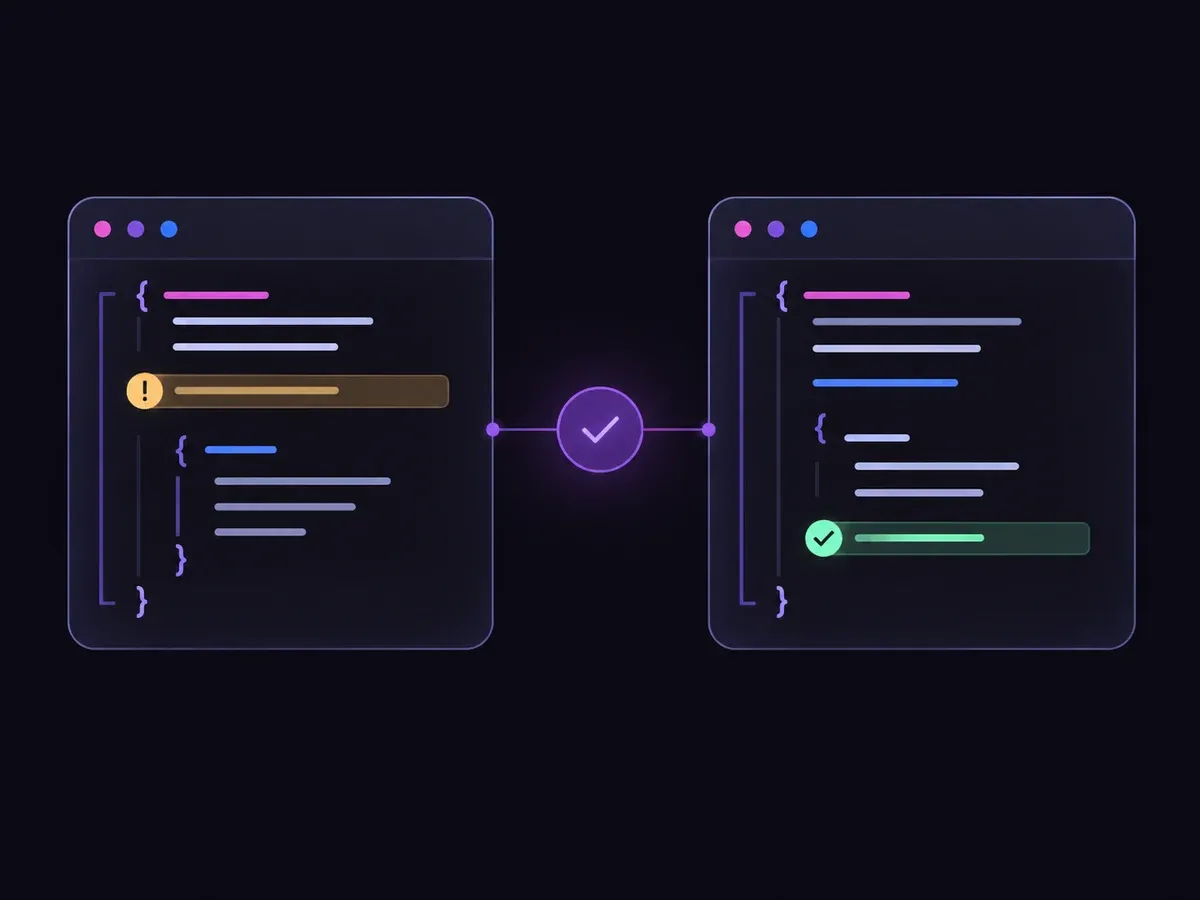
Illustration of checking a code change and reviewing a flagged line
Illustration of the decision flow.
How it works

Try the example in four steps

Use the sample to understand the rule, then test your own input for documentation gaps.

  1. Illustration of adding the text or evidence for a decision

    Add the information to check

    Give the changed behavior and relevant documentation.

  2. Illustration of defining a question and its allowed choices

    Confirm the question and labels

    Open the decision rules and keep the intended distinction between Stale guidance, Missing guidance, Covered, No docs impact, Need docs context. Edit the choices only when testing your own rule.

  3. Illustration of sending one input and comparing the returned choices

    Run the decision

    Use a sample first, then try your own input. Compare the selected label with the other returned probabilities.

  4. Illustration of reviewing a result and an uncertain item before using it

    Review the next step

    Review Missing guidance, Need docs context before using a result. The label is a decision about the supplied information, not an executed action.

Our API test

Recorded API observations

Recorded API observations
Original inputObserved labelLeading probability
Renamed flagStale guidance99.0%
New required settingMissing guidance100%
Updated commandCovered92.0%
Local variableNo docs impact97.0%
Partial excerptNeed docs context52.0%
Old and missingStale guidance97.0%

These are six original synthetic inputs, tested once per request revision. The percentage is the leading option probability, not measured accuracy. Authored expectations and any disagreements remain in the downloadable evidence. 6 of 6 results matched the authored fixture expectations.Verified

Understand the results

Replay the saved synthetic requests to inspect each recorded decision

Replay the saved synthetic requests to inspect each recorded decision. Authored expectations and model disagreements remain available; these examples are not a production accuracy benchmark.

Using the result in your application

The single-request SDK runner uses your private TYPESAFE_API_KEY. The offline consumer reads saved observations, checks request hashes and prints a pending output. It does not call the model or change any external system.

Runnable offline example

Run one sample, then inspect the local packet

View the code example
Single-request replay
npm install @typesafe-ai/sdk@0.6.0
# Set TYPESAFE_API_KEY privately in your shell.
node run-choice-sample.mjs samples.json case-1
python preview_choice_workflow.py samples.json saved-api-results.json
Scope of this demo

Where this decision fits

Useful scope

  • Checking a CLI or configuration change against docs
  • Distinguishing stale instructions from omissions
  • Reviewing documentation packets alongside a patch

Outside this demonstration

  • Assuming unseen documentation is absent
  • Generating release notes automatically
  • Verifying production behavior from a draft
Example FAQ

Questions about change documentation gap.

Input scope and downstream handling determine what this judgment means.

Why does Stale guidance take priority?

It records a direct contradiction when a passage has both stale instructions and an omission. Reviewers should still fix both issues.

Does No docs impact certify the whole patch?

No. It describes the supplied internal-only change. A broader patch can have other documentation effects.

Is the leading probability an accuracy measurement?

No. It is one value in the returned distribution over this request’s choices. The six synthetic fixtures have authored expectations; they do not measure production accuracy.

What happens on an API failure?

The window displays an error without a fresh judgment. An incomplete-input outcome describes the supplied evidence and is not used as a fallback for provider failure.

Try your own change documentation gap input

Edit the input above, or open the Playground to explore another decision.

