Jev call screening response selection

Choose a call-screening reply from supplied messages

Provide the caller's text and current dialogue stage. Choose a fixed purpose, callback or acknowledgment message, or end the exchange when the caller asks.

Choose the next fixed reply from the dialogue state.Live API
Try an example

Original synthetic input. Edit the task or evidence to make a new API request.

Source: Workflow inspiration on X

Source and example scope

The inputs, rubric and preview are original. This window demonstrates the stated decision only; it does not reproduce the source application or its measurements.

Select a fixed next message.

Decision rules and labels
Ask purposeAsk callback detailsAcknowledge noteEnd exchangeNeed dialogue context
A real response from the Jev API

Edit any input to explore a different decision. No request is sent until you run it.

Your next decision

Not run yet

Choose an example or write your own input, then run it to see the ranked choices.

Results are not stored by this site. Your submitted text is processed by the API provider.

The decision

How does Jev call screening response selection use the supplied evidence?

Jev call screening response selection chooses one fixed next message from a supplied dialogue state. When a caller gives only a name during identification, the next response asks the purpose. When a return call is requested during the purpose stage without contact details, it asks for a callback number. The page displays exact candidate text and speaks nothing.

An API-collected X post described selecting pre-canned responses for a call screener. Our original text-only exercise uses a small candidate catalog and six authored dialogue states. It does not reproduce the source recording, transcribe audio, operate a phone line or verify response timing in a live call. A telephone adapter is separate work.

The conversation stage matters alongside the words. Two samples contain the same name statement, but only one identifies the current stage. Need dialogue context keeps the missing state visible. A text classifier that ignores state could choose a plausible reply at the wrong point in the exchange.
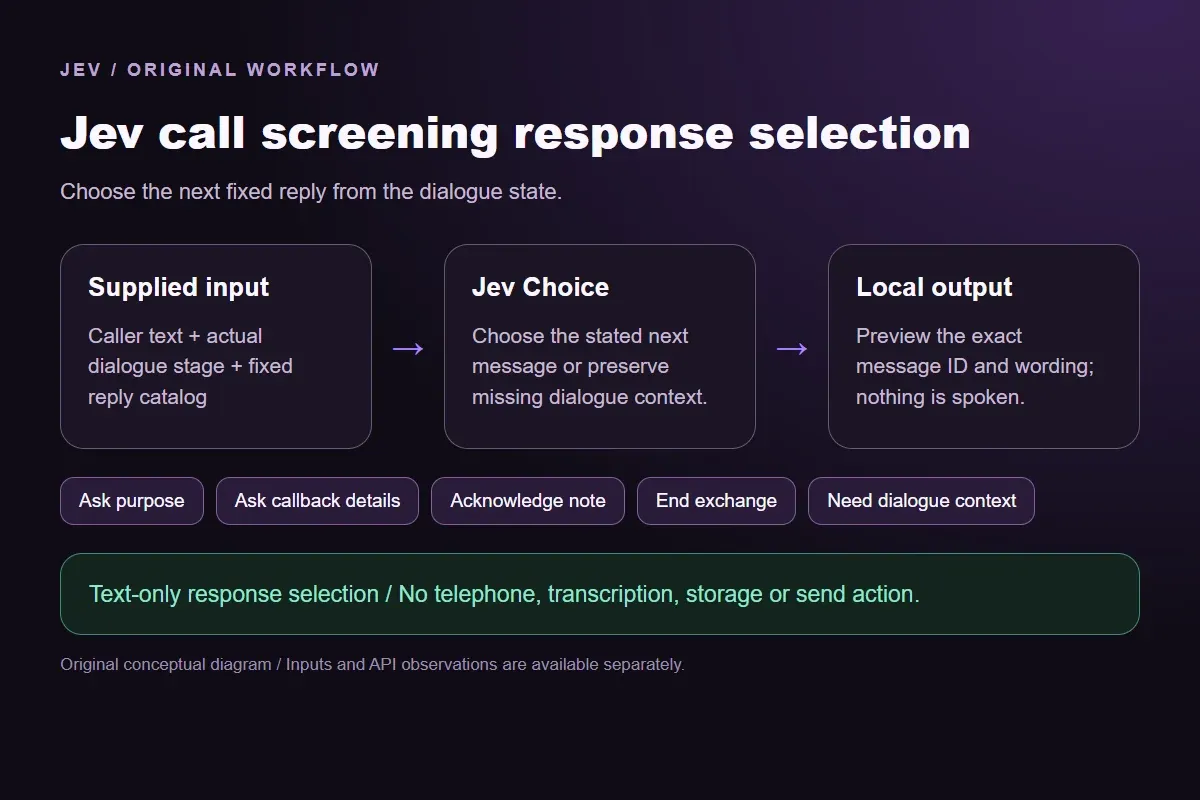

Original Jev call screening response selection workflow diagram showing supplied evidence, a typed decision and the local preview.
Original workflow illustration. The output is a local preview, not an executed action or source screenshot.
How it works

Try the example in four steps

Use the sample to understand the rule, then test your own input for call-screening reply.

  1. Illustration of adding the text or evidence for a decision

    Add the information to check

    Provide the caller's text and current dialogue stage.

  2. Illustration of defining a question and its allowed choices

    Confirm the question and labels

    Open the decision rules and keep the intended distinction between Ask purpose, Ask callback details, Acknowledge note, End exchange, Need dialogue context. Edit the choices only when testing your own rule.

  3. Illustration of sending one input and comparing the returned choices

    Run the decision

    Use a sample first, then try your own input. Compare the selected label with the other returned probabilities.

  4. Illustration of reviewing a result and an uncertain item before using it

    Review the next step

    Review Need dialogue context before using a result. The label is a decision about the supplied information, not an executed action.

Our API test

What the six original inputs returned.

What the six original inputs returned.
Original test inputObserved labelLeading probability
Identification needs a purposeAsk purpose100%
Return call without contactAsk callback details97%
Informational note without replyAcknowledge note95%
Caller asks to endEnd exchange100%
Same name but no dialogue stageNeed dialogue context100%
Another callback with missing numberAsk callback details98%
  • Measured adapter round trips: 480-1212 ms. Estimated input cost: $0.00003003-$0.00003045 per request. These observations are not a latency guarantee or invoice.

6 actual Jev API calls on October 1, 2026. Original synthetic inputs check this rubric and handoff; they do not establish held-out accuracy. Probabilities are model outputs.Verified

Understand the results

The identification sample gives a name but no reason for calling

The identification sample gives a name but no reason for calling.

Read the example notes

Ask purpose selects the catalog message What would you like to discuss? Its message ID and wording appear in the fixed preview. The model cannot add a question, greeting or personal detail to this payload. A production interface should show the selected text before sending it.

Return call without contact

The return-call sample reaches the purpose stage and explicitly lacks contact details.

Read the example notes

Ask callback details selects the supplied question about the return number. It does not invent a telephone number or assume that caller ID is available. The second callback sample tests the same requirement with a scheduling request rather than a generic return-call message.

The delivery update says no reply is needed

The delivery update says no reply is needed.

Read the example notes

Acknowledge note returns Thank you for the information. That sentence makes no claim that a note has been stored or someone has been notified. The offline preview cannot establish either event, and this article never treats an acknowledgment as a receipt for a database write.

The explicit request to end selects End exchange

The explicit request to end selects End exchange.

Read the example notes

This is a message preview, not a hang-up command. A real telephone flow may need its own consent and retention rules, state transitions and failure handling. Those deterministic operations should not be inferred from the presence of an ending phrase in the selected text.

The missing-stage name example retains Need dialogue context

The missing-stage name example retains Need dialogue context.

Read the example notes

Its caller words match the identification example but the application has not established the stage. The expected difference tests what state contributes to the contract. New state from a completed exchange would need to be supplied in a fresh request; no previous response implicitly updates this fixture.

Using the result in your application

A real integration needs audio transcription, caller identity handling, contact validation, conversation persistence and an authorized send mechanism.

Read the example notes

This demo implements none of those services. The v2 offline consumer binds the output text and message ID to the catalog inside the exact request. It reports a fixed local payload, with ties left pending for review.

Using the result in your application

Download the exact sample requests and saved observations below.

Read the example notes

Expected labels are original fixture checks and stay outside the request sent to Jev. The observation file preserves the complete probabilities and the hash of each exact request. Editing a task, rubric or candidate requires a fresh response; a matching sample name does not make an older answer current.

Using the result in your application

The JavaScript runner makes one independent SDK request for a chosen sample ID.

Read the example notes

It reads TYPESAFE_API_KEY privately from the environment and has no automatic retry. The Python consumer operates offline: it checks the rubric, labels, unique sample identities, request hashes and valid probability distributions before selecting a fixed local preview. A tied leading result remains pending for review.

Source and example scope

The page reports measured adapter round trips and estimated input cost for the recorded calls.

Read the example notes

Those values describe these requests, not a provider latency guarantee or a billing statement. Six deliberately authored fixtures can check the stated behavior, but they do not establish accuracy on an unseen dataset. Keep disagreements and missing-input examples when testing an integration.

Runnable offline example

Replay one request and inspect the saved preview.

View the code example
Replay commands
npm install @typesafe-ai/sdk@0.6.0
# Set TYPESAFE_API_KEY privately in your shell.
node run-choice-sample.mjs samples.json name
python preview_choice_workflow_v2.py samples.json saved-api-results.json
Scope of this demo

Where does this decision fit?

Useful with explicit supplied evidence

  • Choose one fixed next response for an original call-screening dialogue using its stated conversation stage and caller intent. The candidate message text stays immutable. Missing dialogue context stays pending. No audio transcription, telephone call, stored note or spoken response is performed.
  • Inspecting the original task and a fixed output before integrating external tools.
  • Comparing an explicit expected label with the complete recorded distribution.

Needs separate implementation or evidence

  • Inferring facts absent from the supplied input.
  • Treating a semantic selection as authorization to act.
  • Executing an external action or generalizing six fixtures into an accuracy claim.
Example FAQ

Questions about this original decision workflow.

Keep relevance, compliance and execution separate.

Does the demo answer or place a phone call?

No. It makes a text-only Jev decision and displays the selected fixed message. Audio, telephone transport and speaking the response require separate components.

Why include the current dialogue stage?

The same caller text can need a different next step at different stages. An absent stage remains Need dialogue context under this explicit rule.

Can Jev rewrite the selected response?

Not in this fixture. Each label maps to exact supplied message text and its ID. The offline consumer rejects a payload that differs from the request catalog.

Does acknowledging a note mean it was stored?

No. The selected sentence thanks the caller for the information and claims no storage or notification. No write operation occurs here.

Will End exchange hang up?

No. It previews an ending message. A telephone action would need a separate authorized adapter and the actual call state.

Try a task from your own workflow

Change the supplied task or evidence here, then inspect the live response. Playground supports another explicit decision.