Jev buyer objection routing

Identify the barrier in a buyer's reply

Provide the buyer's reply to distinguish a budget barrier, integration concern or missing capability. Keep unclear buying context separate before choosing a follow-up.

Which buying barrier needs a follow-up?Live API
Try an example

Original synthetic input. Edit the task or evidence to make a new API request.

Source: Workflow inspiration on X

Source and example scope

The inputs, rubric and preview are original. This window demonstrates the stated decision only; it does not reproduce the source application or its measurements.

Review buyerReply for the stated buying barrier.

Decision rules and labels
Budget barrierIntegration barrierCapability gapNo stated barrierNeed buyer context
A real response from the Jev API

Edit any input to explore a different decision. No request is sent until you run it.

Your next decision

Not run yet

Choose an example or write your own input, then run it to see the ranked choices.

Results are not stored by this site. Your submitted text is processed by the API provider.

The decision

How does Jev buyer objection routing use the supplied evidence?

Jev buyer objection routing maps a supplied sales reply to a follow-up review topic. Jev identifies a stated budget barrier, an integration obstacle, a missing capability, interest without an objection or a need for more buyer context. Code then selects one fixed question for a person to review.

This is a reply-handling decision after someone has expressed interest. It does not qualify the account, score a lead or decide whether to contact someone. The information that blocks a purchase can differ from the facts used to judge whether a lead is sales ready. No company size, title or engagement count appears in these inputs.

An API-collected post describing Jev-assisted prospecting and reply sorting inspired this example. The author describes separate agents for discovery and writing, with a human approving email. Our original demonstration implements only a small reply-to-follow-up mapping. It does not verify the reported demo booking, savings, agent deployment or sales results.

Try the first three replies, which identify different blockers, then compare the unexplained refusal and the reply naming two equally important obstacles. The question asks for one primary topic. When the supplied text cannot establish one, Need buyer context preserves that gap instead of manufacturing a confident explanation for a lost sale.
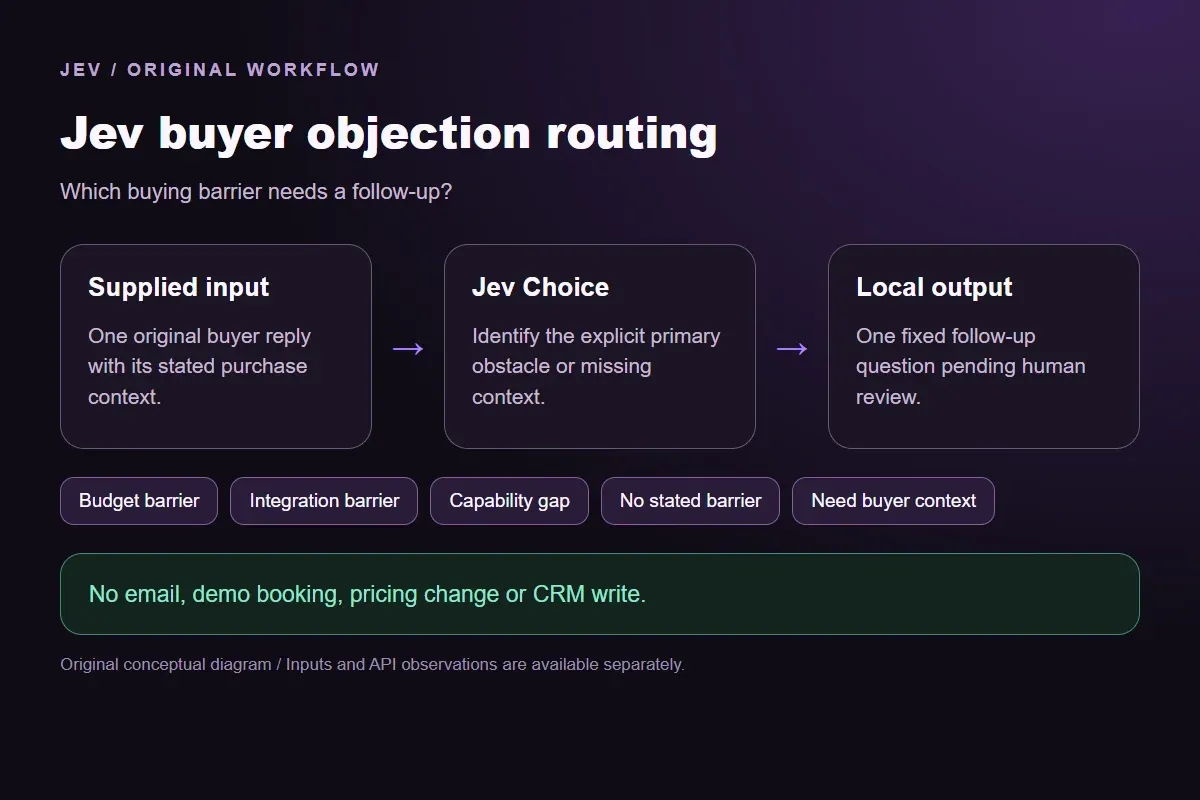

Original Jev buyer objection routing workflow diagram showing supplied evidence, a typed decision and the local preview.
Original workflow illustration. The output is a local preview, not an executed action or source screenshot.
How it works

Try the example in four steps

Use the sample to understand the rule, then test your own input for buyer objections.

  1. Illustration of adding the text or evidence for a decision

    Add the information to check

    Provide the buyer's reply to distinguish a budget barrier, integration concern or missing capability.

  2. Illustration of defining a question and its allowed choices

    Confirm the question and labels

    Open the decision rules and keep the intended distinction between Budget barrier, Integration barrier, Capability gap, No stated barrier, Need buyer context. Edit the choices only when testing your own rule.

  3. Illustration of sending one input and comparing the returned choices

    Run the decision

    Use a sample first, then try your own input. Compare the selected label with the other returned probabilities.

  4. Illustration of reviewing a result and an uncertain item before using it

    Review the next step

    Review Need buyer context before using a result. The label is a decision about the supplied information, not an executed action.

Our API test

What the six original inputs returned.

What the six original inputs returned.
Original test inputFixture expectationObserved labelLeading probability
Price exceeds the stated budgetBudget barrierBudget barrier100%
Connecting an existing system is the blockerIntegration barrierIntegration barrier100%
A required function is missingCapability gapCapability gap100%
Interest without a stated objectionNo stated barrierNo stated barrier100%
An unexplained refusalNeed buyer contextNeed buyer context99%
Two blockers without a primary oneNeed buyer contextNeed buyer context100%
  • 6 of 6 original fixture expectations matched. Contrary outputs are preserved in the table and downloads; these checks are not held-out accuracy or production suitability.
  • Measured adapter round trips: 479-1233 ms. Estimated input cost: $0.00002440-$0.00002486 per request. These observations are not a latency guarantee or invoice.

6 actual Jev API calls on October 4, 2026. Original synthetic inputs check this rubric and handoff; they do not establish held-out accuracy. Probabilities are model outputs.Verified

Understand the results

Price exceeds the stated budget

The first buyer states that allocated funding is below the price.

Read the example notes

Budget barrier follows that explicit statement. It does not imply that every price question is an objection or that a discount should be offered. The fixed local question asks what spending range is available for the planned purchase. A sales representative must review the wording and relationship before using it.

The fixture supplies no authority to change pricing, send an email or update a CRM stage.

Connecting an existing system is the blocker

The second reply identifies connection to an existing inventory system as the obstacle.

Read the example notes

Integration barrier requests clarification about that adoption work. The model does not inspect connector documentation or claim that an integration is supported. A generic promise that the product works with every system would exceed the evidence. This packet therefore contains a fixed question about the connection being evaluated rather than a technical answer or an automatically scheduled implementation project.

A required function is missing

The missing audit-log export is a capability gap in the third reply.

Read the example notes

The fictional input explicitly supplies the lack of that function; the model should not invent a roadmap or workaround. The review question asks which audit-log details the buyer needs. That can inform a human investigation, but the current output does not commit the vendor to building a feature. Editing the stated feature list changes the evidence and requires another response.

Interest without a stated objection

The fourth buyer asks about a demo without stating a blocker.

Read the example notes

No stated barrier keeps this outcome separate from the three objection types. Its fixed question asks what the buyer would like the demo to show. This is not a Sales ready verdict: budget, authority and timing are absent. The example demonstrates a smaller follow-up task while leaving qualification and outreach approval to their own workflows. The local packet records no demo booking.

The short refusal supplies no reason and no meaningful buying context

The short refusal supplies no reason and no meaningful buying context.

Read the example notes

Need buyer context prevents the model from substituting common sales explanations such as price or missing features. The review question asks for the requirement that was not met. In a real conversation, a representative may decide that asking again would be inappropriate. The example neither sends that question nor treats a semantic label as consent to continue contacting the person.

Two blockers without a primary one

The last reply names both funding and integration without identifying a primary issue.

Read the example notes

The declared rule preserves that ambiguity. A real sales workflow could ask several independent questions and retain both barriers, but this single-choice preview cannot quietly become a multi-label record. The fixed clarification asks which blocker should be discussed first. If the buyer then supplies a priority, the revised text creates a new request instead of changing the saved result.

Source and example scope

Fixture expectations are authored before the calls. Any contrary model choice remains visible beside its expectation and complete distribution; no repeated judgment is used to obtain a preferred label.

Using the result in your application

Download the exact sample requests and saved observations below.

Read the example notes

Expected labels are original fixture checks and stay outside the request sent to Jev. The observation file preserves the complete probabilities and the hash of each exact request. Editing a task, rubric or candidate requires a fresh response; a matching sample name does not make an older answer current.

Using the result in your application

The JavaScript runner makes one independent SDK request for a chosen sample ID.

Read the example notes

It reads TYPESAFE_API_KEY privately from the environment and has no automatic retry. The Python consumer operates offline: it checks the rubric, labels, unique sample identities, request hashes and valid probability distributions before selecting a fixed local preview. A tied leading result remains pending for review.

Source and example scope

The page reports measured adapter round trips and estimated input cost for the recorded calls.

Read the example notes

Those values describe these requests, not a provider latency guarantee or a billing statement. Six deliberately authored fixtures can check the stated behavior, but they do not establish accuracy on an unseen dataset. Keep disagreements and missing-input examples when testing an integration.

Runnable offline example

Replay one request and inspect the saved preview.

View the code example
Replay commands
npm install @typesafe-ai/sdk@0.6.0
# Set TYPESAFE_API_KEY privately in your shell.
node run-choice-sample.mjs samples.json budget
python preview_choice_workflow_v2.py samples.json saved-api-results.json
Runnable offline example

The first request and its recorded local output.

View the code example
Exact first sample and local preview
{
  "input": {
    "task": "Choose the follow-up review topic from the buyer reply.",
    "buyerReply": "We want the reporting product, but its price is above the funding allocated for this purchase. That is what stops us."
  },
  "localOutput": {
    "sampleId": "budget",
    "leaders": [
      "Budget barrier"
    ],
    "probabilities": {
      "Budget barrier": 1,
      "Integration barrier": 0,
      "Capability gap": 0,
      "No stated barrier": 0,
      "Need buyer context": 0
    },
    "action": "preview_buyer_followup",
    "payload": {
      "reviewTopic": "Budget barrier",
      "proposedQuestion": "What spending range is available for this planned purchase?",
      "sent": false
    },
    "pending": true
  }
}
Scope of this demo

Where does this decision fit?

Useful with explicit supplied evidence

  • Interpret a buyer reply to identify its explicitly stated primary purchase obstacle and select a fixed follow-up question for human review. Not lead qualification, account fit, campaign scoring or email priority.
  • Inspecting the original task and a fixed output before integrating external tools.
  • Comparing an explicit expected label with the complete recorded distribution.

Needs separate implementation or evidence

  • Inferring facts absent from the supplied input.
  • Treating a semantic selection as authorization to act.
  • Executing an external action or generalizing six fixtures into an accuracy claim.
Example FAQ

Questions about this original decision workflow.

Keep relevance, compliance and execution separate.

Does this qualify the buyer?

No. It identifies the stated obstacle for a follow-up review. Buying authority, purchase timing and account fit are separate questions, and the example does not infer them from an interested reply.

Does Jev write the follow-up question?

No. Each question is original text stored in a fixed local mapping. Jev selects a label, and the offline consumer prints the corresponding pending packet. A person reviews any proposed use of that question.

What happens when several barriers are mentioned?

The supplied rule requires a primary barrier. Without one, the result asks for context. A system needing all mentioned barriers would need a different typed contract and new observations; it cannot reinterpret this one-label answer as a complete list.

Are the source sales results reproduced here?

No. The attributed post is inspiration for reply sorting. These six fabricated replies and their original API observations test a bounded local decision. They establish no demo-booking rate, revenue, savings or deployment results for the source product.

Try a task from your own workflow

Change the supplied task or evidence here, then inspect the live response. Playground supports another explicit decision.