Source and example scope
Compare each saved result with its authored expectation. A disagreement remains in the fixture review; the call is not repeated to obtain a preferred label.
Paste a reviewer note to distinguish unsupported facts, an unmet instruction and a failed test. Inspect mixed repair requests without assuming the fix has succeeded.
This classifier reads what a reviewer asks to fix. In the cost example, latency measurements do not support the quoted cost claim, so the requested repair concerns source support. In the offline-file example, the reviewer names a missing requirement. A later review must check whether the repair was completed.
The source-file example tests a shared word with a different meaning. The note describes executable behavior, so its repair focus is Test failure rather than Source support. Mixed repair keeps equally important requests visible.
The source describes returning specific criticism to workers in a batch loop. This original classifier does not run a swarm, repair a file or validate the workers’ final output.
This is an original synthetic demonstration adapted from the cited workflow discussion. It does not reproduce the source application or verify its performance, adoption or security claims.
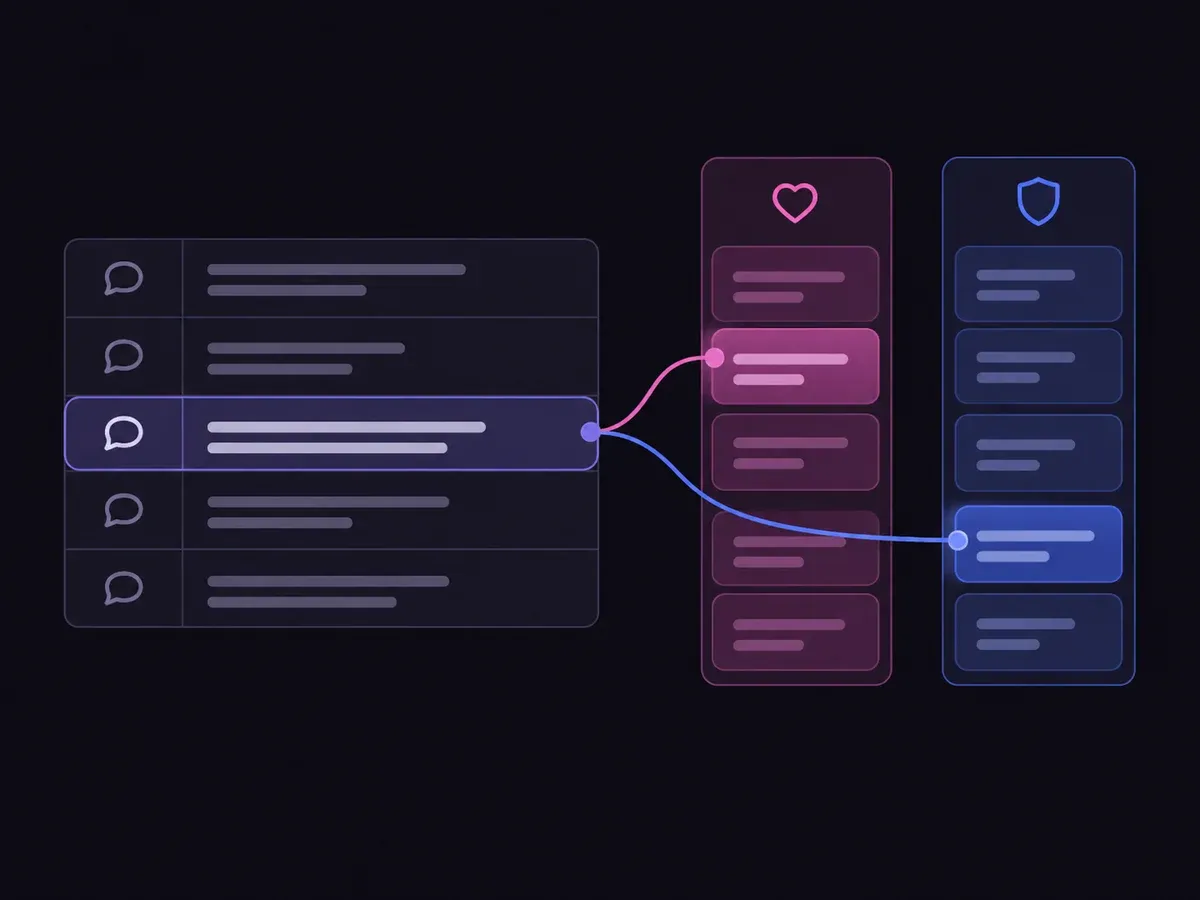
Use the sample to understand the rule, then test your own input for review feedback type.

Paste a reviewer note to distinguish unsupported facts, an unmet instruction and a failed test.

Open the decision rules and keep the intended distinction between Source support, Instruction adherence, Test failure, Mixed repair, Need evidence. Edit the choices only when testing your own rule.

Use a sample first, then try your own input. Compare the selected label with the other returned probabilities.

Review Need evidence before using a result. The label is a decision about the supplied information, not an executed action.
| Original input | Observed label | Leading probability |
|---|---|---|
| Unsupported claim | Source support | 100% |
| Ignored requirement | Instruction adherence | 100% |
| Executable failure | Test failure | 100% |
| Two repair focuses | Mixed repair | 100% |
| Source word in a test | Test failure | 100% |
| No feedback note | Need evidence | 100% |
These are six original synthetic inputs, tested once per request revision. The percentage is the leading option probability, not measured accuracy. Authored expectations and any disagreements remain in the downloadable evidence. 6 of 6 results matched the authored fixture expectations.Verified
Compare each saved result with its authored expectation. A disagreement remains in the fixture review; the call is not repeated to obtain a preferred label.
The single-request SDK runner uses your private TYPESAFE_API_KEY. The offline consumer reads saved observations, checks request hashes and prints a pending output. It does not call the model or change any external system.
npm install @typesafe-ai/sdk@0.6.0
# Set TYPESAFE_API_KEY privately in your shell.
node run-choice-sample.mjs samples.json case-1
python preview_choice_workflow.py samples.json saved-api-results.jsonThe rubric explains the decision; the application owns the next step.
No. It labels the problem named in the note. Diagnosis requires the actual command, output, code and surrounding evidence.
Repair focus describes the kind of issue. Readiness asks whether the note supplies a usable target and evidence for the worker to act on.
No. It is the model distribution for this one request. The six examples are functional checks with authored expectations, not a representative benchmark. Inspect disagreements and evaluate your own examples before using the label.
The window shows an error and supplies no fresh judgment. The downloadable runner sends one request without retries. Need evidence is a valid outcome about incomplete input; it does not stand in for a network or provider failure.
Edit the evidence above or use the Playground to test another bounded question.